




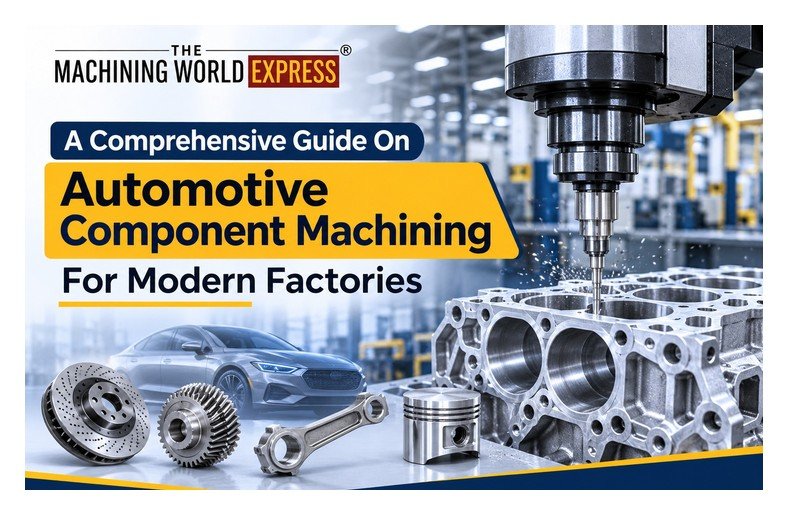
Knowledge about the power of Automotive Component Machining is imperative for current-generation workshop manufacturers. Today’s vehicle manufacturers require highly precise machining, safety, durability, and lightweight components to optimize vehicular performance. Without updated machining equipment, manufacturers would have to deal with a huge amount of waste and costly shipping delays. An upgraded manufacturing plant guarantees smooth compliance with contract specifications and increases profit in high-volume assembly plants.
To become an industrial powerhouse in today’s era, industrial workshop manufacturers need to be intelligent in incorporating digital automation and educate their shop technicians effectively. Exploring new industrial processes using contemporary Automotive Component Machining makes it easy for your manufacturing industry to increase productivity quickly. As discussed in The Machining World Express, “computerized tooling improves part quality.”
What Is Automotive Component Machining In Modern Production
Machining of automobile parts refers to the process of using computerized machinery to manufacture vehicle parts from raw metals. Computer numerical control machines are used to cut aluminum, steel, and titanium blocks to form complex mechanical parts. This machining process guarantees that critical parts like pistons and steering knuckles comply with dimensional tolerances to the micron level.
With the current manufacturing of automobiles, multi-axis machining is applied to manufacture balanced assemblies. Through digital toolpaths, any form of physical errors that may be experienced during Automotive Component Machining when making parts manually is eliminated. With the current transformation of the auto industry in the manufacturing of electric vehicles, precision machining creates specialized high-strength, lightweight battery housing parts and motor shafts.
Key Applications And Benefits In Vehicle Manufacturing
Modern vehicle assemblies require distinct machining workflows to achieve superior road safety and mechanical efficiency. Precision cutting tools allow workshops to manufacture durable parts that handle extreme operational stress. Here are five essential automotive applications driving factory production floors now.
1. Engine and Powertrain Machining
Precision tolerances are required for cylinder heads, engine blocks, and crankshafts in order to withstand high internal pressure and heat from combustion. Computer-controlled boring and surface machining will ensure proper seals and prevent oil leaks to maximize internal combustion efficiency for improved fuel economy.
2. Transmission and Gearbox Fabrication
In Automotive Component Machining, turning and gear hobbing operations manufacture planetary gear sets, transmission shafts, and differentials. High dimensional accuracy in microns reduces gear friction, ensures smooth gear-shifting operation, less mechanical wear, and silent operation under harsh driving conditions.
3. Braking System Precision Milling
Automated machining operations manufacture perfectly flat brake calipers, ventilated rotors, and master cylinders using high-precision drilling and surface grinding. This manufacturing process eliminates brake shudder, dissipates thermal energy, and guarantees quick response of brakes in emergency braking maneuvers.
4. Suspension and Steering Assemblies
Forged metals with precise multi-axis profiling create steering knuckles, ball joints, and control arms to ensure sufficient mechanical strength. This machining process absorbs rough road vibrations and ensures vehicle responsiveness and safe handling in varied road conditions.
5. Electric Vehicle Battery and Motor Enclosures
Battery trays, inverter casings, and rotor shafts in lightweight aluminum are machined through high-speed milling processes. The machining operations provide airtight environment protection of battery cells from water leakage with good heat dissipation in electric cars.
Comparing Conventional Methods With CNC Automotive Machining
Selecting the correct fabrication method directly impacts vehicle reliability, production costs, and delivery turnaround times. Evaluating conventional techniques against modern automated processes helps workshop supervisors optimize shop resources efficiently. Review the comparison below made by professionals of The Machining World Express to understand operational differences between these methods.
| Feature Metric | Manual Machining | Automated CNC |
|---|---|---|
| Dimensional Precision | Moderate accuracy, prone to human errors | Sub-micron tolerances with repeatable consistency |
| Production Speed | Slow manual adjustments limit daily output | Rapid continuous cutting runs without stopping |
| Material Wastage | Higher scrap rates from accidental slips | Optimized digital toolpaths drastically minimize scrap |
| Geometric Capability | Limited strictly to simple basic profiles | Produces complex multi-axis contours and cavities |
| Labor Demand | Needs dedicated manual operators per machine | Single software programmer oversees multiple machines |
| Cost Scaling | Economical only for one-off custom parts | Delivers exceptional profit margins at scale |
| Quality Checks | Requires manual physical measuring | Automated probes inspect parts instantly |
Concluding Note!
Understanding Automotive Component Machining is crucial for manufacturing plants working towards gaining automotive contracts for years to come. It is impossible for a modern assembly line to have the required geometric accuracy without the use of multi-axis computerization. Such technology would help you to avoid human error and cut down costs on scrap, maintaining a good reputation and ensuring the profitability of your commercial enterprise.
Innovations in production processes call for smart strategy, wise financial management, and programming of the proper software. Cooperation with experts and keeping track of news provided by The Machining World Express would ensure the development of operations. High-quality Automotive Component Machining can make your machine shop become a tier one supplier, bringing great commercial success in the global automobile manufacturing industry next year.
FAQs
Q1. Why is computerized precision machining necessary for current vehicle parts?
Ans: Computerized machining allows for the micron tolerances required for vehicle safety components. Computerized toolpaths prevent human mistakes, decrease waste of metal materials, and ensure reliable performance of complicated engines and braking systems under the toughest driving circumstances.
Q2. What types of metal are most commonly machined in automotive manufacturing facilities?
Ans: Aluminum alloys are machined in automotive facilities to produce lightweight engine blocks, while forged carbon steel is used for crankshaft production and ductile iron is used for brake rotor manufacturing. There are also specific copper and titanium alloys machined for high-performance motors of electric vehicles.
Q3. How does the manufacturing of electric vehicles change the need for machining component parts?
Ans: Manufacturing of electric vehicles requires machining of lightweight aluminum battery trays, microprecision motor rotor shafts, and special cooling housings. Machining includes working with thin-walled components with high surface finish.
Q4. What quality control tools verify dimension tolerances of automotive parts?
Ans: Coordinate measuring machines, non-contact optical 3D scanners, and surface profilometers are used to verify automotive parts’ dimensions and surface tolerances according to the digital design drawings.