India’s burgeoning aerospace manufacturing sector, fueled by the “Make in India” and “Atmanirbhar Bharat” initiatives, is experiencing unprecedented growth. The Indian aerospace and defense market, valued at $27.1 billion in 2024, is projected to reach $54.4 billion by 2033, growing at a Compound Annual Growth Rate (CAGR) of 6.99%. To sustain this remarkable momentum and achieve its ambitious goals of becoming a global aerospace hub, a critical element needs to be addressed: the creation of a highly skilled and readily available machining workforce. This necessitates a focused approach encompassing skill development, achieving scale in training, and ensuring the speed at which talent can be deployed.
The demand for precision machining in aerospace is paramount. Manufacturing intricate components for aircraft, satellites, and defense systems requires a workforce proficient in operating advanced Computer Numerical Control (CNC) machines, understanding complex engineering drawings, and adhering to stringent quality standards like AS9100 and NADCAP. A significant challenge, however, is the existing skill gap. The broader aviation sector currently faces a 17% skill shortage, projected to exceed 25% by the fiscal year-end. Specifically for technicians and Aircraft Maintenance Engineers (AMEs), an anticipated 72,900 new jobs are expected to be created by 2035. Overall, India’s aerospace manufacturing sector is projected to require an additional 150,000 to 200,000 skilled professionals with aerospace domain expertise by 2030.
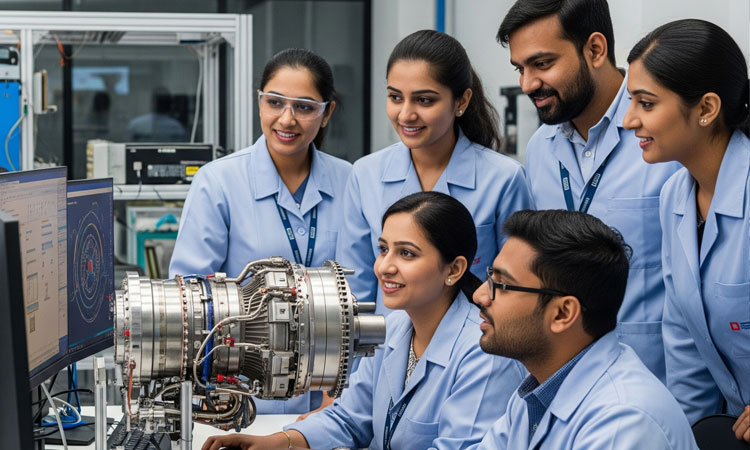
Addressing this skill gap requires a multi-pronged strategy. Firstly, enhanced collaboration between industry and academia is crucial. While India produces over 1.5 million engineering graduates annually, fewer than 20% of engineering programs currently include aerospace manufacturing fundamentals in their syllabi. Educational institutions need to align their curricula with the specific requirements of aerospace manufacturing, incorporating practical training on industry-standard equipment. Establishing dedicated aerospace skilling centers, perhaps within the Defence Industrial Corridors, can provide specialized training and create a pipeline of qualified machinists.
Secondly, achieving scale in training is essential to meet the burgeoning demand. The overall India vocational training market, valued at USD 1,289.2 million in 2024, is expected to reach USD 1,949.8 million by 2033, growing at a CAGR of 4.70%. This indicates a growing infrastructure for vocational training that can be leveraged. Government-backed initiatives like the “Skill India” program can be tailored to focus on aerospace-specific trades. Encouraging vocational training institutes and Industrial Training Institutes (ITIs) to offer specialized aerospace machining courses, with potential for industry apprenticeships, will significantly boost the number of skilled individuals. Leveraging digital learning platforms and simulation technologies can also help in reaching a larger audience and providing cost-effective initial training.
Finally, speed of deployment is critical. Streamlined certification processes and industry-recognized qualifications will ensure that trained personnel can quickly integrate into the manufacturing ecosystem. The “Make in India” initiative has already seen defense production reach a record ₹1.27 lakh crore (approx. $15.2 billion USD) in FY 2023-24, marking a 174% increase since 2014-15. Defense exports have also surged to an all-time high of ₹23,622 crore (approx. $2.8 billion USD) in FY 2024-25, a 34-fold increase in less than a decade, with the private sector contributing 21% to the total defense production. This rapid expansion necessitates a workforce that can be deployed quickly. Creating a national database of certified aerospace machinists can facilitate recruitment. Moreover, upskilling and reskilling existing manufacturing workforce through short-term intensive programs can address immediate needs and ensure adaptability to evolving technologies, including the increasing adoption of AI, robotics, and digitalized manufacturing in the sector.
Investing in skill development, achieving scale in training, and ensuring the speed of talent deployment are not merely operational necessities; they are strategic imperatives for India’s aerospace ambitions. By building a future-ready machining workforce, India can solidify its position as a reliable and competitive player in the global aerospace manufacturing landscape, transforming the vision of “Make in India for the Skies” into a tangible reality.