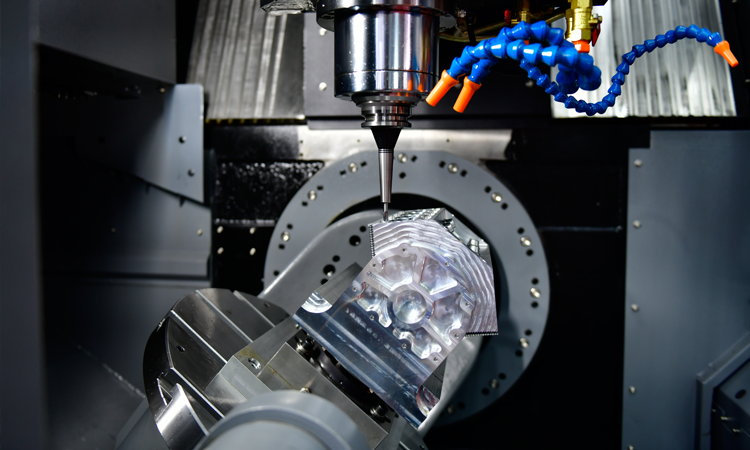
In the aerospace industry, performance is everything—be it in the air or on the shop floor. As aircraft, satellites, and defence systems evolve into lighter, faster, and more complex platforms, manufacturing must keep pace. That’s where high-speed machining (HSM) steps in. Delivering unmatched precision, surface finish, and cycle-time reduction, HSM has become a cornerstone of aerospace manufacturing globally—and India is embracing it with renewed energy under the “Make in India” mission.
Why High-Speed Machining Matters in Aerospace
Aerospace parts—from turbine blades and engine housings to airframe ribs and missile skins—are made from exotic materials like titanium, Inconel, aluminium-lithium alloys, and carbon composites. These materials offer high strength-to-weight ratios but are notoriously difficult to machine using traditional techniques. High-speed machining, characterized by higher spindle speeds, feed rates, and low depth of cut, enables manufacturers to machine these tough materials with exceptional precision and minimal distortion.
Beyond material challenges, aerospace also demands extreme dimensional accuracy, often in the range of microns, along with flawless surface finishes. Components must meet stringent tolerances for aerodynamic performance, structural integrity, and safety. High-speed machining allows manufacturers to deliver parts that meet these expectations—without compromising efficiency.
India’s Aerospace Shops Are Gearing Up
With the Indian aerospace sector poised to grow to $70 billion by 2030, OEMs, Tier-1s, and MSMEs are investing aggressively in high-speed machining centres. Companies like Tata Advanced Systems, HAL, Godrej Aerospace, and L&T Defence have already deployed 5-axis HSM machines from global leaders like DMG Mori, Makino, and Hermle. These systems are used to produce everything from missile control surfaces to aircraft wing spars.
Hyderabad, Bengaluru, and Pune—India’s leading aerospace clusters—are also home to several MSMEs now equipped with HSM capabilities. These shops, often AS9100 and NADCAP certified, have begun manufacturing precision parts for global majors like Boeing, Airbus, and Lockheed Martin, reducing cycle times by up to 40% and improving surface quality substantially.
Tooling, Software & Coolants – The Trifecta
High-speed machining’s success depends not just on the machine, but on the synergy between tooling, software, and cooling. Cutting tool manufacturers like Sandvik Coromant, ISCAR, and Kennametal India are offering specially coated solid carbide tools optimized for aerospace materials. CAM software with HSM modules (like Mastercam, Siemens NX, or HyperMILL) ensures optimal tool paths to reduce vibration and extend tool life.
Coolant strategies—especially minimum quantity lubrication (MQL) and through-spindle coolant—play a critical role in maintaining temperature control during high RPM operations, thereby preserving part integrity.
Outlook: Faster, Smarter, Lighter
As India ramps up production of the Tejas Mk1A fighter, AMCA stealth aircraft, BrahMos-NG missile, and indigenous UAVs, the demand for high-speed machining will continue to rise. Additive + subtractive hybrid machining, in-process metrology, and AI-driven feed rate optimization are already redefining what’s possible on the shop floor.