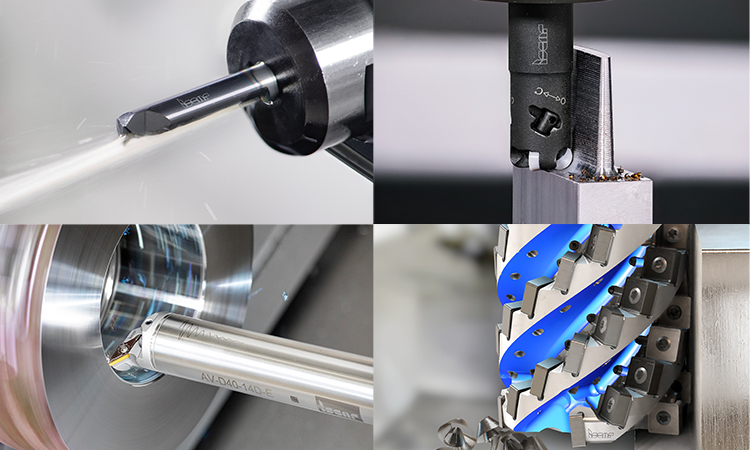
New cutting tool solutions help to overcome difficulties when cutting hard-to-machine materials
Difficult-to-cut materials are engineering materials with much lower machinability than conventional ones. Often called “hard-to-machine” or “tough-to-cut,” their challenge does not come from hardness alone—multiple factors contribute to machining difficulty.
Almost every industry uses such materials, but aerospace is their largest consumer. In turbine engines, landing gear, and airframe structures, materials must offer high strength-to-weight ratio, corrosion and heat resistance, fatigue life, and reliability. The very properties that make them ideal for aerospace also make them difficult to machine.
Key material groups include:
- High-alloy high-strength steel
- Titanium alloys
- Hot temperature superalloys (HTSA)
- Composites
High-strength steels serve heavy-load parts such as landing gear and fasteners. Titanium alloys, valued for strength-to-density ratio and corrosion resistance, are widely used in the cold section of jet engines and as weight-saving replacements for steel. HTSA maintain strength at extreme temperatures and are essential in hot engine sections. Composites reduce aircraft weight and enhance aerodynamics and stealth.
Machining these materials presents several challenges:
- High strength generates strong cutting forces and mechanical load on the tool.
- Intense heat with poor thermal conductivity (e.g., titanium) accelerates thermal wear and edge build-up.
- Work hardening, especially in HTSA, increases surface strength during cutting.
- High abrasion in composites accelerates tool wear.
Additional issues—such as titanium’s “springiness” causing vibrations and composite delamination—further reduce tool life.
Aerospace trends show increasing use of these difficult materials, including new stronger alloys, composites, and hybrid structures. Modern CNC machines and CAM strategies help, but the cutting tool remains the final and most conservative link. Reduced machining parameters are often required, lowering productivity. Hence, even small improvements in tooling bring significant benefits.
Requirements for aerospace machining tools:
High hardness, durability, accuracy, predictable life, and stability. Achieving these involves extensive R&D. Tool development focuses on:
- Cutting material grades
- Tool design
- Tool’s digital component
Advances include nano-coatings, use of CBN and ceramics, optimized tool geometries, improved chip evacuation, vibration-resistant designs, and digital twins for simulation, cutting data, and tool life estimation.
Recent ISCAR innovations under the LOGIQUICK campaign reflect these trends. New PVD-coated carbide grades include IC1017 for turning Ni-based HTSA and IC716 for milling titanium. IC608 endmills support superalloys, while IC5600 boosts steel machining. The new CERMILL family features rigid clamping and ceramic inserts for HTSA. ISCAR has also expanded anti-vibration tools, introduced QUICK-X-FLUTE rough milling shell mills, enhanced coolant-focused designs, and added new PICCO inserts, drills, and holders with optimized coolant channels.
Digital improvements to NEOITA now enable AI-powered material data search.
Machining tough aerospace materials remains challenging, but continuous tooling advancements are driving steady, evolutionary progress