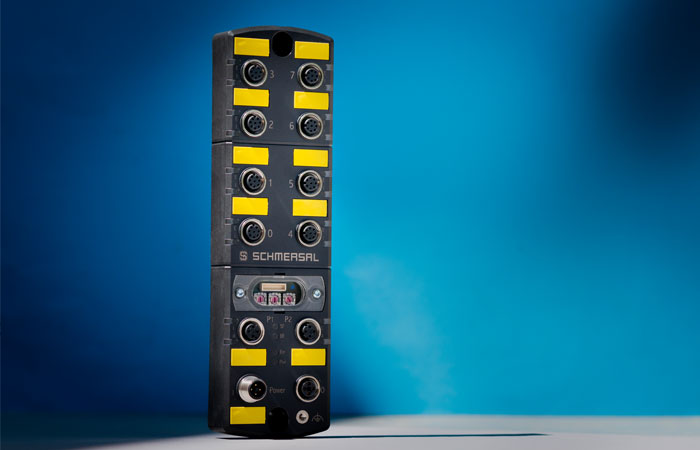
Connectivity is redefining how safety works inside modern machines. Integration, networking, and intelligent data exchange are no longer optional features—they are the foundation of productive, flexible, and future-ready automation. At the heart of this transformation is Schmersal Group, which continues to push boundaries with safety-oriented networking concepts that drastically reduce wiring while increasing transparency and uptime.
For decades, machine builders had a simple choice when integrating safety devices: series or parallel wiring. While proven, these approaches added complexity, installation effort, and limited diagnostics. Today, the landscape has changed. Designers can choose from safety bus systems, serial diagnostic networks, and modular fieldboxes—each offering plug-and-play simplicity, rich diagnostics, and seamless integration into digital factories.
Proven Safety Bus Systems with Modern Benefits
Among the most established solutions is AS-Interface Safety at Work (ASi SaW). This safety bus enables both operational and safety signals to travel over a single yellow flat-ribbon cable. The result is significantly reduced wiring, faster installation, and flexible system expansion.
For machine manufacturers, ASi SaW simplifies design and commissioning. For end users, it delivers enhanced diagnostics—making it easier to pinpoint faults, reduce downtime, and maintain productivity. Whether applied to compact machines or large, complex systems, safety bus technology offers measurable advantages in efficiency and reliability.
Continuous Communication from Device to Cloud
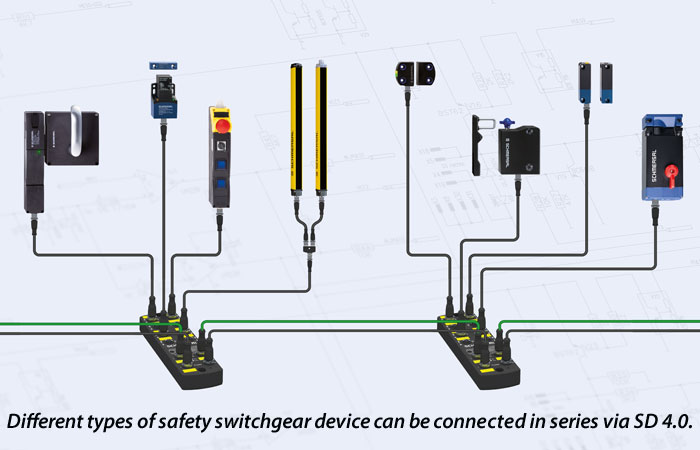
Beyond safety signals, modern machines demand continuous operational data. Schmersal’s SD bus addresses this need by collecting switching cycles, limit warnings, and distance alerts from safety devices. The latest SD 4.0 version transmits this data via a single-wire bus to SD gateways or safety controllers, creating a direct pathway to higher-level systems such as OPC UA for machine-to-machine communication.
This connectivity enables real-time visualisation of machine status on HMIs, tablets, or smartphones. Misaligned guard doors or abnormal switching behaviour can be identified instantly—allowing maintenance teams to act before downtime occurs. Importantly, up to 31 safety devices can be connected with minimal cabling, delivering both technical and economic benefits.
Intelligence at the Edge: SD Gateway with Web Server
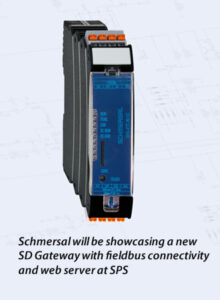
Taking diagnostics further, Schmersal has introduced a new SD Fieldbus Gateway with an integrated web server and microSD card. This innovation allows users to access event logs and diagnostic data in plain text directly through a browser—no additional software required. Devices such as solenoid interlocks and control panels can even be operated via the web interface, bringing unprecedented transparency and control to machine safety.
Field-Level Flexibility with Safety Fieldbox
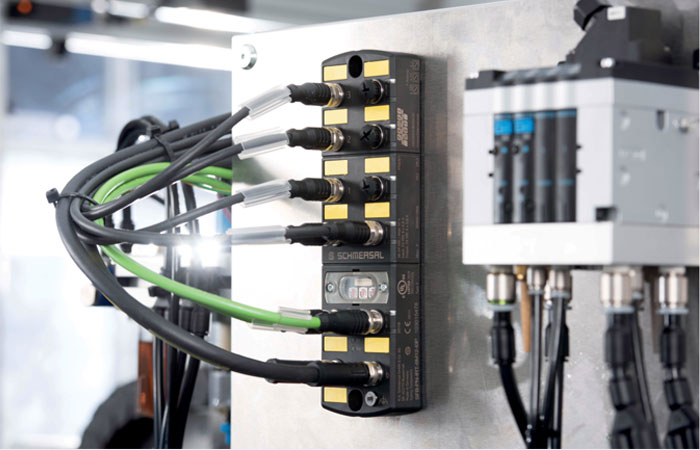
For decentralised safety architectures, the Safety Fieldbox enables direct connection of multiple safety devices—interlocks, sensors, emergency-stop panels, and light curtains—directly in the field. Supporting PROFINET/PROFIsafe, Ethernet/IP CIP Safety, and now EtherCAT FSoE, this solution allows machine builders to design safety systems independently of the chosen control platform, ensuring global compatibility.
Fewer Cables, Smarter Machines
Across all these concepts, the objective is clear: less wiring, greater flexibility, richer diagnostics, and sustainable resource use. Reduced copper and plastic consumption aligns safety networking with environmental goals—without compromising performance.
The Road Ahead
The evolution continues. Future networking concepts point toward digital type plates, deeper M2M connectivity, and tighter integration with digital twins. As connectivity advances, machine safety is no longer just about protection—it becomes a strategic enabler of transparency, serviceability, and productivity.
In the connected factory, safety doesn’t disappear into wiring. It becomes intelligent, visible, and networked.