As electric mobility accelerates toward mass adoption, a silent revolution is unfolding inside India’s toolrooms. Giga Casting—once a futuristic concept—is now reshaping how vehicles are designed, manufactured, and assembled. For Indian toolmakers, this is not just a technological shift; it is a defining moment that will determine who leads and who lags in the EV era.
In the precision-driven, temperature-controlled toolrooms of Pune, Chennai, and Bengaluru, a new kind of engineering conversation is taking center stage. The familiar hum of CNC machining is now accompanied by discussions around scale, integration, and a single transformative idea—Giga Casting.
Often described as the “Big Squeeze,” Giga Casting represents a fundamental shift in automotive manufacturing. Much like how smartphones consolidated multiple devices into one, this technology is collapsing dozens—sometimes hundreds—of individual automotive components into a single, unified casting.
As India pushes aggressively toward its 2030 electric vehicle targets, this shift is forcing a complete rethinking of tooling strategies. For Indian toolmakers, the challenge is no longer about precision alone—it is about mastering precision at an unprecedented scale.
From Complexity to Compression: The End of the 170-Part Assembly
Traditional automotive manufacturing has always been an exercise in complexity. A typical vehicle structure—especially the rear underbody—can consist of nearly 150 to 170 individual parts, each requiring its own tooling, machining, welding, and quality checks.
This fragmented approach, while proven, is resource-intensive:
- Multiple dies and fixtures
- Extensive robotic welding lines
- Larger factory footprints
- Higher chances of cumulative errors
Giga Casting eliminates this complexity in one bold move.
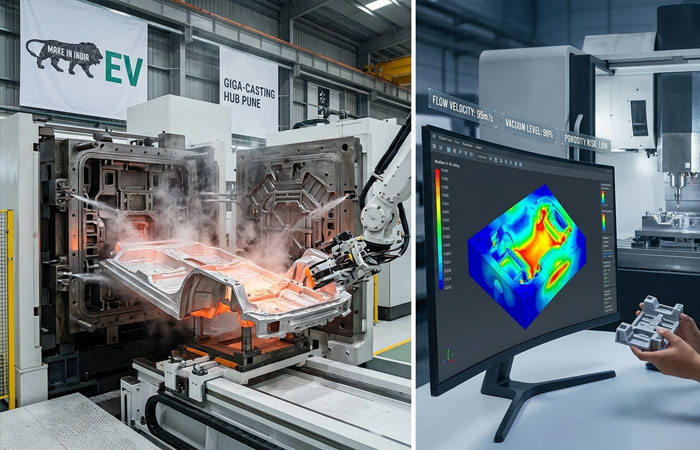
Using massive High-Pressure Die Casting (HPDC) machines—some with clamping forces exceeding 9,000 tons—entire sections of a vehicle chassis are cast in a single shot. What once required dozens of operations is now achieved in seconds.
Inspired by the success of global EV pioneers, Indian OEMs such as Tata Motors and Mahindra are actively exploring Giga Casting architectures for their next-generation EV platforms (2026–2027).
The impact is transformative:
- Up to 30% reduction in factory footprint
- Significant drop in assembly time
- Improved structural rigidity and consistency
In essence, Giga Casting is not just improving manufacturing—it is redefining it.
The Toolroom Challenge: Engineering at Extreme Scale
While Giga Casting simplifies the assembly line, it dramatically increases the complexity within the toolroom. For Indian toolmakers, this is where the real test begins.
A Giga-die is not just a larger mold—it is an entirely different engineering challenge.
The Thermal Tightrope
These dies can weigh over 100 tons, and during operation, they must handle molten aluminum injected at temperatures exceeding 700°C, often within milliseconds.
The challenge lies in thermal management.
Different sections of a large casting cool at different rates due to variations in wall thickness. This creates risks such as:
- Warping and distortion
- Porosity (air pockets)
- Structural weaknesses in critical components
To address this, Indian toolmakers are rapidly adopting Vacuum-Assisted HPDC technology. By removing air from the die cavity before injection, this process ensures:
- Higher density castings
- Reduced defects
- Enhanced structural integrity—critical for EV battery housings and chassis components
This shift marks a move from conventional tooling to highly engineered, system-driven tooling solutions.
Material Innovation: The Rise of Advanced Alloys
At the heart of Giga Casting lies material science. The choice of alloy determines not just performance, but manufacturability.
Aluminum-Silicon (Al-Si) Alloys
In 2026, the industry is witnessing a strong shift toward “as-cast” Aluminum-Silicon alloys. Unlike traditional materials, these alloys:
- Provide high strength and ductility immediately after casting
- Eliminate the need for post-casting heat treatment
- Reduce risks of distortion in large structural parts
The Magnesium Frontier
For high-performance EV applications, magnesium alloys are emerging as a game-changer.
- Approximately 33% lighter than aluminum
- Ideal for interior structural components like सीट frames and dashboard beams
- Contribute directly to improved battery efficiency and range
In India, companies like Hindalco are collaborating closely with toolmakers to develop sustainable “green alloys”, incorporating higher recycled content to meet global ESG standards.
This synergy between material suppliers and toolrooms is becoming a critical competitive advantage.
India’s Opportunity: Precision at Scale for the World
Giga Casting is not just a challenge—it is a massive opportunity for India to position itself as a global hub for advanced tooling.
With the ongoing China Plus One shift, global OEMs are actively seeking alternative suppliers capable of delivering large-scale, high-precision tooling.
India’s value proposition is becoming increasingly compelling:
- 25–30% lower tooling costs compared to Europe
- Strong design-to-delivery capabilities
- Growing expertise in complex die engineering
Indian toolmakers are now delivering Giga-dies capable of meeting 100,000+ shot lifecycles, aligning with global quality benchmarks.
The Rise of the Digital Toolmaker
Perhaps the most significant shift is not physical—it is digital.
In the era of Giga Casting, errors cannot be corrected on the shop floor. The cost of rework is simply too high. Instead, the focus has shifted to getting it right before manufacturing begins.
This has given rise to a new breed of professionals—the Simulation Engineers or “Digital Artisans.”
Using advanced tools like:
- AI-driven mold flow simulation
- Digital twins
- Predictive defect analysis
Indian toolrooms are drastically reducing first-trial failures (T0), improving efficiency, and building global credibility.
As one industry expert puts it:
“In Giga Casting, you don’t fix the mold with a grinder—you fix it in the simulation.”
Barriers to Entry: The Capital Conundrum
Despite the opportunities, the path to Giga Casting is not easy—especially for MSME toolrooms.
The challenges are significant:
- Massive investment in HPDC-compatible tooling
- Requirement for ultra-large CNC machining centers
- High cost of simulation software and infrastructure
To overcome this, a new trend is emerging—collaborative tooling clusters.
These clusters allow smaller toolrooms to:
- Share high-end infrastructure
- Access advanced simulation tools
- Compete collectively with global players
This model could become a defining feature of India’s tooling ecosystem in the coming years.
The Bottom Line: Owning the Mold, Owning the Market
The transition to electric vehicles is not just changing what we drive—it is changing how vehicles are built.
Giga Casting is turning the automobile from a collection of parts into a single, integrated structure. And in this new paradigm, the importance of tooling has moved to the very core of manufacturing strategy.
For India, this is a moment of transformation.
Toolmakers are no longer peripheral suppliers—they are becoming strategic partners in product development and manufacturing innovation.
Because in the EV era, one truth is becoming increasingly clear:
The company that controls the mold, controls the manufacturing—and ultimately, the market.