The aerospace and defence industry has always demanded precision, reliability, and continuous innovation. Every gram of weight saved, every component optimized, and every production cycle reduced contributes to improved aircraft performance, fuel efficiency, operational readiness, and sustainability. Today, these evolving requirements are accelerating the adoption of Additive Manufacturing (3D Printing), transforming how aerospace systems are designed, manufactured, inspected, and maintained.
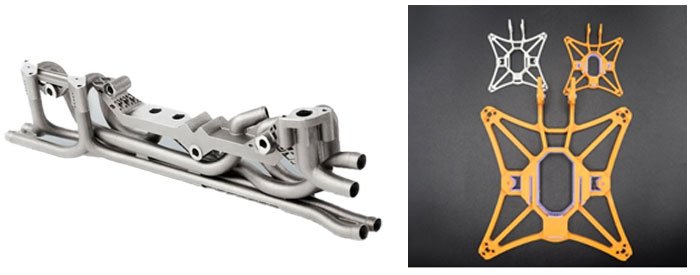
One of the greatest advantages of metal additive manufacturing is part consolidation. Manufacturers are increasingly adopting this approach for brackets, heat exchangers, propulsion components, RF hardware, and lightweight structural parts, reducing assembly time while improving reliability and performance.
Precision Begins with Digital Engineering
Advanced 3D scanning and metrology solutions from ZEISS create highly accurate digital twins of aircraft components. These systems capture millions of measurement points, enabling engineers to inspect existing parts, validate designs, perform reverse engineering, and compare manufactured components with original CAD models. This digital workflow minimizes design iterations while ensuring compliance with stringent aerospace quality standards.
The combination of digital inspection and additive manufacturing creates a seamless Scan – Design – Print – Verify workflow, enhancing both speed and accuracy throughout the manufacturing process.
Metal Additive Manufacturing Takes Flight
Among the most widely adopted technologies in aerospace is Direct Metal Printing (DMP). Using high-performance metal powders and laser powder bed fusion technology, DMP produces complex parts with exceptional dimensional accuracy, high density, and outstanding mechanical properties. Materials such as titanium, aluminium, stainless steel, nickel superalloys, cobalt chrome, and copper alloys are routinely used for mission-critical aerospace applications.
These materials provide the ideal balance of strength, corrosion resistance, heat tolerance, and reduced weight qualities essential for aircraft, satellites, launch systems, and defence platforms. The ability to manufacture topology-optimized and lattice structures enables significant weight reduction without compromising performance, contributing to lower fuel consumption and reduced emissions throughout an aircraft’s operational life.
The Rise of Drone Manufacturing
The rapid growth of Unmanned Aerial Vehicles (UAVs) is creating new opportunities for additive manufacturing. From lightweight airframes and propulsion components to customized payload mounts, tooling, and replacement parts, 3D printing enables faster product development and cost-effective low-volume production.
Ceramic Contribution in Aerospace
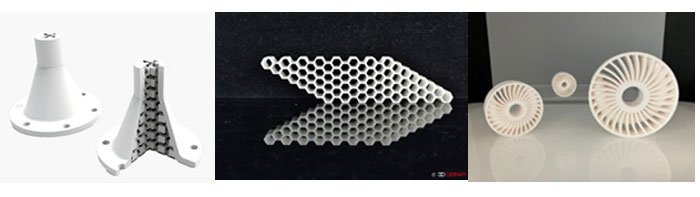
Innovation extends beyond metals. Advanced ceramic additive manufacturing enables the production of high-temperature-resistant components for thermal management and electrical insulation, while industrial polymer 3D printing is widely used for tooling, fixtures, jigs, functional prototypes, and cabin components. Together, metal, ceramic, and engineering polymers provide manufacturers with greater design flexibility, shorter development cycles, and improved production efficiency across aerospace applications.
Together, metal, ceramic, and engineering polymers are expanding the possibilities of aerospace manufacturing like never before.
Shree Rapid Technologies: Enabling India’s Aerospace Manufacturing Journey

Modern aerospace manufacturing begins long before the first layer of metal is printed.
Additive manufacturing gives full freedom for designers to design product without much caring about manufacturing as it is a real free form manufacturing directly from raw material. Also, you don’t need any special fixing, fixtures, tools, attachments, machine setup, etc., which are required in conventional manufacturing. You can also build simultaneously any number of components together in one go. All these unique features give it very strong competitive edge over conventional manufacturing. Hence, we feel that additive manufacturing will help shaping future of aerospace manufacturing.
As one of India’s leading providers of additive manufacturing and digital manufacturing solutions, we help organizations accelerate the adoption of advanced manufacturing. Through our wide portfolio solutions, and comprehensive application, SRT enables manufacturers to optimize product development, reduce production lead times, improve quality, and drive innovation. By delivering end-to-end solutions from design validation and precision inspection to production-ready additive manufacturing SRT continues to support India’s vision of building a globally competitive and self-reliant aerospace manufacturing ecosystem.
Visit : https://www.shreerapid.com/industries/aerospace-defence/