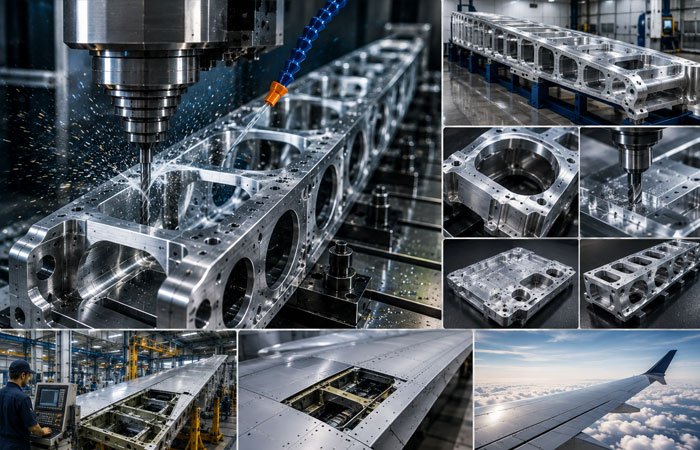
Building Stronger, Lighter and More Efficient Aircraft through Advanced Manufacturing
Aircraft wings are among the most sophisticated engineering structures ever designed. They generate lift, withstand enormous aerodynamic forces, and support the weight of fuel, landing loads, and engine thrust throughout an aircraft’s service life. Every wing component must therefore be manufactured with exceptional precision, as even the smallest dimensional deviation can affect structural performance, aerodynamic efficiency, and long-term reliability. As the aerospace industry moves toward lighter and more fuel-efficient aircraft, precision machining of wing components has become a cornerstone of modern aerospace manufacturing.
The opportunity for manufacturers is growing rapidly. India’s aircraft component market, valued at US$17.3 billion in 2025, is projected to reach US$31.3 billion by 2034, while the country’s precision machining market is expected to expand from US$7.35 billion in 2026 to US$16.6 billion by 2033, growing at a 12.4% CAGR. With Indian airlines placing orders for more than 1,500 commercial aircraft, domestic suppliers are increasingly investing in advanced machining technologies to meet global aerospace quality standards.
Machining the Backbone of Aircraft Wings
Modern aircraft wings are no longer assembled from hundreds of small fabricated sections. Instead, manufacturers increasingly produce large monolithic components machined from solid aluminium or titanium billets. Critical wing structures include:
- Wing spars
- Wing ribs
- Stringers
- Skin panels
- Floor beams
- Attachment fittings
- Hinge brackets
- Fuel system components
These parts must deliver maximum structural strength while minimizing weight, making precision machining essential to aerospace design.
Lightweight Structures through Material Removal
One of the most remarkable aspects of wing component manufacturing is the amount of material removed during machining. Large aerospace machining centres routinely remove up to 90% of the original billet, leaving behind lightweight skeletal structures that retain exceptional rigidity.
Producing these thin-wall components demands extremely stable machining processes. Wall thicknesses often fall below 1 millimetre, requiring precise control of cutting forces, vibration, and thermal distortion throughout the machining cycle.
To achieve this, manufacturers rely on 5-axis CNC machining centres, high-speed milling, adaptive toolpaths, and advanced workholding systems that maintain part stability while allowing unrestricted cutter access.
Advanced Aerospace Materials
Wing components are primarily manufactured from Aluminium-Lithium alloys, 7000-series aluminium, and increasingly from titanium alloys in highly stressed structural areas.
Each material requires specialized machining strategies.
Aluminium-Lithium alloys permit very high spindle speeds and material removal rates, enabling rapid production of large structural components with excellent surface quality.
Titanium components demand lower cutting speeds, rigid machine structures, high-pressure coolant systems, and optimized cutting tool geometries to control heat generation and extend tool life.
Selecting the correct tooling, coatings, coolant strategy, and machining parameters is critical for achieving dimensional accuracy while minimizing machining costs.
Digital Manufacturing Drives Precision
Today’s aerospace machining facilities are increasingly powered by Industry 4.0 technologies.
Digital twins simulate machining operations before production begins, allowing engineers to optimize toolpaths, predict tool deflection, and eliminate potential collisions. Real-time sensors continuously monitor spindle loads, vibration, coolant flow, and tool wear, enabling adaptive machining that maintains consistent quality throughout production.
In-process probing and automated Coordinate Measuring Machines (CMMs) verify dimensional accuracy during machining, reducing manual inspection while ensuring compliance with stringent aerospace standards.
Benefits Beyond Manufacturing
Precision machining provides significant advantages throughout an aircraft’s operational life. Monolithic wing structures eliminate thousands of rivets and fasteners, reducing structural weight, minimizing potential fatigue points, and improving corrosion resistance. The result is stronger airframes, lower maintenance requirements, improved fuel efficiency, and longer service life.
Advanced machining also shortens production cycles, improves repeatability, and reduces overall manufacturing costs, enabling aerospace suppliers to meet increasing global demand without compromising quality.
The Future of Wing Component Manufacturing
As aircraft manufacturers continue developing lighter and more sustainable aircraft, precision machining will remain central to aerospace innovation. Future production will increasingly combine high-speed 5-axis machining, hybrid manufacturing, AI-driven process optimization, and digital quality control to manufacture larger, more complex wing structures with unprecedented efficiency.
For India’s rapidly expanding aerospace manufacturing ecosystem, mastering precision machining of wing components represents a significant opportunity. Companies investing in advanced CNC technologies, cutting tools, automation, and metrology will play an increasingly important role in the global aerospace supply chain, contributing to the next generation of safer, lighter, and more fuel-efficient aircraft.