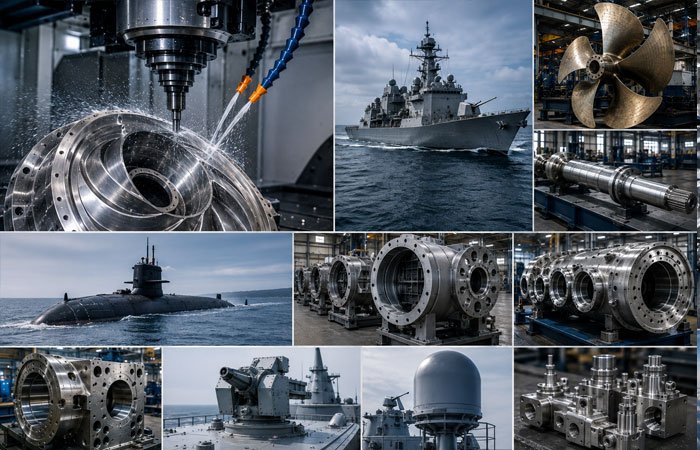
Advanced Machining Technologies Powering the Future of Maritime Security
The world’s naval forces are rapidly modernizing their fleets with stealth warships, submarines, aircraft carriers, unmanned surface vessels, and advanced weapon systems capable of operating in some of the harshest environments on Earth. At the heart of every modern naval platform lies precision engineering—the ability to manufacture highly complex components with exceptional dimensional accuracy, structural integrity, and long-term reliability. From propulsion systems and combat management equipment to propellers and sonar housings, precision machining has become a critical enabler of modern naval defence capabilities.
The global naval defence market is projected to exceed US$70 billion by 2030, driven by increasing maritime security concerns, fleet modernization programmes, and technological advancements. In India, initiatives such as ‘Make in India’ and Atmanirbhar Bharat are accelerating indigenous production of warships, submarines, and naval systems, creating significant opportunities for machine tool manufacturers, cutting tool companies, metrology providers, automation specialists, and precision engineering firms.
Precision Components for Modern Naval Platforms
Naval vessels operate continuously under corrosive seawater conditions, heavy mechanical loading, vibration, pressure variations, and extreme temperature fluctuations. Every machined component must therefore meet demanding military standards for accuracy, durability, and operational reliability.
Critical naval components manufactured through precision machining include:
- Marine propulsion shafts
- Controllable pitch propellers
- Gearbox housings
- Pump casings
- Turbine and diesel engine components
- Sonar domes and sensor housings
- Missile launcher structures
- Periscope assemblies
- Steering and rudder systems
- Valve bodies and hydraulic manifolds
Many of these parts require dimensional tolerances measured in microns despite weighing several tonnes.
Machining Challenging Marine Materials
Naval engineering relies on materials specifically selected for corrosion resistance, strength, fatigue life, and resistance to seawater exposure.
Duplex and Super Duplex stainless steels are widely used in pumps, valves, piping systems, and offshore structures because of their outstanding corrosion resistance. However, their high strength and work-hardening characteristics require rigid CNC machining centres, optimized cutting parameters, and advanced carbide tooling.
Titanium alloys are increasingly employed in submarines, naval propulsion systems, and heat exchangers due to their exceptional strength-to-weight ratio and immunity to seawater corrosion. Machining titanium demands high-pressure coolant systems, low cutting speeds, and precise thermal management to maximize tool life.
Marine-grade aluminium alloys are commonly used in lightweight naval structures and patrol vessels, while nickel-based superalloys are utilized in gas turbine propulsion systems operating under extreme temperatures.
Advanced Machining Technologies
Modern naval manufacturing increasingly depends on advanced CNC technologies capable of machining large, highly complex components.
5-axis machining centres enable single-setup machining of intricate marine parts with exceptional positional accuracy. Large gantry machining centres are used for oversized propulsion housings and structural assemblies, while mill-turn machines combine multiple operations to reduce setup time and improve productivity.
High-speed machining, adaptive toolpaths, and automated tool monitoring ensure consistent machining quality while reducing production costs.
Digital Manufacturing and Quality Assurance
Naval defence production increasingly embraces Industry 4.0 technologies.
Digital twins simulate machining operations before production begins, minimizing risk and optimizing machining strategies. Real-time machine monitoring continuously evaluates spindle load, vibration, coolant flow, and tool wear, ensuring stable production of critical defence components.
Automated Coordinate Measuring Machines (CMMs), laser scanners, and non-contact optical inspection systems verify component accuracy throughout the manufacturing process.
Non-destructive testing—including ultrasonic inspection, radiographic testing, dye penetrant inspection, and magnetic particle testing—further ensures structural integrity before deployment.
Reliability Through Complete Traceability
Military naval components demand complete manufacturing traceability. Material certificates, machining records, heat-treatment data, inspection reports, and process documentation are digitally maintained throughout production to comply with stringent military quality standards.
Such traceability ensures consistent quality while simplifying maintenance and lifecycle management throughout decades of naval service.
The Future of Naval Precision Engineering
The next generation of naval platforms will increasingly integrate lightweight materials, hybrid propulsion systems, autonomous technologies, and advanced weapon platforms. Supporting these innovations will require even greater machining accuracy, digital manufacturing, and intelligent automation.
Artificial Intelligence, predictive maintenance, robotics, and automated inspection will continue transforming naval manufacturing by improving productivity while maintaining uncompromising quality.
For India’s rapidly expanding maritime defence industry, precision engineering represents a strategic manufacturing opportunity. Companies investing in advanced CNC machining, cutting technologies, metrology, automation, and digital manufacturing will play a vital role in strengthening indigenous naval capabilities and positioning India as a globally competitive supplier of high-value defence components.