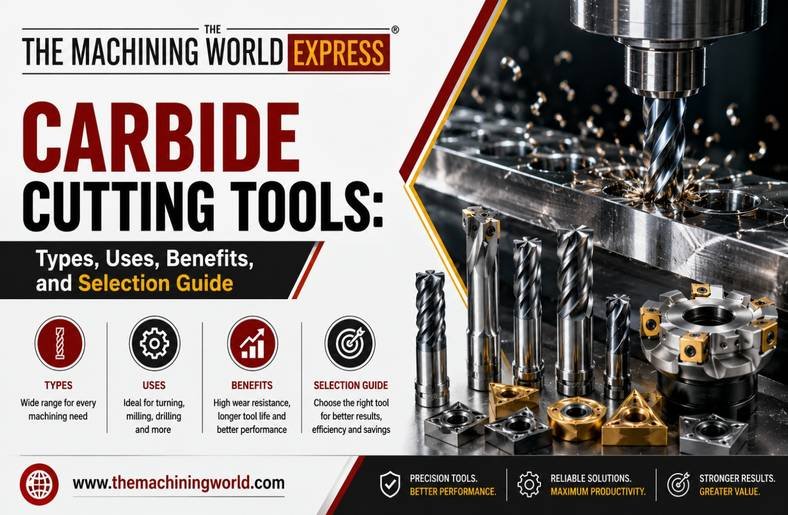
Any machining job work can go wrong quickly if the cutting tool is not suitable. The edge may wear, the finish may suffer, and the machine may need more stops.
This is where “carbide cutting tools” have found a strong place in modern machining. They are hard, handle heat well, and can keep working at cutting speeds that would wear many HSS tools faster.
But carbide is not a one-tool-fits-all option. End mills, drills, inserts, and other cutters are made for different jobs.
In this guide from “The Machining World Express”, we’ll look at the main types, common uses, key benefits, and a few simple points to consider before choosing a carbide cutting tool.
What Are Carbide Cutting Tools?
The “carbide cutting tools” are tools that use carbide as the cutting material. In most cemented carbide tools, tungsten carbide particles are held together with a metallic binder, usually cobalt.
The amount and structure of these materials can vary depending on the grade and the job the tool is meant to handle.
Carbide is not just used for one kind of cutter. It can be found in solid tools, replaceable inserts, drills, milling cutters, reamers, and many tools made for specific machining jobs.
Why Are Carbide Cutting Tools Used in Machining?
Carbide cutting tools are widely used in machining because they handle heat, wear, and demanding cutting jobs well. They are very useful and offer several benefits, including:
- Longer Tool Life
- Higher Cutting Speeds
- Better Surface Finish and Accuracy
- Reduced Downtime
- Improved Productivity
These benefits make carbide a practical choice for CNC machining.
Types of Carbide Cutting Tools
Below are the main types of “carbide” cutting tools:
Carbide End Mills
Carbide end mills are mainly used for milling. They can make slots, pockets, grooves, profiles, and different shapes in a workpiece. Common types include square-end, ball-nose, and corner-radius end mills.
They are widely used on CNC machines because they can handle high cutting speeds while producing accurate results. The number of flutes and the tool shape can be selected based on the material and type of cut.
Carbide Drills
Carbide drills are used to make holes where good accuracy and consistent results are important. Solid carbide drills are particularly useful for CNC production work, where many holes have to be made to the same size.
They are also useful when machining materials that can cause faster wear with ordinary steel drills. Correct cutting data and good machine stability are important because carbide is hard but less forgiving of vibration than HSS.
Countersinks
Carbide countersinks are used to create a tapered opening around a drilled hole. This allows a countersunk screw sit level with the surface instead of sticking out.
They are useful in both metalworking and other machining jobs where a clean hole entrance is needed. Carbide also makes these tools suitable for jobs where wear resistance is key.
Carbide Inserts
Carbide inserts are small cutting edges that fit into toolholders. They are commonly used for turning, milling, boring, grooving, and other CNC machining jobs.
Different insert grades, shapes, coatings, and edge designs are available for different materials and machining conditions. This makes inserts a practical choice for production machining.
Carbide Reamers and Specialty Tools
Carbide reamers are used to bring drilled holes to a more accurate size and improve the surface finish. They are useful when tight hole tolerances are required.
There are also many specialty carbide tools, including burrs, chamfering tools, thread mills, and custom cutters. These are selected according to the shape or feature being machined.
Carbide Cutting Tools vs. HSS Tools
Carbide and HSS tools are both useful in machining. But each one works better for different types of jobs and conditions. Let’s see the differences between the two:
| Feature | Carbide | HSS |
| Cutting speed | Generally higher | Generally lower |
| Hardness | Higher | Lower |
| Heat resistance | Better at high cutting temperatures | More limited |
| Tool life | Usually longer under suitable conditions | Usually shorter at high speeds |
| Cost | Higher initial cost | Lower initial cost |
| Typical applications | CNC production, hard materials, high-speed machining | General work, lower-speed machining, intermittent cuts |
Carbide has a clear advantage when high speed and long production runs are involved. However, that does not make HSS outdated.
HSS is tougher and more forgiving when there is vibration, shock, or an interrupted cut. It can also make more sense for occasional work where the higher price of carbide is difficult to justify.
Applications of Carbide Cutting Tools
Let’s see the use cases of carbide cutting tools:
Automotive Manufacturing
Carbide cutting tools are used for engine, transmission, and drivetrain parts. They work well for high-volume production where consistent dimensions and repeatable results are important.
Aerospace Manufacturing
Aerospace machining usually involves titanium and nickel-based alloys. Carbide tools are useful for these demanding materials, where precision, heat resistance, and reliable cutting matter.
Die and Mould Manufacturing
Die and mould work usually involves hardened materials, complex profiles, cavities, and detailed finishing. Carbide end mills and other precision tools can provide the rigidity and edge performance needed for these jobs.
General CNC and Precision Machining
Carbide tools are commonly used for milling, turning, drilling, boring, and finishing. They suit many CNC jobs where accuracy, steady performance, and good surface finish matter.
Conclusion
As discussed throughout this guide from The Machining World Express, carbide cutting tools have gradually earned their place in modern machining for good reason.
They can handle higher speeds, resist wear, and deliver consistent results when the tool and machining conditions are properly matched. From end mills and drills to inserts and reamers, there are carbide options for many different jobs. They do cost more than HSS in many cases, but the extra tool life and production speed can make that cost worthwhile.
Frequently Asked (FAQs)
Q1. What are carbide cutting tools used for?
- They are used to cut, shape, drill, and turn hard materials like iron at high speed.
Q2. Are carbide cutting tools better than HSS tools?
- Carbide is usually a better option for high-speed and heavy production work. On the other hand, “HSS” can be more suitable for low-speed, interrupted cuts, or machines that are less rigid.
Q3. What materials can carbide cutting tools machine?
- Carbide cutting tools can machine a wide variety of hard and abrasive materials, including carbon steels, alloy steels, stainless steel, cast iron, titanium, and nickel alloys, etc.
Q4. How long do carbide cutting tools last?
A. There is no fixed lifespan, but carbide cutting tools usually last 5 to 10 minutes longer than HSS tools. Its longevity also depends on the material and cutting conditions.