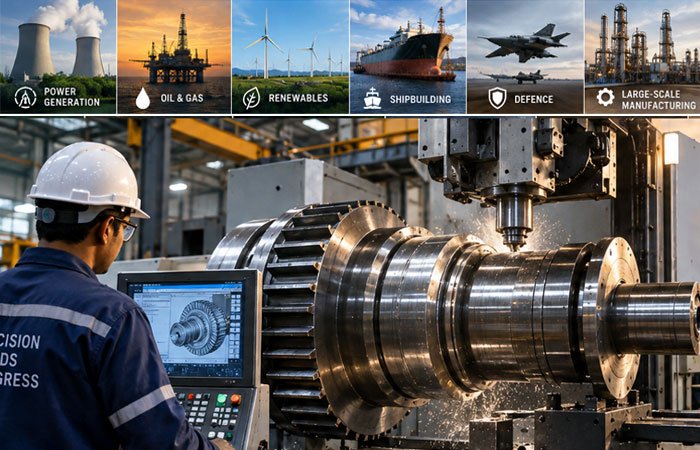
As power generation, renewables, oil & gas, shipbuilding, defence and infrastructure accelerate investment, the demand for large-format, high-precision machining is entering a new cycle. For machine-tool builders, cutting-tool companies and component manufacturers, the opportunity is no longer simply about making bigger components—it is about machining them faster, smarter and with greater process certainty.
The global heavy-engineering and energy-equipment machining landscape is entering an important transformation. Across major industrial economies, capital is flowing into electricity generation, grids, nuclear, renewables, LNG, defence, shipbuilding and industrial infrastructure. These investments ultimately translate into demand for turbines, generators, shafts, gearboxes, pressure vessels, pumps, compressors, heat exchangers, transmission components and large structural parts—all requiring increasingly sophisticated machining capabilities.
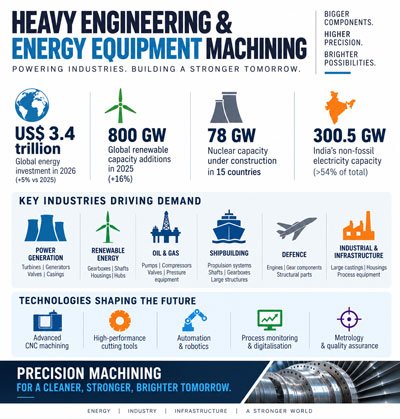
The scale of the opportunity is evident in energy investment alone. The International Energy Agency (IEA) expects global energy investment to reach a record US$3.4 trillion in 2026, up 5% from 2025. Around US$2.2 trillion is expected to go into clean-energy technologies, while US$1.2 trillion is directed towards oil, natural gas and coal. Electricity-related investment is expected to approach US$1.6 trillion, while grid investment is projected at nearly US$550 billion. (IEA)
That investment is creating a broad, multi-industry machining opportunity.
POWER GENERATION: MACHINING FOR A NEW ELECTRICITY ERA
The power-generation industry remains one of the largest consumers of heavy-engineering components. Turbine rotors, generator shafts, casings, blades, valves and transmission equipment require extreme dimensional accuracy and reliability.
The transition is simultaneously creating demand across thermal, gas, nuclear, hydro, solar, wind and grid infrastructure.
Globally, 78 GW of nuclear capacity is currently under construction across 15 countries, with China accounting for roughly half. India, Egypt and Türkiye each have around 5 GW under construction. (IEA)
For machining companies, nuclear and large-scale power projects represent particularly demanding applications because component integrity, traceability and process control are critical.
RENEWABLE ENERGY: BIGGER COMPONENTS, HIGHER PRODUCTIVITY
Renewables are rapidly changing the component mix.
Global renewable capacity additions reached approximately 800 GW in 2025, up 16%. Solar accounted for more than three-quarters of new additions, while wind contributed around 20%. Solar additions exceeded 600 GW, while wind additions reached about 160 GW. (IEA)
China alone added almost 500 GW of renewable capacity in 2025, including approximately 370 GW of solar PV and 117 GW of wind. India added almost 50 GW of solar PV, while wind additions exceeded 6 GW. (IEA)
Wind-energy manufacturing creates substantial machining demand for gearboxes, main shafts, bearing housings, hubs and drivetrain components. Larger turbines mean larger components, tighter process control and greater requirements for high-performance boring, turning, milling and grinding.
OIL & GAS: HIGH-VALUE, HIGH-PRECISION MACHINING
Oil and gas remain major customers for heavy engineering despite the energy transition.
The Middle East supplied around 30% of global oil production and 17% of natural-gas production in 2024. The region was expected to invest approximately US$130 billion in oil and gas supply during 2025, representing around 15% of global investment in the segment. (IEA)
This supports demand for large valves, pumps, compressors, pressure equipment, drilling components, flanges and critical rotating equipment.
India is also a major refining hub. Government data shows India’s installed refining capacity at 267.1 million tonnes per annum as of April 1, 2026, while the government identifies India as the world’s fourth-largest refiner. (Petroleum Planning & Analysis Cell)
For machining suppliers, this market rewards capabilities in difficult materials, deep-hole machining, precision boring, threading and production of safety-critical components.
SHIPBUILDING: ASIA DOMINATES
Shipbuilding represents another significant heavy-machining opportunity, particularly for propulsion systems, shafts, gearboxes, bearings, pumps, valves and large structural components.
China continues to dominate global shipbuilding. In the first half of 2026, Chinese shipyards secured 1,131 of 1,481 global vessel orders, representing approximately 72% of compensated gross tonnage. South Korea secured 195 vessels and remained particularly strong in higher-value LNG carriers. (Maritime Executive)
India is attempting to build a stronger position. In March 2026, the government reported 288 shipbuilding contracts worth ₹19,748 crore covering 456 vessels under its Shipbuilding Financial Assistance Policy. In July, India approved a broader ₹69,725 crore package aimed at strengthening shipbuilding capacity, financing and skills. (Press Information Bureau)
That creates a significant domestic opportunity for heavy machining companies.
| Country/Region | Current industrial signal | Machining opportunity |
| India | Machine-tool production reached ₹16,478 crore in FY2025-26, up ~13%; consumption crossed ₹35,000 crore. (IMTMA) | Power, defence, shipbuilding, energy, infrastructure |
| China | Manufacturing PMI rose to 51.5 in August 2026, with output and new orders strengthening. (Reuters) | Power equipment, shipbuilding, industrial machinery |
| USA | July factory orders rose 0.9% MoM; machinery orders increased 0.8%. (Reuters) | Aerospace, defence, energy, turbines, industrial equipment |
| Germany | July industrial orders increased 2.5% MoM, boosted by transport equipment. (Reuters) | Precision machinery, energy, defence, industrial equipment |
| Japan | Manufacturing PMI reached 54.9 in August, the highest since April. (Reuters) | Machine tools, robotics, precision components |
| South Korea | Manufacturing PMI remained in expansion at 52.3, supported by strong exports. (Reuters) | Shipbuilding, LNG, industrial machinery |
| EU | Manufacturing PMI reached 52.7, its fastest expansion in more than four years. (Reuters) | Wind, grids, power equipment, industrial machinery |
| Middle East | Oil & gas remains a major investment engine; 2025 oil/gas supply investment estimated at US$130bn. (IEA) | Oilfield equipment, valves, pumps, compressors |
INDIA: A PARTICULARLY STRONG MACHINING STORY
India deserves special attention because multiple investment cycles are converging simultaneously.
Industrial output grew 6.7% year-on-year in July 2026, while manufacturing increased 7.3% and capital-goods output rose 16.1%. (Reuters)
At the machine-tool level, FY2025-26 production reached a record ₹16,478 crore, with order bookings of approximately ₹16,176 crore, up around 20%. Domestic machine-tool consumption crossed ₹35,000 crore, although imports still represented roughly 60–65% of consumption. (IMTMA)
India’s energy transformation adds another layer. As of July 31, 2026, the country had crossed 300.5 GW of non-fossil electricity capacity, representing more than 54% of total installed generation capacity. Solar stood at 164.59 GW, wind at 58.14 GW, hydro at 57.24 GW and nuclear at 8.78 GW. (Press Information Bureau)
The implication is clear: India will need not only more energy equipment but also more domestic manufacturing capability to produce it.
THE MACHINING TECHNOLOGY SHIFT
The challenge for heavy-engineering manufacturers is that component size is increasing while production economics are becoming tighter.
The next generation of machining therefore centres on:
- High-performance cutting tools – Longer tool life, higher metal-removal rates and predictable performance in difficult materials.
- Large-format CNC machining – Multi-axis turning, milling, boring and hybrid platforms capable of handling massive components.
- Process monitoring – Real-time monitoring of cutting forces, vibration, spindle condition and tool wear to reduce process uncertainty.
- Digital machining – Simulation, digital twins and offline programming increasingly allow manufacturers to optimise processes before a component reaches the machine.
- Automation – Palletisation, robotic loading, tool management and automated inspection are becoming increasingly relevant even in low-volume heavy engineering.
- Metrology and quality assurance – As component tolerances tighten, machining and measurement are becoming increasingly integrated.
The pressure is not simply for accuracy. Manufacturers increasingly need accuracy at speed.
THE BIGGER OPPORTUNITY: FROM MACHINE CAPABILITY TO PROCESS CAPABILITY
Perhaps the most important change is that heavy machining is moving away from a traditional “machine + operator” model towards an integrated machine + tooling + software + metrology + data ecosystem.
The global grid story illustrates why. More than 2,500 GW of renewable, large-load and storage projects are currently stalled in grid connection queues, while annual grid investment needs to rise approximately 50% by 2030 from today’s US$400 billion level. (IEA)
This means the future demand for transformers, generators, turbines, transmission equipment and associated components will place additional pressure on manufacturers to increase throughput without compromising quality.
For the machining industry, therefore, the opportunity extends well beyond selling machines or cutting tools. It lies in engineering complete manufacturing solutions that deliver productivity, repeatability, traceability and lower cost per component.
THE OUTLOOK
The September 2026 industrial picture points towards a powerful convergence: energy security, electrification, renewable expansion, defence spending, shipbuilding, infrastructure investment and industrial localisation.
The IEA expects clean-energy investment alone to reach US$2.2 trillion in 2026, while global energy investment reaches a record US$3.4 trillion. (IEA)
For India, the opportunity is particularly significant. Record machine-tool consumption, accelerating capital-goods production, expanding power infrastructure, a rapidly growing renewable base, new shipbuilding policies and defence localisation are creating multiple demand centres for heavy machining.
The winners will not necessarily be those with the largest machines.
They will be the companies capable of delivering precision at scale, productivity under pressure and intelligent manufacturing for increasingly complex components.
That is the new definition of heavy machining.
Data note: This feature uses the latest publicly available information located through September 4, 2026. Where full-year 2026 data is not yet available, the latest actual period or official 2026 forecast is identified. Energy-investment figures are IEA estimates/forecasts, while industry data is sourced from official government agencies and industry associations.