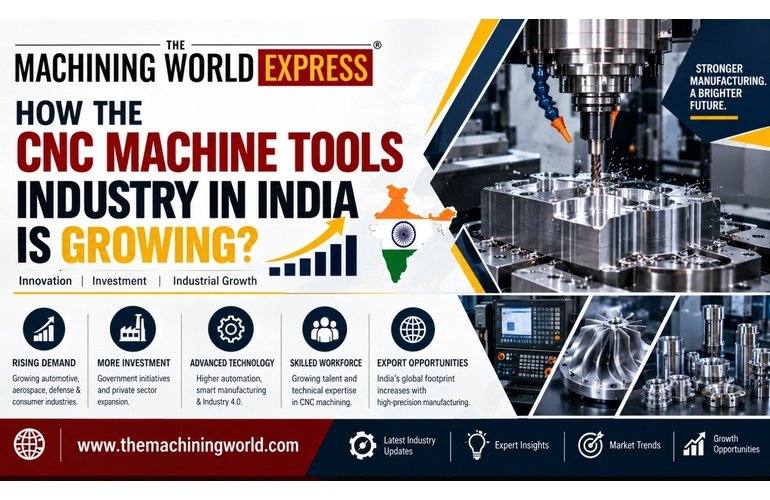
CNC machine tools are now a major part of India’s manufacturing sector. They help factories make parts faster, with better accuracy and less variation. As manufacturers look for higher production, lower waste, and consistent quality, the use of CNC machines is increasing across many industries.
The growth is visible in the wider machine tool market as well. IMTMA estimated India’s machine tool production at ₹14,566 crore and consumption at ₹31,781 crore in FY 2024-25. India ranked 9th in the world for machine tool production and 4th for consumption in CY2024.
The Machining World Express follows these developments closely, covering the technologies and changes shaping India’s machining and manufacturing sector.
This article explains what is driving CNC growth, the challenges involved, and what manufacturers can expect in the coming years.
Overview of the CNC Machine Tools Industry in India
CNC stands for Computer Numerical Control. A CNC machine follows instructions from a computer program to perform operations such as cutting, drilling, turning, milling, and grinding.
Conventional machines depend more on manual control. CNC machines, on the other hand, can repeat the same operation with high accuracy. This makes them useful when manufacturers need to produce large quantities of parts with the same specifications.
Common CNC machine types used in India include:
- CNC turning machines for shafts, pins, bushes, and round parts.
- Vertical machining centers (VMCs) for milling, drilling, and tapping.
- Horizontal machining centers (HMCs) for more complex production work.
- CNC grinding machines for close tolerances and smooth finishes.
- CNC milling machines for cutting and shaping components.
- Multi-axis machines for complex parts that need several operations.
The industry is also moving toward connected machines. CNC equipment can now work with robots, sensors, software, and production monitoring systems.
What is the Current State of the Indian Machine Tool Industry?
India’s machine tool market is growing, but there is still a sizable gap between domestic production and consumption. In FY 2024-25, IMTMA estimated production at ₹14,566 crore, imports at ₹18,686 crore, exports at ₹1,472 crore, and consumption at ₹31,781 crore.
These figures show two things. First, manufacturers in India are investing more in production equipment. Second, the country still relies heavily on imported machine tools and components to meet demand.
The market continued to grow in CY2025. IMTMA data reported by Modern Manufacturing India showed production of around ₹12,930 crore and consumption of ₹32,632 crore.
Key Industries Driving CNC Machine Tool Demand in India
Automotive and Auto Components
Automotive manufacturing is one of the biggest users of CNC machines. The sector produces large volumes of parts, so accuracy and repeatability are important. The growth of e-vehicles is also changing component requirements and creating demand for new machining capabilities.
Aerospace and Defence
Aerospace and defence parts often have complex shapes and tight tolerances. This makes advanced CNC machines, especially multi-axis systems, useful for producing such components. Increasing domestic manufacturing in these sectors is also supporting demand for precision machine tools.
Electronics and Electrical Manufacturing
India’s electronics industry is expanding, creating demand for equipment that can handle smaller and more precise components. CNC machining can support the production of tools, fixtures, housings, and other parts used in electronics and electrical manufacturing.
Major CNC Machine Tool Trends in India (H3)
Automation and Robotics
More factories are using robots for loading and unloading parts, material movement, and repetitive jobs. This reduces manual work and allows CNC machines to run for longer periods with less interruption.
Industry 4.0 and IIoT
Connected CNC machines can provide information about production, machine usage, alarms, and operating conditions. Manufacturers can use this data to find production problems and make better decisions on the shop floor.
AI and Predictive Maintenance
AI-based systems are also finding a place in modern machining. They can help monitor tool wear, identify unusual machine behaviour, and predict possible maintenance needs. This can help reduce unexpected machine stoppages.
Multi-Axis and High-Speed Machining
Manufacturers are handling more complex parts, which is increasing interest in multi-axis machining. These machines can complete several operations with fewer setups. High-speed machining can also improve productivity and surface finish when used for the right applications.
Challenges Facing the CNC Machine Tools Industry in India
The industry has strong growth opportunities, but some challenges remain:
- Dependence on imported CNC systems and precision components
- High initial investment
- Skilled workforce shortage
- Rising raw material and component costs
- Maintenance and technology-upgradation requirements
- Supply-chain and lead-time issues
- Need for stronger domestic R&D
Building more local capabilities in CNC controls, precision components, software, and automation can help reduce technology dependence over time.
What Are the Opportunities for CNC Machine Tool Manufacturers in India
India’s growing manufacturing base offers several opportunities for CNC machine tool companies. Automotive and EV production can create demand for new machines, while aerospace and defence need equipment capable of handling complex and high-precision parts.
MSMEs are another important market. As smaller manufacturers modernise their workshops, there is room for compact CNC machines, automation solutions, and easier-to-use digital systems.
Localisation is also creating opportunities. Companies that develop CNC controls, precision components, automation systems, and related technologies within India can help meet domestic demand.
Exports are another area to watch. Indian machine tool exports rose substantially in CY2025, reaching around ₹2,599 crore, according to IMTMA data reported by MMI.
Conclusion
India’s CNC machine tools industry is growing as manufacturers invest in automation, precision, and higher production capacity. Automotive, EVs, aerospace, defence, electronics, and general engineering are creating new demand. The next stage will be shaped by automation, Industry 4.0, AI, and greater localisation.
As they continue to change the sector, The Machining World Express covers these trends and the key developments influencing India’s machining industry.
Frequently Asked Questions (FAQs)
Q1. Why is CNC machine tool demand increasing in India?
- Manufacturers are adopting CNC machines to improve accuracy, production speed, repeatability, and overall efficiency across different manufacturing operations.
Q2. Which industries use CNC machines the most?
- Automotive, auto components, aerospace, defence, electronics, engineering, medical equipment, energy, and consumer goods industries use CNC machines.
Q3. Is India dependent on imported machine tools?
- Yes. India still imports many machine tools, CNC controls, and precision components, although domestic production and exports are also growing.
Q4. How is Industry 4.0 affecting CNC machining?
- It connects CNC machines with sensors, software, and networks, helping manufacturers monitor machines, collect data, and improve production planning.
Q5. What will drive future CNC growth in India?
- Automation, robotics, multi-axis machining, smart monitoring, AI, localisation, and rising manufacturing investment are expected to support future CNC growth.