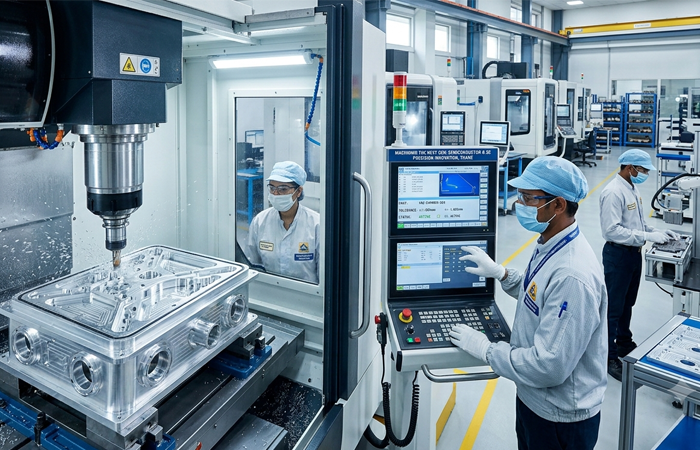
The machining industry is entering a significant new phase. For decades, automotive, aerospace, general engineering and heavy engineering have been the primary growth engines for precision machining. But the rapid expansion of semiconductors, consumer electronics, communications equipment and AI infrastructure is creating an entirely new demand curve for high-precision machining.
The opportunity is particularly important for India. Electronics production in the country has risen from around ₹1.9 lakh crore in FY2014-15 to ₹13.11 lakh crore in FY2025-26, while electronics exports have grown from approximately ₹38,000 crore to ₹4.24 lakh crore. Mobile-phone production alone has reached about ₹6.27 lakh crore, compared with only ₹18,000 crore in 2014-15.
This transformation is changing not only what India manufactures, but also how components must be machined.
The Semiconductor Boom Is Reshaping Precision Manufacturing
The global semiconductor industry is experiencing an extraordinary investment cycle. According to the World Semiconductor Trade Statistics (WSTS), the global semiconductor market is forecast to reach approximately US$1.51 trillion in 2026, representing around 90% growth. Memory is expected to account for more than US$800 billion, driven largely by AI, high-bandwidth memory (HBM) and accelerated computing.
The manufacturing-equipment ecosystem is expanding just as rapidly.
SEMI forecasts total global semiconductor manufacturing-equipment sales of approximately US$165.9 billion in 2026, up 23.2% year-on-year. By 2028, the figure could reach US$229.5 billion. Wafer-fab equipment alone is expected to reach US$143.9 billion in 2026.
For machining companies, these numbers matter because semiconductor manufacturing requires an enormous ecosystem of precision mechanical components, chambers, fixtures, handling systems, vacuum components, heat-management parts, inspection equipment and automation hardware.
The opportunity is therefore much broader than machining the semiconductor itself.
From Chips to Components: Where Machining Fits
Semiconductor manufacturing demands extreme levels of dimensional accuracy, surface finish, cleanliness and process repeatability.
Machined components may include:
- Vacuum and process-chamber components
- Aluminium and stainless-steel precision parts
- Heat sinks and thermal-management components
- Semiconductor equipment frames and structures
- Wafer-handling components
- Precision fixtures and tooling
- Ceramic and difficult-to-machine material components
- Inspection and metrology equipment parts
- Automation and robotic components
- Test and packaging equipment components
The increasing adoption of advanced packaging, HBM and heterogeneous integration is particularly significant. SEMI expects semiconductor test-equipment sales to rise 31% to US$15.3 billion in 2026, while assembly and packaging equipment is forecast to grow 9.6% to US$6.7 billion.
This creates opportunities for machining companies beyond traditional wafer-fabrication applications.
3C Manufacturing: Smaller Components, Higher Expectations
The second major growth engine is the 3C sector — Computers, Communications and Consumer Electronics.
Smartphones, laptops, tablets, networking equipment, wearables, servers, telecom equipment, cameras, gaming hardware and increasingly AI-enabled devices all require large numbers of precision components.
However, the 3C machining environment is fundamentally different from conventional heavy engineering.
The emphasis is increasingly on:
Miniaturisation + high speed + complex geometries + excellent surface finish + repeatability + high-volume production.
Components such as smartphone frames, camera components, connectors, heat-management parts, laptop structures, hinges, housings and precision brackets require sophisticated CNC machining, high-speed milling, micro-machining, grinding and finishing.
The global market is also becoming more demanding. Gartner projected significant pressure on PC and smartphone shipments in 2026 because of soaring memory costs, with premium products expected to become increasingly important.
This means machining suppliers cannot depend simply on volume. Precision, productivity and cost-per-component will determine competitiveness.
India: From Assembly to Component Manufacturing
India’s biggest opportunity is that the country’s electronics story is gradually moving from assembly towards deeper domestic value addition.
The Electronics Components Manufacturing Scheme (ECMS), initially launched with an outlay of ₹22,919 crore, was increased to ₹40,000 crore in the 2026-27 Budget. By August 2026, 106 projects across 15 states had been approved, representing approximately ₹69,548 crore of investment. Thirty-eight plants were already operational, with another 16 at advanced construction or machinery-installation stages.
This is an important development for the machining industry.
As more electronic components are manufactured locally, demand will increase for precision tooling, CNC machines, cutting tools, workholding, automation, metrology, coolants, coatings and specialised manufacturing processes.
The transition from importing components to manufacturing them domestically could therefore create an extensive new customer base for India’s machine-tool and cutting-tool industries.
Semiconductor Manufacturing Is Also Creating a New Industrial Ecosystem
India’s semiconductor ambitions are moving beyond policy announcements into manufacturing capacity.
As of July 2026, 12 semiconductor-related manufacturing units had been approved under the Semicon India programme, involving investments exceeding ₹1.64 lakh crore. These include semiconductor fabrication, silicon-carbide fabrication and multiple packaging facilities.
The government has subsequently moved towards Semicon 2.0, with a broader focus covering design, materials, machinery, fabs, ATMP, R&D and talent.
Industry forecasts suggest the Indian semiconductor market itself could grow from approximately US$64 billion in 2026 to US$200 billion by 2035. Consumer electronics, automotive and industrial applications are currently among the largest demand drivers.
This makes India increasingly attractive not only as an electronics assembly destination but as a potential precision-manufacturing hub.
The New Machining Technology Agenda
The rise of semiconductor and 3C machining will accelerate several technology trends.
- 5-Axis Machining: Complex components and multi-sided geometries will increase demand for simultaneous 5-axis machining and sophisticated CAM strategies.
- High-Speed Machining: Aluminium, copper and other lightweight materials used extensively in electronics require high spindle speeds, efficient chip evacuation and controlled cutting parameters.
- Micro-Machining: As electronic components become smaller, machining capabilities will move increasingly towards miniature features, micro-holes, thin walls and extremely tight tolerances
- Advanced Cutting Tools: Tool manufacturers will need solutions for aluminium alloys, copper, stainless steels, titanium and advanced materials, with greater emphasis on tool life and predictable performance.
- Automation: High-volume 3C production will demand automated loading, unloading, inspection, tool management and process monitoring.
- In-Process Metrology: When component tolerances become extremely tight, inspection can no longer remain a final-stage activity. Measurement must increasingly become part of the machining process itself.
- Digital Manufacturing: Digital twins, machine monitoring, predictive maintenance, AI-assisted process optimisation and data-driven quality control will become competitive differentiators.
A Strategic Opportunity for Indian Machining Companies
The semiconductor and 3C revolution does not mean that automotive or traditional engineering machining will disappear. Instead, it creates another high-value growth vertical.
India already possesses a large engineering base, a growing electronics industry, skilled manpower and an expanding semiconductor ecosystem. The next step is to connect these strengths.
For machining companies, the strategic question is no longer simply:
“How many components can we produce?”
It is increasingly:
“Can we produce semiconductor- and electronics-grade components with the accuracy, cleanliness, repeatability and economics demanded by global customers?”
Companies that invest early in 5-axis machining, high-speed CNC, micro-machining, advanced tooling, automation, metrology and process engineering can position themselves for this emerging market.
The semiconductor and 3C revolution is therefore not only a story about chips and smartphones. It is a story about the thousands of precision-machined components and manufacturing technologies behind them.
And for India’s machining industry, that could become one of the most important growth opportunities of the next decade.