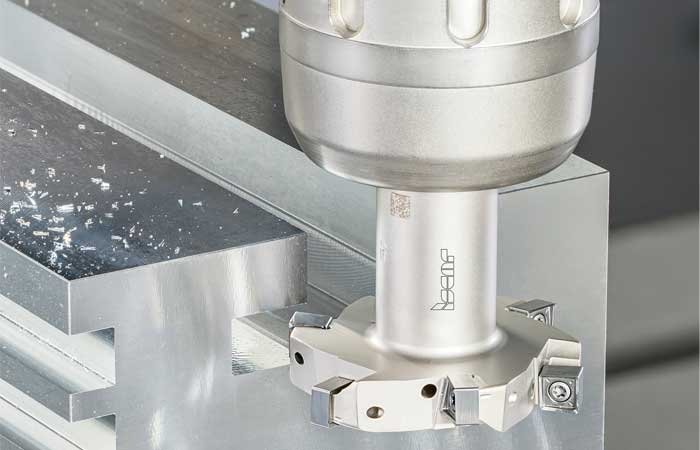
 Disc-type side and face milling cutters, often called slotting cutters or side mills, have long been effective for slot and groove milling. Compared with smaller diameter solid end mills, their larger diameter accommodates more cutting teeth. Their higher tooth-pass frequency can permit higher table feed and metal removal rates (MRR), while their greater rigidity improves the machining of deep and narrow slots.
The effective cutting width determines the slot width, allowing full-width slots to be produced in a single pass. Indexable versions also allow worn cutting edges to be renewed by indexing or replacing inserts, reducing tooling costs compared with solid carbide end mills.
However, side and face cutters present specific challenges. Peripheral teeth generate tangential and radial forces, while side teeth produce axial forces. Unequal loading can cause cutter deflection, lateral movement and irregular wear. Axial and radial runout are particularly critical, causing vibration, reduced tool life, poorer surface quality and diminished dimensional accuracy.
Tooth corners are another critical area because they simultaneously machine the slot bottom and walls, experiencing higher mechanical and thermal loads. Chip evacuation can also become difficult in deep, narrow slots, increasing the risk of recutting and tool wear.
Modern cutter development therefore focuses on advanced cutting materials and coatings, optimized tooth geometry, dimensional accuracy, chip-space design, increased tooth density, vibration resistance and effective coolant delivery. Indexable designs additionally emphasize rigid insert clamping and economical use of tungsten carbide.
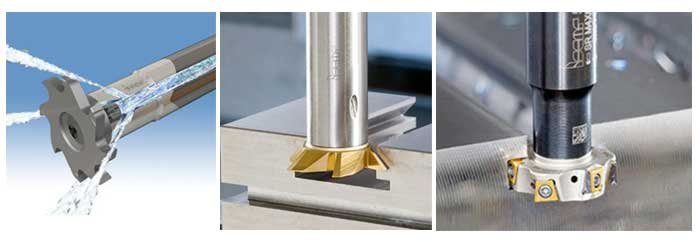
ISCAR’S Slotting Solutions
ISCAR’s HELISLOT family uses cost-effective, double-sided square inserts with eight cutting edges. Available in 09, 13 and smaller 06 sizes, the range supports slots and grooves as narrow as 7 mm (0.275 in.). Inserts for aluminum and non-ferrous metals feature ground side surfaces and polished rake faces to promote chip flow and prevent built-up edge (BUE).
TANGSLOT uses tangential inserts with four cutting edges and a rake-face geometry designed to improve chip formation, reduce cutting forces and power consumption. The range includes multiple insert corner radii for different slot milling applications.
The MULTI-MASTER family of exchangeable-head cutters now includes solid carbide dovetail milling heads from 10.5 to 25 mm diameter. Six-tooth designs enable higher feed rates and improved productivity when machining 90° and 120° dovetail slots in steel, stainless steel and cast iron.
ISCAR’s T-SLOT system uses accurately centred exchangeable milling heads secured by a screw and a spline connection that transmits torque. Carbide tool bodies with internal coolant deliver coolant directly to the cutting zone, improving cooling and chip evacuation while extending tool life.
Building on this concept, TANG-DISC applies the robust spline connection to indexable tooling. Its exchangeable heads use compact tangential inserts with a 5 mm inscribed circle diameter, each providing four cutting edges. The design offers an economical solution for small industrial components.
The Way Forward
Modern slotting cutters demonstrate that productivity depends on more than cutting speed and feed. Cutter rigidity, balanced forces, secure insert clamping, effective chip evacuation and directed coolant are equally important.
By combining these features with economical indexable inserts and exchangeable-head concepts, modern side and face cutters enable more productive, reliable and cost-efficient machining of slots, grooves, dovetails and parting operations.