




Grinding has moved far beyond its traditional role as a finishing operation. In today’s competitive manufacturing environment, grinding directly influences dimensional accuracy, surface integrity, productivity, component quality, tool life and overall cost per component.
Across automotive and EV, aerospace, cutting tools, bearings, medical, tool & die, precision engineering and heavy engineering, manufacturers are seeking solutions that deliver higher material-removal rates, consistent quality, longer wheel life and shorter cycle times. At the same time, difficult-to-machine materials and increasingly demanding tolerances are driving greater adoption of advanced abrasives, superabrasives and application-specific grinding solutions. In this interaction, Tyrolit shares its perspective on the changing requirements of industrial grinding, the importance of application engineering and the latest abrasive technologies, helping manufacturers improve productivity, precision and competitiveness.
Q1. How do you see the evolution of grinding technology in modern manufacturing?
Grinding is becoming increasingly strategic within the manufacturing process. Traditionally, it was viewed primarily as a finishing operation. Today, manufacturers expect grinding to contribute directly to productivity, dimensional accuracy, surface quality and cost optimisation.
Components are becoming more complex, materials harder and tolerances tighter. Simultaneously, manufacturers demand shorter cycle times and longer wheel life.
This is driving the adoption of advanced abrasive technologies, superabrasives, high-performance grinding wheels and application-specific solutions.
The future of grinding is therefore not simply about selecting a grinding wheel; it is about optimising the complete grinding process.
Q2. What are the key challenges manufacturers face in demanding grinding applications?
One of the biggest challenges is achieving the right balance between material removal, surface quality, dimensional accuracy and wheel life.
Diverse materials behave differently during grinding. Hardened steels, carbide, ceramics, nickel-based alloys and other difficult-to-machine materials require carefully selected abrasive technologies and process parameters.
Manufacturers also need to control issues such as thermal damage, grinding burn, wheel loading, dressing requirements and surface-finish variation.
Therefore, successful grinding requires the right combination of abrasive technology, wheel specification, machine capability, coolant strategy and process parameters.
Q3. What is Tyrolit’s approach to addressing these challenges?
Our approach is strongly application-oriented.
We do not believe that a single wheel specification can address every manufacturing requirement. We work with customers to understand the material, component geometry, machine, production volume, tolerance, surface-finish requirement and target cycle time.
Based on these parameters, the appropriate abrasive technology and wheel specification can be selected.
This approach allows customers to optimise the grinding process rather than treating the grinding wheel as an isolated consumable. The objective is to achieve measurable improvements in productivity, consistency and cost per component.
Q4. What are some of the latest Tyrolit grinding solutions that can make a difference to Indian manufacturers?
Our portfolio covers conventional abrasives as well as diamond and CBN superabrasive technologies.
Superabrasives become particularly important when manufacturers are working with hard materials, complex geometries and demanding precision requirements. They can provide excellent cutting performance and dimensional consistency.
We also develop application-specific wheel specifications and engineered grinding solutions, allowing manufacturers to address individual production requirements.
For Indian manufacturers, the opportunity is to move towards grinding solutions that deliver not only precision, but also higher productivity and better overall process economics.
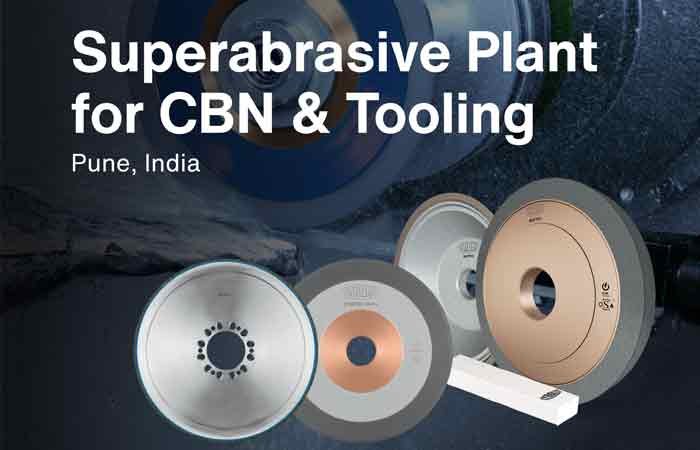
Q5. How can CBN and diamond grinding technologies benefit manufacturers?
CBN and diamond grinding solutions are important for modern precision manufacturing.
CBN is particularly suitable for grinding hardened ferrous materials and is therefore relevant to applications such as machining automotive components, bearings, gears and other hardened-steel components.
Diamond abrasives are widely used for hard and brittle materials including carbide, ceramics, glass and other advanced materials.
Depending on the application, the benefits can be high dimensional accuracy, excellent surface finish, high grinding performance and longer wheel life. The correct selection of superabrasive technology can therefore significantly improve the economics of difficult grinding operations.
Q6. How important is wheel specification in achieving productivity and quality?
Wheel specification is critical. The abrasive type is only one part of the equation.
Factors such as grit size, concentration, bond system, wheel structure and dressing strategy all influence grinding performance.
A wheel specification optimised for high material removal may be very different from one designed primarily to achieve an exceptional surface finish.
This is why application engineering is so important. The objective is to select a wheel that is matched to the component, machine and process, rather than simply selecting a standard product.
Q7. How important are grinding solutions in cutting tool manufacturing?
Cutting tool manufacturing is one of the most demanding precision-grinding applications.
Tool manufacturers need to achieve accurate geometries, sharp cutting edges, excellent surface quality and repeatability across large production volumes.
Diamond and CBN grinding technologies can play an important role in manufacturing carbide, HSS and other high-performance cutting tools.
The right grinding solution can help manufacturers improve tool geometry, reduce grinding time and maintain consistent edge quality. As cutting tool manufacturers move towards more complex geometries and advanced materials, the importance of grinding technology will continue to increase.
Q8. How is grinding technology supporting automotive and EV manufacturing?
Automotive and EV manufacturing are creating evolving grinding requirements. Traditional automotive applications such as gears, shafts, bearings and transmission components continue to require high-volume and repeatable grinding.
At the same time, EV manufacturing is introducing new components and materials, increasing the demand for productivity and precision. Grinding solutions must therefore deliver consistent quality at high production volumes while controlling cycle times and manufacturing costs.
Optimising wheel specifications for individual applications can provide significant productivity benefits in these environments.
Q9. How are sustainability and total cost of ownership influencing grinding decisions?
Sustainability and economics are increasingly interconnected. Manufacturers are no longer looking only at the purchase price of a grinding wheel. They are evaluating the total cost per component.
A wheel that delivers longer life, fewer dressing operations, lower consumption and shorter cycle times can provide significantly better economics over its operating life.
Therefore, we focus on solutions that help customers optimise abrasive consumption, improve wheel utilisation and reduce unnecessary process steps.
Sustainability in grinding should ultimately contribute to both resource efficiency and manufacturing competitiveness.
Q10. As the Grinding Partner for M&M 2026, what technology will Tyrolit be presenting and exhibiting in Pune?
M&M 2026 provides an excellent opportunity to engage directly with India’s machining and manufacturing community and demonstrate how advanced grinding technologies can address today’s production challenges.
As the Grinding Partner, Tyrolit will showcase its expertise across high-performance abrasive technologies, precision grinding, superabrasives and application-specific grinding solutions.
The objective is to demonstrate how the right combination of abrasive technology and process expertise can help manufacturers achieve higher productivity, improved dimensional accuracy, better surface finish, longer wheel life and lower cost per component.
We look forward to engaging with professionals from automotive, aerospace, cutting tools, die-mould, medical, 3C, heavy engineering and other manufacturing sectors to understand their specific grinding challenges.
For us, M&M 2026 is not only about showcasing products. It is an opportunity to discuss real-world applications, process optimisation and productivity opportunities directly with manufacturers.
Q11. What should manufacturers consider when selecting a grinding solution?
Manufacturers should evaluate the complete grinding process rather than selecting a wheel based only on its initial price or specification.
Key factors include component material and hardness, geometry, tolerance, surface-finish requirements, machine capability, dressing method, coolant conditions, production volume and target cycle time.
Wheel life, consistency and cost per component should also be considered.
A technically appropriate wheel can deliver benefits throughout the manufacturing process. This makes application engineering and technical support an important part of the overall solution.
Q12. What is your message to Indian manufacturers looking to improve their grinding processes?
India has a tremendous manufacturing opportunity, and grinding will play an important role as industries move towards higher precision and greater value addition.
Manufacturers should look at grinding as a technology investment rather than simply a consumable purchase.
The right grinding technology can influence productivity, quality, tool life, energy consumption and ultimately profitability.
Our objective at Tyrolit is to work closely with customers, understand their applications and provide solutions that deliver measurable improvements.
The future of grinding will be driven by precision, productivity, advanced abrasives, application engineering and sustainable manufacturing.