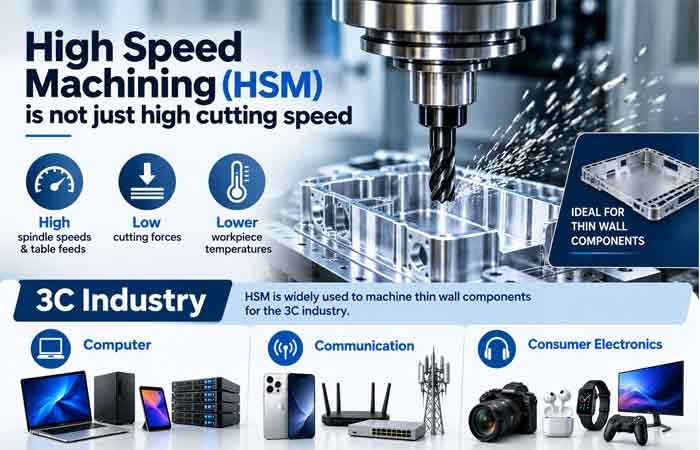
High Speed Machining (HSM)- is not just high cutting speed The term High Speed Machining commonly refers to end milling at high rotational rpms and high surface feeds.
The shallow cuts used in HSM generate low cutting forces on the tool, resulting in only small and consistent tool deflections that maintain thin wall components accuracy and minimize component deflections.
Low cutting tool forces and workpiece temperatures are a characteristic of HSM! HSM is today mainly performed in HSK 63 or taper 40 machines with high spindle speeds and table feeds and thus require rigid machine tool structures that can withstand the higher rpms and table feeds. This characteristic of HSM is applied to machining thin wall components that are so prevalent in the 3C industry.
The 3C industry consists of:
- Computer: Laptops, desktops, tablets, servers, peripherals.
- Communication: Smartphones, routers, network devices, antennas
- Consumer electronics: Cameras, headphones, wearables, gaming products, displays.
The components in this industry are characterized by thin wall, difficult to machine materials like titanium, stainless steel etc. with high accuracies on complex profiles. The products are characterized by short product life cycles & high production volumes. Thin sections can deform because of:
- Cutting forces.
- Clamping pressure
- Residual material stress
- Heat generated during machining
- Uneven stock removal
Common countermeasures include use of:
-
- SC Tools with number of flutes 4 or more held precisely in Tool Holders like HYDROGRIPs, shrink fits to give a TIR less than 0.005 microns.
Generate tool paths in modern CAM software’s using HSM techniques to machine accurately, distortion free with good surface finish, and at high parameters, consistently.
Let us now examine these HSM techniques and how they are applied:
Contact time and conduction of heat:
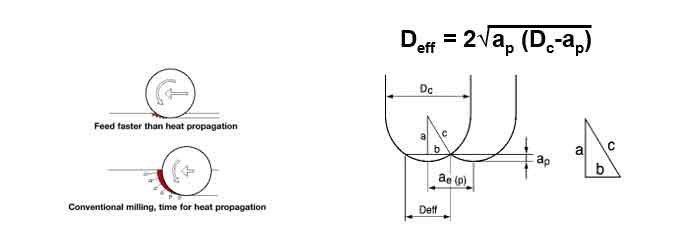
In HSM the tool is fed faster than the heat propagation as against conventional milling which generates heat in the component and the cutting edge.
The pre-requisites of HSM machining are
- Small radial engagement
- Small axial engagement
- High cutting speed(rpm)
- High feeds (mm/min)
- Tool geometry that uses the concept of effective diameter of the tool (diameter in actual contact) to get a higher rpm for the same cutting speed.
The use of HSM tool paths supported by modern CAM software’s with AI supported adaptive controls that ensure in machining of thin wall
components the least stresses are generated in the component and the highest level of accuracy, finish is maintained consistently. This means:
- Shallow cuts(ae=radial shift, ap=axial doc) ie ae/ap=0.1 to 0.3mm.
- Stay cut continuously as far as possible in down milling paths.
- Maintain constant stock for preceding and successive operations.
Strategy to machine in corners:
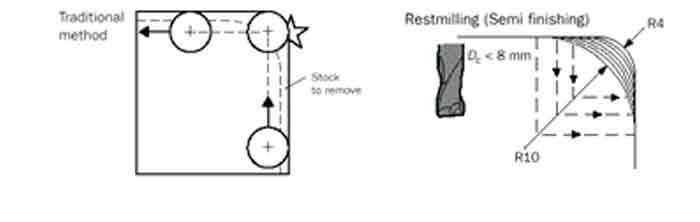
The traditional way of machining a corner is to use linear movements (G1) with non-continuous transitions in the corner.This will result in varying cutting forces, vibration and also undercutting of the corner.
Instead by programming with larger radius than the final result, these problems are normally overcome and the corner is produced with smooth continuous transitions and without any vibration.
The remaining stock in the corner can be machined using circular interpolation – preferably in combination with a cutter radius smaller than stated for the corner.
Influence of Runout on tool(TIR) on Tool life and surface Finish.
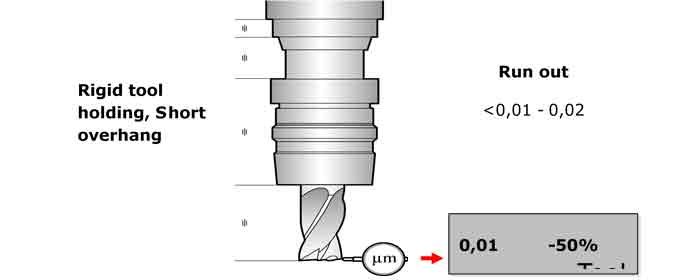
Tool holding plays a crucial role in maintaining the TIR on the tool which is vital to get consistent benefits of HSM ie Tool life and surface finish on the component consistently.
In conclusion the main benefits of applying HSM Tool paths to thin wall component machining in materials like Titanium, Stainless steels including duplex, Inconel etc are:
- Meet the higher demands on time and cost efficiencies.
- New materials and hardened materials.
- Higher quality and productivity demands
- Demands on shorter throughput times, fewer set ups.
- Shorter product life cycles – faster design changes.
- Rapid product development time.