





What is HARD PART TURNING?
Hardened steels above 55 Hrc are generally rough to semi finish machined.
By turning and boring in soft stage and then finished by the grinding process, which is principally a multi-point contact process and has low Productivity and involves heavy investments..
Today’s process of Hard Part Turning(HPT) makes it possible “to turn” on modern rigid Turning centres by using different grades of Cubic Boron Nitride and this leads us to define Hard Part Turning(HPT) as Turning of hardened steels at 55 HRC and above.
There are many different types of steel (carbon steels, alloy steels, tool steels, bearing steels etc.) that can achieve these high levels of hardness. The common hardening methods are case hardening, induction hardening and through hardening. Hard part turning is usually a finishing or semi-finishing process with high dimensional accuracy and surface quality requirements.
In addition to turning hardened Steels above 55 HRc, HPT also extends itself to Hardened SG Iron, chilled Cast Iron etc when they have hardness levels of 55Hrc level and above.
Therefore HPT defines itself as:
- Single-point cutting
- Differs from grinding which is multi-point contact
- In Applications where hardness values are > 45 HRC, typically 55-65 HRC
The HPT process is similar to conventional turning and allows a switch to HPT in normal factory environment with only small adaptations to rigid Turning Centres.
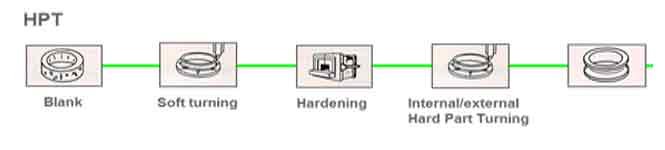
The HPT process positions itself as a Time-and cost saving alternative to grinding, increasingly replacing grinding as a process for machining hardened Steels eg. Hardened Gears, Gearbox shafts and Cast Irons. See (Fig 1.) below:
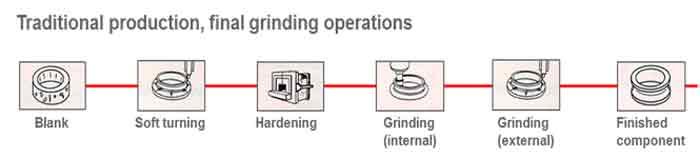
Machining Sequences Comparison: Traditional versus HPT (fig 2 & 3):
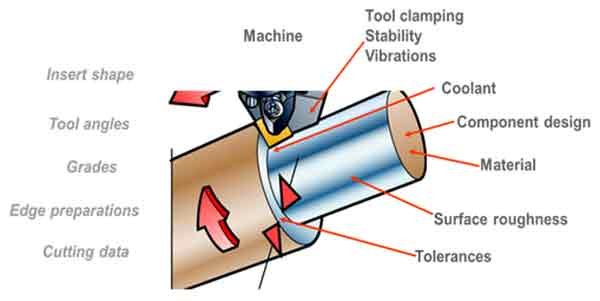
External Process Parameters that influence HPT(Fig 4):
HPT-The Machine:
Performance demands on a grinding machine can vary depending on the degrees of accuracies and surface finish requirements of the component to be machined. They can vary from Tolerances of h5/H5 to h7/H7 and Ra= 0.4 to 1.6 microns.
The most common demand Rz < 6.3 µm ie Ra=1.2 microns and h7/H7 tolerance can be achieved with most Turning centers, provided the other process requirements like job clamping, tool stability, geometry and grade are met with.
Generally Turning centers are be used for HPT for “one off” items, or when the demands on accuracies are on the higher side of the surface finish and tolerance requirements.
But whenever the demands on accuracies on HPT are closer , with a requirement of establishing a process capability index then its better to go in for a dedicated HPT machine.
The demands on a high precision HPT Machine are:
The accuracies of a component in HPT are determined by the tolerances, the surface finish, and roundness that are achievable when comparable with the Grinding process; These accuracies are influenced strongly by the type of machine.. especially when a surface finish level of Ra=0.8 microns is desired and a h7/H7 capability on the tolerance is desired with a cpk.
The machine characteristics are typically influenced by:
- It is important to have a “stiff” bed machine design. HPT lathes normally have a concrete-bed or ceramic bed for good dampening, this avoids/reduces vibration. The machine must “resist” the cutting forces in its best way. The more rigid and bigger the guide system, the better is the stiffness.
- The dynamical roundness-quality of the spindle bearing; different Spindle revolutions may give different roundness quality.
- Important to have spindles balanced at the maximum RPM.
- The Main Spindle and the Tailstock have to be accurately aligned? If they run with different axes to each other, this can negatively affect quality.
- Important to have spindles balanced at the maximum RPM.
- The Machine stability, rigidity, spindle bearing quality, component clamping quality, Tool stability, the cutting parameters etc together form a “System” ; with all possible cutting data variations you will never come below a certain Ra level for the machine. We call this Ra level as the “Basic system noise”.(Fig 5.)
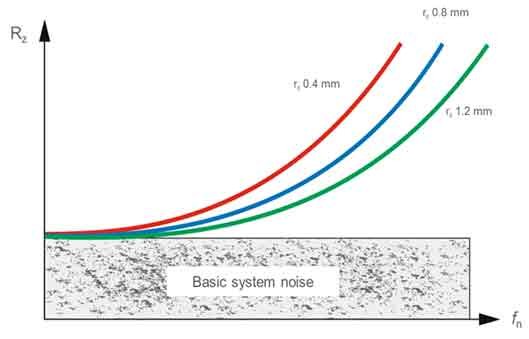
For good stable machines Ra= 0.4 µm is possible, for other machines Ra= 0.6 to 0.8 µm is achievable.Now, we look at the other external factors that will influence the success of the HPT process…….
- Positional & Mechanical accuracies: If the positioning devices of the machine are precise down to 0.01mm, you will never achieve 1 µm correction in the machine.
- Thermal aspects:If the machine is in a cold workshop in the morning, during the day the workshop gets warm. The gradual warming of the machine can produce variations in the components- this can be avoided by a Spindle cooling system.
- Software resolution: The actual resolution is not always shown on the machine screen. For example, if values are given as: “2.376 mm“, it does normally not mean that the real resolution is 0.001mm.
- Precision of machine measuring system: There are different qualities of measuring system available, both direct and indirect measuring systems. Indirect measuring systems deliver signals/values which are recalculated by the machine computer. This may create deviation between actual and calculated values.
HPT-Tool Stability, Clamping; Insert Clamping and location:
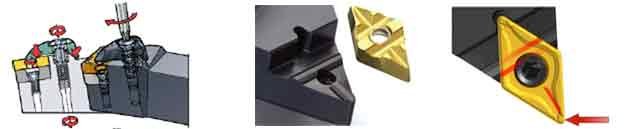
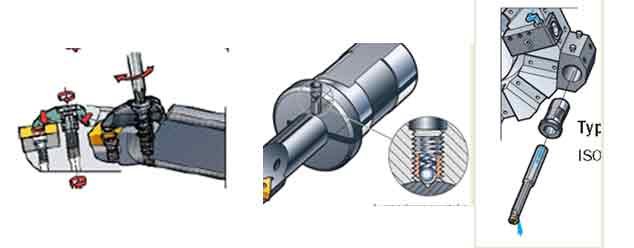
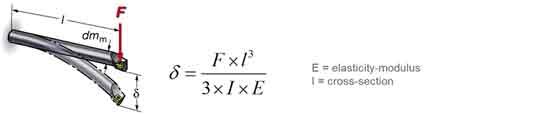
In HPT , both clamping and location of the insert needs to be rigid and prevent insert movements; An example of this for External and Internal HPT applications is shown below :(Fig 6& 7)):
HPT- Insert –The Grade:
Hardened components are defined as those that cannot be machined with Carbide and are between 55 and 65Hrc. Below 55Hrc Carbide can also machine the component at very low parameters of Vc < 35-40m/min. No doubt that Ceramics – especially whisker re-enforced Ceramics are used on hardened components, but they are not so competitive wrt to CBN in terms of Productivity and sustained accuracies.
Components in the range 45 to 55 Hrc are generally machine economically with Ceramic inserts and grades ….. But as the hardness goes above 55 Hrc, its CBN (Cubic Boron Nitride) that becomes more “Economical”;
By “Economical” we mean Optimum Productivity with Optimum Tooling cost. CBN is the second hardest known material in the world; the hardest being diamond.
This attribute, in addition to many other extreme properties makes it the ideal cutting tool material for hard, abrasive workpieces.
CBN has greater chemical and thermal stability than Diamond( which dissolves in iron and has a maximum temperature limit of approximately 700°C); In contrast, CBN is chemically inert in ferrous materials and retains its hardness at temperatures in excess of 1000°C; In contrast, CBN is chemically inert in ferrous materials and retains its hardness at temperatures in excess of 1000°C, which is typical for HPT.
The Grade of CBN is selected by the content of CBN by Percentage, wrt to the Ceramic binder and the grain distribution:
A Typical HPT application in a Steel shaft of 58 to 62 Hrc as below(Fig 8) will help us select the right CBN grade: