


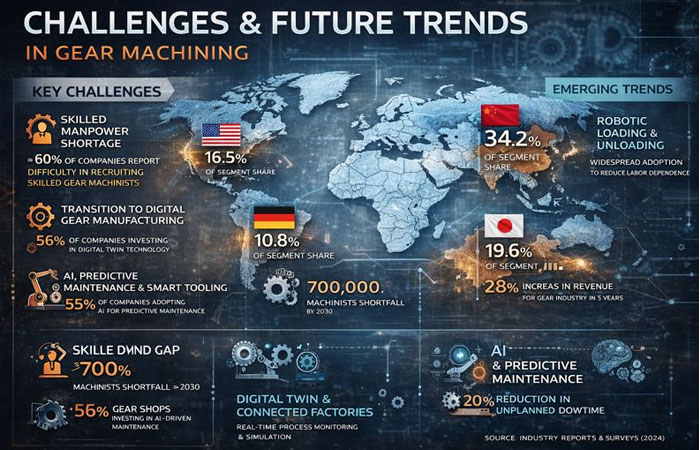
Gear machining is entering one of the most transformative phases in its history. While demand from automotive, EVs, wind energy, robotics, and heavy engineering continues to grow, manufacturers across the world are facing a common set of challenges that are redefining how gears are designed, machined, monitored, and maintained. At the same time, rapid advances in digitalization and artificial intelligence are opening new pathways to productivity and resilience. The future of gear machining will be shaped by how effectively companies respond to these shifts.
The Skilled Manpower Gap: A Growing Constraint
One of the most pressing challenges in gear machining today is the shortage of skilled manpower. Gear cutting, grinding, and finishing remain highly specialized processes that demand deep understanding of geometry, materials, tooling, and machine behavior. However, the traditional talent pipeline—experienced machinists, gear technologists, and process engineers—is shrinking.
Younger entrants into manufacturing are fewer, while experienced professionals are retiring faster than they can be replaced. This gap is particularly acute in advanced processes such as gear grinding, power skiving, and NVH optimization, where small errors can result in noise, premature wear, or rejection of entire batches.
As a result, manufacturers are being forced to redesign processes that were once operator-dependent into systems that rely more on automation, standardized workflows, and digital assistance. Training is shifting from long apprenticeships to simulation-based learning, digital work instructions, and machine-integrated guidance, reducing reliance on tribal knowledge.
Transition to Digital Gear Manufacturing
The response to workforce challenges is closely tied to the transition toward digital gear manufacturing. Digitalization is no longer limited to CNC controls or offline programming; it now spans the entire value chain—from design and simulation to machining, inspection, and feedback loops.
Digital twins of gears, machines, and processes are increasingly used to simulate cutting strategies, predict distortion, and optimize cycle times before production begins. This reduces trial-and-error on the shop floor and allows less-experienced operators to achieve consistent results. In gear machining, where micron-level accuracy matters, digital process planning has become a necessity rather than a luxury.
Connected machines are another defining trend. Modern gear hobbing, grinding, and machining centers continuously generate data on spindle loads, vibrations, temperatures, and tool wear. When this data is captured and analyzed in real time, manufacturers gain unprecedented visibility into process stability and machine health. This digital backbone is the foundation on which future productivity gains will be built.
AI and Predictive Maintenance: From Reactive to Proactive
Artificial intelligence is beginning to play a decisive role in gear machining, particularly in predictive maintenance. Traditionally, maintenance schedules were based on fixed intervals or reactive responses to breakdowns—both costly approaches in high-value gear manufacturing environments.
AI-driven systems analyze machine data to detect subtle patterns that precede failures, such as changes in vibration signatures or spindle power consumption. This enables maintenance teams to intervene before breakdowns occur, reducing unplanned downtime and extending machine life. In gearbox machining lines, where a single machine failure can disrupt entire production flows, predictive maintenance delivers immediate and measurable benefits.
Beyond machines, AI is also being applied to process optimization. Algorithms can correlate cutting parameters, tool wear, surface finish, and inspection results to recommend optimal machining conditions. Over time, these systems “learn” the best parameters for specific gear materials, geometries, and tools—reducing dependence on expert intuition.
Smart Tooling: Intelligence at the Cutting Edge
Another major trend shaping the future is the rise of smart tooling. Cutting tools embedded with sensors can measure temperature, force, and vibration directly at the cutting edge. This real-time feedback provides early warning of tool wear, chipping, or abnormal cutting conditions.
In gear machining, where tool failure can damage expensive components or machines, smart tooling adds a critical layer of protection. When integrated with machine controls and production systems, smart tools enable adaptive feed rates, automated tool changes, and consistent quality even during lights-out operation.
Tool manufacturers are also leveraging digital platforms to offer tool-life prediction models and cloud-based analytics. This transforms tooling from a consumable into a managed asset, aligned with overall equipment effectiveness (OEE) and cost-per-part targets.
The Road Ahead: Convergence, Not Replacement
The future of gear machining will not be defined by a single technology, but by the convergence of skills, digital systems, and intelligent automation. While AI and smart manufacturing will reduce dependence on manual expertise, human knowledge will remain essential—particularly in interpreting data, making strategic decisions, and driving continuous improvement.
Manufacturers that succeed will be those who invest simultaneously in people and technology: upskilling their workforce while embedding intelligence into machines, tools, and processes. Gear machining plants of the future will be leaner, more connected, and far more resilient—capable of producing high-precision gears with fewer people, less waste, and greater consistency.
In an industry where precision is everything, the ability to adapt to these challenges and trends will determine who leads—and who falls behind—in the next decade of gear manufacturing.