


Blending Swiss Precision, German Engineering, Italian Innovation, Japanese Reliability with Indian Manufacturing Strength
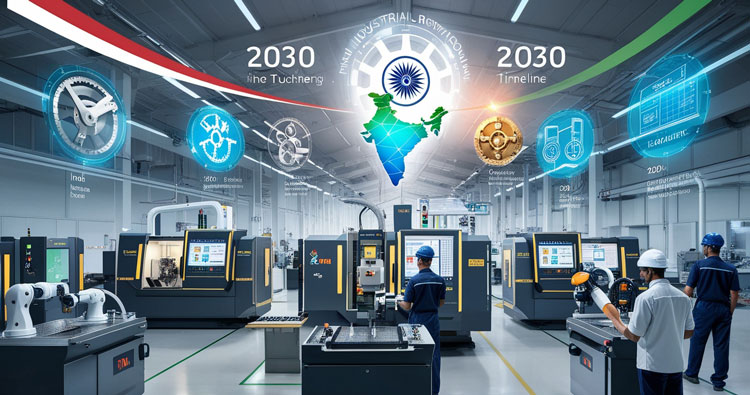
India’s industrial growth journey is undergoing a remarkable transformation. Once seen largely as a cost-competitive production hub, the country is now positioning itself as a global center for advanced manufacturing and engineering excellence. At the heart of this shift lies the machine tools industry, the very foundation upon which every sector of manufacturing depends. By 2030, the Indian machine tools sector is expected to expand significantly, riding on domestic demand, technological upgrades, and global supply chain diversification. What makes this future even brighter is the possibility of India combining the best global traditions—Swiss precision, German engineering, Italian innovation, and Japanese reliability—with its own growing manufacturing strengths.
This fusion could redefine India’s global identity in machine tools, transforming it from an importer and consumer to an innovator and exporter.
Swiss Precision: Building Accuracy into Indian DNA
Switzerland has long been a symbol of unmatched precision—whether in watches, medical devices, or micro-machining equipment. For India’s machine tools sector, adopting this ethos means going beyond Close Enough tolerances to Always Accurate results. As industries like aerospace, defense, EV components, electronics, and medical implants expand in India, micron-level precision will no longer be optional—it will be mandatory.
To achieve this, Indian Machine Tool Manufacturers Should:
- Strengthen metrology infrastructure and testing labs across clusters.
- Invest in high-accuracy spindles, ball screws, and thermal compensation technologies.
- Implement in-process probing, laser calibration, and digital error correction within machines.
- By embedding Swiss-style process discipline and tolerance culture into everyday manufacturing, Indian Machine Tool Builders will be able to consistently deliver world-class accuracy.
German Engineering: Systems Thinking and Durability
German engineering is synonymous with robustness, reliability, and lifecycle value. Machines designed in Germany are not just about functionality, they are built to last decades with minimal breakdowns. For Indian companies aspiring to reach global markets, this long-term approach must be adopted.
India Machine Tool Builders can achieve this by:
- Designing modular machine platforms with scalable options.
- Using FEA ( Finite Element Analysis) -optimized castings and vibration-dampening structures.
- Embedding predictive maintenance and IoT sensors for continuous health monitoring.
- Documenting TCO (Total Cost of Ownership) and offering service guarantees.
- When Indian-built machines can demonstrate high availability, repeatability, and efficient after-sales support, they will gain credibility not just at home but also in export destinations.
Italian Innovation: Design Thinking Meets Flexibility
Italian machine tool makers are admired for their creativity, design elegance, and ability to offer flexible, customer-centric solutions. They don’t just build machines—they design experiences. This is an area where India can leap forward by combining human-centered design with software-driven innovation.
Opportunities For Indian Machine Tool Builders include :
- Compact, ergonomic layouts for space-constrained SMEs.
- User-friendly HMIs (Human Machine Interfaces) with intuitive controls.
- Hybrid machine platforms that combine milling, turning, and grinding.
- Additive manufacturing integration and quick-change tooling systems.
By infusing Italian-style innovation into Indian-built machines, OEMs can cater to a wide range of industries that demand agility and differentiation—key traits for global competitiveness.
Japanese Reliability: Discipline and Supplier Development
Japanese manufacturers have mastered reliability through discipline, kaizen (continuous improvement), and strong supplier ecosystems. Machines from Japan are trusted worldwide because they Just Work Shift After Shift. For India to emulate this, reliability must become a cultural pillar across its manufacturing ecosystem.
Key steps that Indian Machine Tool Builders should include:
- Strengthening tier-2 and tier-3 supplier quality through joint kaizen projects.
- Enforcing standard work, poka-yoke systems, and 5S practices.
- Running reliability growth testing (RGTD) and documenting MTBF (Mean Time Between Failures) / MTTR ( Mean Time To Repair) metrics.
- Building strong after-sales networks with guaranteed uptime.
The moment Indian machines are known for predictable reliability and quick service, the global perception of Risk will shift towards Trust.
Indian Strength: Scale, Digital Talent, and Policy Support
While precision, engineering, innovation, and reliability are inspirations drawn globally, India itself brings unique advantages that will propel its Machine Tool Sector:
- Domestic Demand – Rapid growth in EVs, aerospace, defense, renewable energy, and electronics ensures a steady local market for advanced machine tools.
- Digital Advantage – With a vast pool of software talent, India can integrate AI-driven toolpath optimization, predictive analytics, and Industry 4.0 applications seamlessly into machines.
- Cost Competitiveness – India’s MSME ecosystem, skilled workforce, and lower production costs provide an edge in value engineering.
- Policy Tailwinds – Programs like Make in India, PLI schemes, defense indigenization, and R&D subsidies are already boosting manufacturing infrastructure.
- Global Opportunity – China+1 supply chain diversification makes India a natural partner for global buyers seeking reliability with cost efficiency.
Path to 2030: Strategic Priorities
To fully realize its potential, the Indian machine tools industry must take the following steps by 2030:
- Localization of Critical Subsystems: Spindles, ball screws, controllers, and linear guides must increasingly be produced in India.
- Own software-Controller Ecosystem: Develop an Indian CNC controller platform with open APIs, predictive features, and cybersecurity safeguards.
- Automation-First Approach: Provide pre-engineered Machine + Robot /pallet pool cells for SMEs.
- Global Certifications: CE/UL compliance, ISO/AS standards, and sustainability certifications should be non-negotiable.
- Service Excellence: Create nationwide service academies and spare-part hubs with guaranteed response times.
- Sustainability: Incorporate energy-efficient drives, MQL (minimum quantity lubrication), and mist collectors into standard offerings.
- Export Readiness: Start with Asia, Middle East, and Africa, then penetrate Europe and the US with niche, high-performance machines.
India as a Global Benchmark by 2030
By 2030, the Indian machine tools industry will no longer be defined only by cost advantage. If nurtured carefully, it will represent a rare synthesis: Swiss precision in accuracy, German strength in engineering, Italian flair in design, Japanese dependability in reliability, and India’s own power of scale, digital innovation, and speed.
This fusion will allow India not just to participate in global supply chains but to set new benchmarks in Machine Tools Excellence. Machines Made in India will be recognized worldwide not only as affordable but as advanced, accurate, and reliable—powering the next era of global manufacturing.