


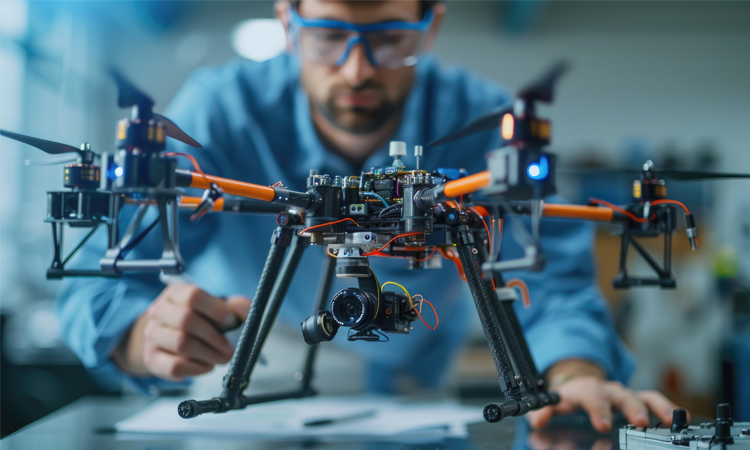
The global drone market is soaring. From military surveillance and combat drones to delivery UAVs and agricultural drones, unmanned aerial vehicles (UAVs) are fast becoming essential across industries. According to a 2024 PwC report, the global drone market is expected to reach $91 billion by 2030, with India alone projected to become a $2.5 billion market by 2026. As drone design evolves toward greater agility, endurance, and payload efficiency, precision machining is emerging as a foundational pillar in UAV manufacturing.
Machining’s Expanding Role in Drones
While drones are often associated with composite materials and 3D printing, machined metal and polymer parts remain vital for performance-critical components. These include:
- Propeller hubs and motor mounts
- Structural frames and arms (especially for larger drones)
- Gear housings, brackets, and payload connectors
- Landing gear systems
- Actuator components and sensor mounts
- Precision enclosures for avionics and guidance systems
Unlike large aircraft, drones demand a delicate balance between lightweight design and mechanical strength. High-performance alloys like aluminium 7075, magnesium, titanium, and engineering plastics such as PEEK or Delrin are commonly machined into lightweight, rigid components.
Key Machining Trends in UAV Manufacturing
- Miniaturization with Micron Precision
The smaller the drone, the more precise the machining required. High-speed micro-milling and turning machines with sub-10 micron tolerances are increasingly used to produce miniature parts like gimbal joints, couplers, and servo mounts. - Multi-Axis Machining for Complex Geometry
With drones becoming more aerodynamic and modular, 4- and 5-axis machining centres are used to manufacture complex contours and integrated structural parts, reducing assembly points and weight. - Lightweighting Through Material Innovation
Aerospace-grade aluminium, carbon-reinforced polymers, and magnesium alloys are being increasingly adopted. Machining strategies now include high-speed dry cutting, trochoidal milling, and MQL (minimum quantity lubrication) to reduce heat distortion. - Rapid Prototyping + Machining Hybrid Model
In drone startups and R&D labs, initial designs may be 3D printed for rapid testing, but final performance parts are machined to ensure integrity under flight conditions. Hybrid workflows combining additive and subtractive methods are gaining ground.
India’s Drone Manufacturing Momentum
India’s indigenous drone ecosystem is gaining momentum with policy support such as the PLI Scheme for Drones and Components and ban on import of fully-built drones. Defence drone projects like SWITCH, Rustom-II, Archer-NG, and DRDO’s loitering munitions are driving demand for precision parts machining.
Companies like IdeaForge, Adani Elbit, Garuda Aerospace, and HAL’s UAV division rely on a growing network of MSMEs in cities like Bengaluru, Coimbatore, Pune, and Hyderabad for CNC-machined drone components. These suppliers are now investing in dedicated setups for UAV-grade tooling, faster spindle speeds, and fixture systems to support rapid turnaround.
The Future is Autonomous—and Machined
With growing applications in defence, logistics, surveillance, and urban air mobility (UAM), drones will only get smarter and faster. But no matter how intelligent the system becomes, the physical parts still need to be manufactured with absolute accuracy.
Machining is not just relevant to drone manufacturing—it is mission-critical. As UAV designs become more compact, aerodynamic, and durable, precision machining will continue to play a pivotal role in turning drone innovations into airborne reality.