


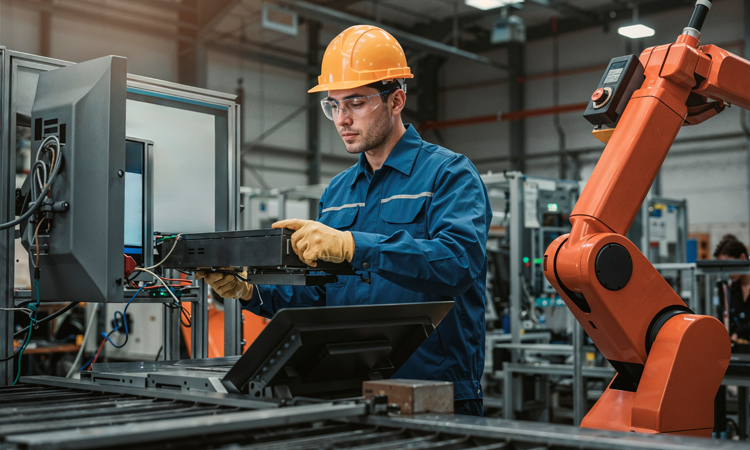
India’s aerospace and defence sector is undergoing a rapid transformation driven by advanced machining technologies and vertical integration of capabilities. Under the “Make in India” initiative, a bevy of innovations in precision manufacturing—spanning from materials to smart machines—are redefining production of critical systems. Here’s how next-gen machining is shaping the future.
Advanced Material Processing Meets Precision
The global aerospace shift toward lightweight, high-performance materials—titanium, superalloys, composites—is mirrored in India’s ecosystem. Notably, Aerolloy Technologies inaugurated the world’s largest aerospace-grade titanium and superalloy plant in Lucknow in May 2025, embedded within the UP Defence Industrial Corridor, securing indigenous supply for engine components and airframes
On the shop floor, machining leaders like Jyoti CNC Automation are answering the call: their FY25 order book included ₹1,694 crore from aerospace and defence clients (39 % of total), supported by new 5‑axis gantry centres, twin–spindle with gantry automation, and Tachyon Beta linear‑motor high‑dynamics machines .
State-of-the-Art Machine Tools & Automation
Five-axis CNC machining, EDM, and precision grinding are now mainstream in military-grade part production—producing turbine disks, landing-gear housings, and missile components. Indian suppliers are fast adopting these systems, with Industry 4.0 automation, smart tool changers, and digital interfaces. Jyoti CNC’s HUMA touchscreen HMI, patented in Jan 2025, empowers machinists with intuitive machine control
Digitalisation & AI-Driven Manufacturing
Digital twins, IoT-enabled systems, and AI-based predictive maintenance underpin the new machining paradigm. Smart cells in firms like Bharat Forge / Kalyani Strategic Systems and L&T Defence are lowering downtime and ensuring traceability—critical for AS9100-certified supply.
Abroad, partnerships like RTX’s Collins Aerospace “Powered by Collins” program connect Indian SMEs via digital platforms (like Switchpitch), fostering rapid prototyping in material informatics and quantum nav systems
Additive + Subtractive Hybrid Manufacturing
Hybrid manufacturing—embedding additive metal prints with precision subtractive finishing—is gaining traction. ISRO, HAL, and defence OEMs are using AM for complex satellite and drone parts. Machining integration reduces lead times by ~30%, based on Tejas LCA experience .
Strategic Capacity Expansion & Ecosystem Growth
Infrastructure development is surging: Lucknow’s titanium plant, Karnataka’s helicopter assembly line by Tata‑Airbus (starting 2026 ) and centre of excellence hubs in Bengaluru elevate machining capabilities. OEMs like HAL, TASL, and Godrej Aerospace are expanding engine and airframe facilities to support AMCA (5th‑gen stealth fighter) and Gaganyaan space engines
Adaptive Defence Needs
DRDO’s expanding missile portfolio—hypersonics, next-gen BrahMos, air defence and AMCA fighters—demands ultra-tight machining tolerances for guidance systems, airframes, and propulsion components.
Recent UAV systems like Rudrastra (hybrid-VTOL loitering munition) embody this trend, requiring precision-machined guidance modules for autonomous operations
Outlook & Challenges Ahead
- Certification speed: Military-grade approvals (like NADCAP, AS9100) remain lengthy.
- Materials supply: India’s reliance on imported high‑end material persists, though titanium self-sufficiency is improving.
- Skill development: Upskilling machinists for sophisticated systems is essential.
Nevertheless, with estimated aerospace market CAGR at ~8.5% by 2030, the country is well-placed to scale production, innovation, and exports.
Next-gen machining—powered by advanced materials, high-precision tools, intelligent automation, and digital ecosystems—is reshaping aerospace and defence manufacturing in India. From titanium superalloys in north India to smart CNC hubs in the south, the foundational building blocks are in place. As indigenous programmes like AMCA, BrahMos variants, and Gaganyaan advance, machining will remain the critical launchpad for India’s aspirations in self-reliant aerospace power.