


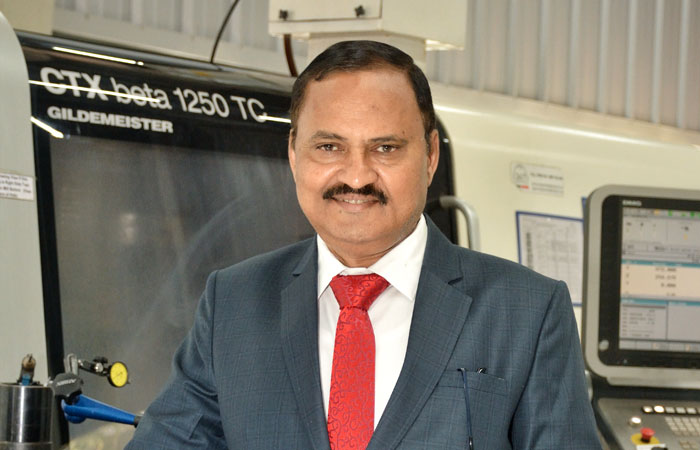
As gear manufacturing evolves to meet the growing demands of industries such as automotive, aerospace, wind energy, and industrial machinery, the role of advanced cutting tools has become more critical than ever. Manufacturers today seek higher productivity, superior finish quality, and cost-efficient processes while maintaining global quality standards.
LMT Tools, one of the world’s leading gear-cutting tool manufacturers, continues to support this transformation through innovation, engineering expertise, and strong manufacturing capabilities in India. In this interaction, Ramakant Reddy of LMT Tools India Private Limited shares insights into the company’s capabilities, technology developments, and the growing opportunities in the gear manufacturing ecosystem.
Please tell us about LMT Tools and its role in supporting the gear industry.
LMT Tools is globally recognized as a specialist in the development and production of precision tools. The company’s purpose is to simplify machining for customers by delivering reliable, high-performance tooling solutions. This allows manufacturers to focus on their core production processes while relying on the performance and consistency of LMT Tools’ solutions.
The company serves multiple product lines including gear cutting, milling and threading, reaming, rolling systems, and advanced tooling. With an international network of experts and production facilities in Germany, the USA, China, and India, LMT Tools develops innovative machining solutions backed by strong engineering support and fast service response.
In gear manufacturing specifically, LMT Tools partners with leading manufacturers by providing high-productivity gear-cutting tools that help reduce cycle times while ensuring consistent quality. The company’s state-of-the-art manufacturing facility in Pune plays a crucial role in supporting both domestic and global demand.
The Pune plant is capable of producing gear-cutting hobs from 0.5 to 36 module with diameters ranging from 30 mm to 400 mm. With a production capacity of 1500–1600 hobs per month, it is India’s largest gear-cutting tool manufacturing facility. Notably, LMT Tools India is the only gear-cutting tool manufacturer in the country with an in-house coating facility, ensuring better control over tool performance and delivery timelines.
For gear manufacturers, these capabilities translate into reliable tooling supply, faster turnaround, and consistent machining performance.
What are the latest technological advances shaping gear-cutting tools today?
Increasing demand across industries is driving the need for faster production cycles and higher efficiency in machining operations. This trend is pushing tooling technology forward at a rapid pace.
LMT’s Gear skiving tools set standards in terms of machining time, production costs, component quality, tool life and process reliability.
One of the major advancements introduced by LMT Tools is gear skiving technology with process-reliable simulation. Gear skiving offers significant advantages compared to conventional gear manufacturing processes. It enables faster machining than hobbing, supports a wider range of applications, and eliminates the need for special machines often required in broaching operations. This results in lower tooling costs and improved production flexibility.
The hobbing of gears from module 6 onwards can be carried out extremely economical with LMT’s modern hobs with indexable carbide inserts
Another important development is finish hobbing tools, which help manufacturers achieve superior surface finish quality directly during gear cutting. In many cases, this eliminates the need for shaving operations, saving both time and cost in production.
For manufacturers, these advancements mean improved productivity, reduced machining steps, and better gear quality.
Could you highlight some of your recent product innovations?
LMT Tools continues to expand its gear-cutting portfolio through ongoing research and development supported by its global engineering network. Recent additions include gear skiving cutters, ChamferCut tools, next-generation gear-cutting inserts, and combination tools.
LMT has developed the ChamferCut to save costs and time in the deburring process with uncompromised quality making it highly process reliable.
The ChamferCut technology is particularly significant for gear manufacturers. Chamfering and deburring gears through machining processes are increasingly preferred due to their qualitative and economic advantages. The ChamferCut process enables highly reproducible and geometrically defined chamfers, improving consistency and reducing manual finishing operations.
The company has further extended the ChamferCut process to address complex applications such as gears with interference contours and internal gears. These developments allow manufacturers to achieve accurate chamfer geometry while maintaining process reliability.
Another innovation is the combination tool that integrates a hob and ChamferCut on a single arbor, enabling gear production in a single setup. This eliminates the need for separate hobbing and chamfering machines, reducing capital investment and manpower requirements.
Such solutions significantly improve manufacturing efficiency while lowering overall production costs.
What are LMT Tools India’s production capabilities and industry focus?
LMT Tools India operates as a technology-driven, multi-product manufacturing organization serving industries such as automotive, aerospace, die and mold, wind energy, and general machining.
The Pune facility functions as a center of competence for gear cutting, milling, tapping, thread rolling, and advanced tools. The plant currently manufactures around 15,000 gear hobs annually and exports tooling solutions to global markets. Engineers at the facility are trained in Germany, ensuring adherence to global manufacturing standards.
The Indian manufacturing unit has also been recognized with a Star Performer Award for highest export performance, reflecting its global competitiveness.
Ongoing investments in round tools, gear hobs, and coating technology continue to strengthen the company’s manufacturing capabilities in India.
How do you see the Indian manufacturing market evolving?
India’s manufacturing sector is experiencing steady growth, supported by investments across industries. Indian manufacturers are not only meeting domestic demand but also supplying high-quality products to global markets, demonstrating increasing reliability and competitiveness.
While challenges remain, particularly in automation adoption and workflow optimization, the opportunities are significant. The shift toward advanced machining technologies and precision manufacturing will continue to drive demand for high-performance tooling solutions.
What applications do you foresee for gear-cutting tools in the future?
LMT Tools offers gear-cutting solutions for hobbing, skiving, and chamfering across a wide range of modules and applications. The company also produces customized tools designed for specific customer requirements.
Looking ahead, strong opportunities are expected in power generation and wind energy industries, along with continued demand from automotive and industrial gearbox manufacturing.
Indian gear manufacturers increasingly rely on sophisticated CNC hobbing machines to achieve precision production, which further drives the need for advanced tooling solutions.
What initiatives has LMT Tools taken toward sustainability and social responsibility?
LMT Tools actively supports educational institutions and promotes vocational skill development to enhance employability. The company also participates in healthcare initiatives in rural areas.
From an environmental perspective, LMT Tools follows green manufacturing practices aligned with international standards, ensuring zero-carbon generation within its production processes.
How will industry platforms like Gear Technology India benefit manufacturers?
Gear Technology India provides an important platform for the gear manufacturing ecosystem by enabling knowledge exchange, sharing technological advancements, and discussing industry trends. Such initiatives help manufacturers improve processes and remain competitive in global markets.