


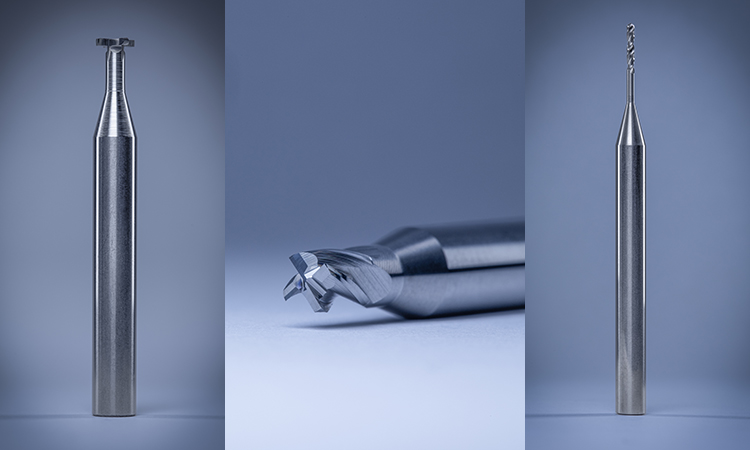
Over the past two decades, the cutting tool industry has been reshaped by the rapid evolution of the global 3C market. The shift is dramatic: components have shrunk, tolerances have tightened, and material and geometric complexity have increased. Cutting tools must now deliver higher accuracy, consistency, and capability than ever before.
This transformation is driven by consumer expectations. Smartphones, wearables, earbuds, and semiconductor hardware demand compactness and flawless performance. Internal components must fit with near-perfect precision, where a deviation of just a few microns can cause failure. As products shrink, toolmaking must achieve accuracy on a scale beyond human vision—measured in microns and increasingly in nanometers.
The true magnitude becomes clear when comparing these scales. Human vision blurs around 100 microns. A red blood cell is seven microns, dust particles are two or three, and viruses under one micron. A nanometer—one-thousandth of a micron—is almost unimaginable, yet tool grinders must operate with this level of control. A tool even slightly out of tolerance risks producing components that fail in the field.
To meet these extreme demands, ANCA has continuously advanced the integration of machines, software, and process control. As geometries and materials grow more intricate, software now plays a central role. ANCA’s ToolRoom, 3D simulation, and integrated process control systems allow toolmakers to validate designs and detect errors before grinding begins. What seemed impossible twenty years ago is now essential: offline simulation boosts accuracy, reduces scrap, and improves productivity.
But software alone cannot achieve nanometer-level tolerances. Machine structure, servo systems, and motion stability must work in unison—driving the development of the ANCA ULTRA Series. These machines incorporate enhanced control systems, redesigned structures, real-time compensation, and advanced measurement technologies to deliver nanometer motion control. The result: superior surface finishes, tighter profiles, and repeatability for high-volume 3C production.
Each ULTRA platform supports specific customer needs. The FX5 ULTRA provides an accessible entry into high-precision toolmaking. The MX5 ULTRA adds rigidity and advanced measurement for complex geometries. The MX7 ULTRA enables high-volume, high-stability production with advanced automation for semiconductor-grade accuracy.
Automation is essential to maintaining this repeatability. Robotic loading, AI workflow systems, and in-process measurement tools like LaserUltra reduce human variability and ensure consistent output.
ANCA’s vertically integrated business model—designing and manufacturing mechanical systems, servos, controls, and software in-house—enables rapid innovation and fine-tuned precision across every subsystem. This, combined with deep R&D investment, ensures that ANCA anticipates future 3C demands rather than reacting to them.
ANCA’s technology has been proven in demanding markets such as China, where accuracy, reliability, and strong customer collaboration drive success.
Comparing today’s capabilities—live simulation, laser gauging, nanometer motion control—to machines from twenty years ago shows how far grinding has advanced. As electronic components continue to shrink, ANCA’s Ultra Series enables manufacturers to push the limits of precision and shape the future of the 3C industry—one nanometer at a time.