


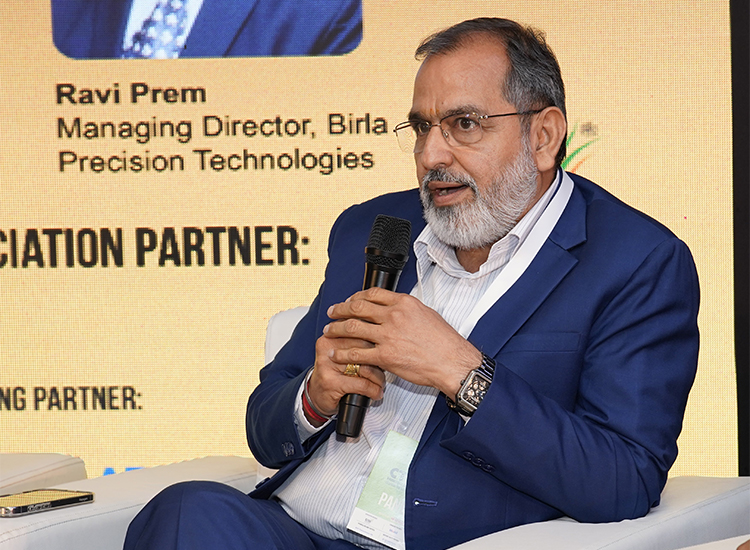
The manufacturing industry in India is going through a big change because of growth in electronics, defense, aerospace, and the rapidly changing 3C sector. The cutting tools sector is at the heart of this change, and Birla Precision Technologies is a key player, keeping an eye on trends, growing capabilities, and supporting advocacy through groups like ICTMA. In this one-on-one interview with Mr. Ravi Prem, Managing Director of Birla Precision Technologies Ltd., we talk about his views on growth, working together, problems, and the lasting legacy that is being built for the future.
Q) How is Birla Precision Technologies staying ahead of evolving market demands, and what role does ICTMA play in contributing to this journey?
India is undergoing an exciting phase across all manufacturing sectors, with industries accelerating and the geopolitical environment creating opportunities for the entire cutting tool industry. Historically, India’s metal-cutting manufacturing sector relied heavily on the automotive and auto components segments. However, the government’s strong emphasis on manufacturing in the 3C (computers, communications, and consumer electronics) sector, defense, power, and aerospace has opened significant doors—not only for Indian cutting tool producers but also for attracting global players.
At Birla Precision Technologies, we proactively respond to market needs by investing in advanced technology, customer insights, and operational agility. Our strategy goes beyond mere reaction; we aim to anticipate and shape market trends, ensuring sustainable growth and industry leadership.
We also actively participate in ICTMA initiatives and advocate for the cutting tools sector with government authorities to build a robust ecosystem for the entire manufacturing landscape.
Q) How have your decades of industry experience shaped your perspective on collaboration and “coopetition” within the cutting tools sector?
With over 39 years of industry experience, now at Birla Precision Technologies, I’ve witnessed how shared knowledge can effectively address challenges like supply disruptions. This has shaped my perspective on “coopetition”—a blend of cooperation and competition—evident in ICTMA’s collaborative events, which foster enhanced standards and mutual growth.
The cutting tool industry has been instrumental in my professional journey, and I owe much of my success to it. It’s essential to give back through ICTMA, where I collaborate with other industry leaders to tackle common challenges. Key issues include advocating for “industry sector status” to secure government budgets for the cutting tools sector. Such legislation is crucial from India’s perspective, aligning with the Government of India’s “Make in India” vision and the goal of achieving 25% of GDP from manufacturing.
Q) What strategies help Birla Precision Technologies meet customer expectations while setting new benchmarks in the cutting tools industry?
By integrating customer insights with our established manufacturing infrastructure—Birla Precision Technologies serving the nation’s cutting tool needs since 1937—we consistently exceed expectations. The adoption of cutting-edge technologies, including CNC systems and LEAN manufacturing principles, enables us to deliver superior performance in sectors like railways, automotive, and defense. Our recent participation in EMO Hannover showcased our high-performance PM drills, establishing us as a benchmark setter in the industry.
Q) What motivates you to represent the cutting tools industry in forums like ICTMA, and how do you leverage these platforms to create impact?
Driven by a deep passion for manufacturing and my past presidency of ICTMA, I actively represent the industry in such forums. I leverage these platforms for advocacy on technology adoption, sharing the latest developments in manufacturing technologies, materials, and coatings through technical seminars.
Q) What key lessons would you share with SME and MSME manufacturers, and how does ICTMA enable knowledge exchange to support their growth?
We are actively reaching out to SME and MSME players, encouraging them to join ICTMA so they can benefit from its activities and gain access to advanced technology platforms. ICTMA’s seminars, mentorship programs—including the 2025 International Tooling Summit—and meetings with counterparts from other associations create a larger platform for Indian cutting tool companies. This enables smaller firms to adopt best practices and thrive in a competitive landscape.
Q) How do you foster a culture of innovation, resilience, and continuous learning within Birla Precision Technologies?
At Birla Precision Technologies Ltd., learning and growth form a core pillar of our strategy. Through employee training and development, cross-functional teams, and agile practices, we cultivate innovation to navigate uncertain markets effectively. Employees are the primary drivers of innovation—technology comes second. Motivated teams make the critical difference in an ever-changing environment.
Q) What legacy do you aspire to leave in the Indian manufacturing sector, and how does ICTMA contribute to realizing that vision?
My desired legacy is to contribute to a self-reliant Indian manufacturing sector. ICTMA’s advocacy for indigenous manufacturing amplifies this through setting standards and driving collective initiatives, helping Indian cutting tool manufacturers grow and participate in India’s broader growth story.