



In today’s competitive manufacturing environment, precision, productivity, and cost efficiency are crucial in drilling applications. With the rise of CNC machining and advanced tool holding systems, solid carbide drills (SCDs) have emerged as the preferred choice over HSS.
Why SCDS Outperform HSS?
SC drills have their flute, point, and microgeometry optimised per application and work material and they are clamped in precise & secure tool holding systems resulting in:
Productivity: At similar feeds, carbide drills can achieve cutting speeds of 100 m/min, compared to just 15 m/min with HSS.
Tool life: On average, SCDs last 20 times longer, reducing the cost per hole by up to 80%.
Quality: SCDs maintain hole tolerances of H9 vs H13-H14 for HSS, plus minimizing scrap and rework.
Key Factors In Selecting The Right SCD
Choosing the right solid carbide drill involves more than picking the carbide grade—it requires optimised geometry, coatings, and precision tool holding.
- Carbide Grade: Most SCDs use grades with 8–10% cobalt, balancing toughness and wear resistance. For challenging materials like stainless steel, titanium, or Inconel tougher grades with 12% cobalt with internal coolant hole carbide rods are recommended to aid chip evacuation.
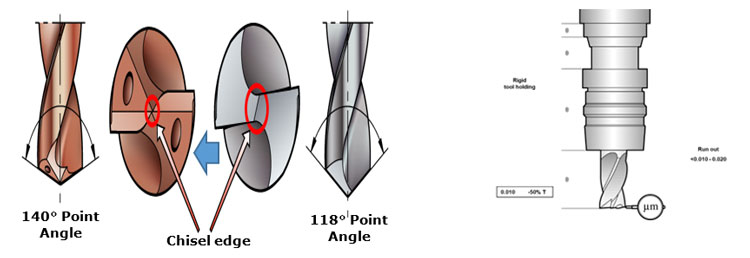
- Geometry: Modern SCDs require carefully designed cutting edges, microgeometry, chisel edges and flute profiles. These features vary depending on whether the material is steel, cast iron, stainless steel, Inconel,titanium,etc. Manufacturers use advanced CNC grinding machines (e.g., ANCA) to produce accurate geometries tailored to applications.
- Coatings: PVD coatings with TiAlN or AiTlN enhance tool life and heat resistance. The right coating is selected based on the material and machining conditions.
- Toolholding: Drill performance depends heavily on secure clamping. ER collets are getting rapidly phased out by high-precision hydraulic holders. For instance, an ER collet may transmit around 45–50 Nm torque on a 16 mm drill with a TIR of 0.01, while a hydraulic holder can deliver up to 160 Nm with a TIR of < 0.005 microns, ensuring a high degree of process security.
Solid carbide drills offer superior productivity, tool life, and accuracy compared to HSS drills, provided the correct drill geometry, coating, and toolholding are chosen. Partnering with the right tool manufacturer ensures the best combination of consistent supplies in the right carbide grade, flute design, and coatings tailored to specific materials—helping manufacturers achieve higher efficiency and lower costs in drilling applications.