


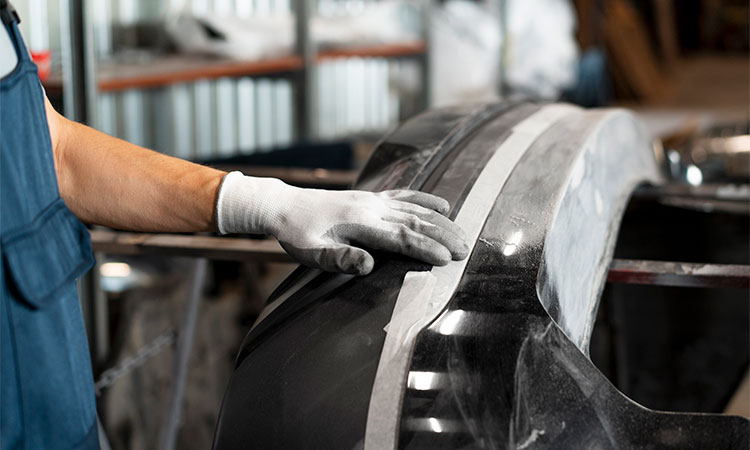
Advanced finishing techniques ensuring durability, efficiency, and noise reduction
Precision has always been the soul of automotive engineering, and as vehicles evolve toward higher efficiency, lower emissions, and quieter operation, surface finishing and tight tolerances have become more critical than ever. The modern automobile, whether electric, hybrid, or internal combustion, demands surfaces that not only fit perfectly but also perform flawlessly across extreme conditions.
Why Surface Finish Matters More Than Ever
Every moving part in a vehicle—from engine pistons and crankshafts to EV gear reducers and braking systems—depends on the smoothness and dimensional consistency of its mating surfaces. A poor finish can lead to friction, wear, vibration, or even catastrophic failure. Studies show that improving surface finish by even 20% can extend component lifespan by up to 40%, while simultaneously cutting noise levels by 15–20%.
In today’s automotive machining landscape, tolerances are shrinking to the micron level. Components like transmission shafts, bearing seats, and cylinder liners are now machined with roughness average (Ra) values as low as 0.1 µm, a feat achievable only with the most advanced finishing processes.
Advanced Techniques Powering the Shift
The modern toolkit for achieving exceptional surface integrity goes far beyond traditional honing and grinding. Technologies such as superfinishing, hard turning, precision lapping, and abrasive flow machining (AFM) are redefining the finishing process.
- Superfinishing: Using fine-grit abrasives oscillated against the workpiece, superfinishing achieves mirror-like surfaces with micro-geometrical precision. This reduces friction by up to 80%, ideal for engine bearings and camshafts.
- Abrasive Flow Machining (AFM): By forcing a viscoelastic abrasive media through intricate passages—such as in fuel injectors or EV cooling channels—AFM delivers unmatched internal surface quality and consistency.
- Electrochemical Machining (ECM): Especially valuable for hard materials like titanium and nickel alloys, ECM removes material atom by atom, ensuring burr-free surfaces and uniform finishes without thermal stress.
- Micro Finishing in EV Components: For e-mobility parts like rotors, stators, and gearbox shafts, micro finishing ensures reduced NVH (Noise, Vibration, Harshness) and increased energy efficiency by minimizing mechanical drag.
Automation and robotics are also transforming finishing operations. Intelligent polishing systems integrated with vision sensors and AI algorithms can now self-correct surface deviations in real time, ensuring repeatable quality at mass-production scale.
Meeting the Tolerance Challenge
As vehicle components become more compact and lightweight, dimensional tolerances are reaching new extremes. Automotive OEMs increasingly specify tolerances of ±2–3 microns for key precision assemblies. For example, EV drive motor shafts require concentricity within 0.005 mm, while hydraulic valve bores demand sub-10 µm roundness.
To achieve this consistency, machining systems now incorporate in-line metrology, temperature compensation, and tool wear monitoring. Smart CMMs (Coordinate Measuring Machines) and non-contact laser scanners provide instantaneous data feedback, enabling real-time process control.
According to a 2024 McKinsey report, automotive plants deploying integrated precision metrology and closed-loop machining achieved 25% fewer reworks and 18% higher first-pass yield—a significant gain in both quality and profitability.
Material Matters: From Steel to Aluminum and Beyond
The shift toward lightweighting is transforming surface finishing dynamics. Aluminum and magnesium alloys, though easier to machine, pose challenges in achieving tight tolerances due to their softness and thermal expansion. Meanwhile, composites and coated steels require non-traditional finishing tools with diamond-like carbon (DLC) or cubic boron nitride (CBN) coatings to prevent surface tearing or delamination.
EV manufacturing, in particular, demands flawless finishes on battery casings, cooling plates, and motor housings, where even microscopic irregularities can cause energy losses or sealing failures. Surface flatness below 0.02 mm is now a norm in battery component machining.
Toward Quieter, Longer-Lasting Vehicles
Surface finishing directly influences NVH behavior—a top priority for EVs and luxury vehicles. As internal combustion engines fade, the relative quietness of electric drivetrains makes any mechanical noise more perceptible. High-quality surface finishes in gears, shafts, and bearings minimize frictional noise and enhance the refined driving experience.
A study by Germany’s Fraunhofer Institute revealed that enhanced surface texture control can reduce gear whine by up to 25%, contributing to smoother, more premium-feeling vehicles.
The Road Ahead: Smart Finishing and Sustainable Processes
The future of surface finishing is digital and green. Predictive analytics, real-time wear tracking, and digital twins are optimizing finishing cycles, ensuring consistent output and tool longevity. Meanwhile, sustainability concerns are driving adoption of Minimum Quantity Lubrication (MQL) and dry finishing techniques, which cut coolant use by 70–90% without compromising surface quality.
In India and across Asia, the rise of precision component suppliers catering to global OEMs is spurring investment in robotic finishing cells, plasma polishing, and eco-friendly abrasive technologies.
In the high-stakes world of automotive manufacturing, surface finishing and tolerances are no longer end-of-line concerns—they are core enablers of performance, efficiency, and brand reputation. As vehicles become more electric, lightweight, and digitally engineered, surface perfection becomes the ultimate differentiator. Manufacturers who master this art will define the next generation of mobility—quiet, durable, and precision-built for the road ahead.