


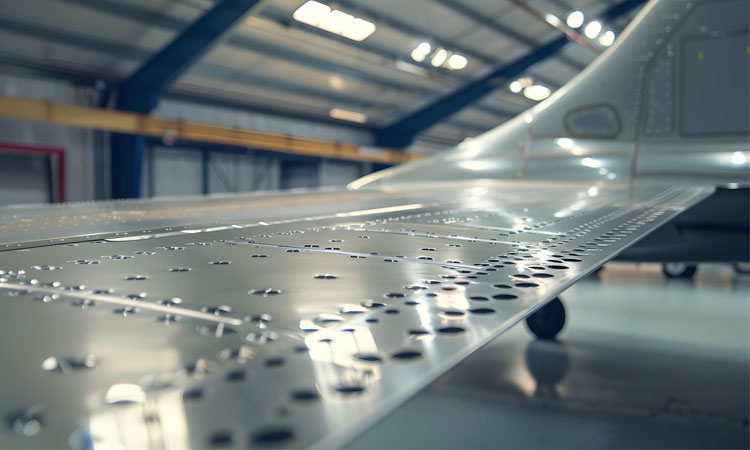
In the aerospace industry, surface finish isn’t just about appearance—it’s about performance. Whether it’s a turbine blade, fuselage panel, or aileron component, the surface quality of an aerospace part directly impacts aerodynamics, fatigue resistance, fuel efficiency, and structural reliability. As India rises as a global aerospace manufacturing hub, mastering advanced finishing strategies has become essential to meet the exacting standards of modern aviation and defence systems.
Why Surface Finish Matters in Aerospace
Aircraft and defence components operate under extreme conditions—high velocity, intense pressure, and thermal stress. A poor surface finish can cause turbulence, increase drag, and lead to premature wear or even failure. For critical surfaces, manufacturers must achieve finishes as fine as Ra 0.2 to 0.4 microns, especially in turbine engine parts, sealing surfaces, and hydraulic components.
According to a 2024 study by Deloitte, over 60% of part rejections in aerospace machining are due to inadequate surface finish or dimensional inaccuracies, underscoring the need for precision finishing technologies.
Finishing Techniques in Aerospace Machining
Aerospace parts typically undergo multiple finishing processes depending on material, geometry, and function. These include:
- Grinding & Superfinishing: Used for components requiring extreme flatness and tight tolerances, like bearing surfaces, valve seats, and gear faces.
- Polishing & Buffing: Essential for reducing surface roughness on aerodynamic parts like fan blades, compressor disks, and leading edges.
- Honing & Lapping: Applied in cylindrical or sealing components, such as landing gear cylinders and fuel injector housings.
- Abrasive Flow Machining (AFM): Popular for deburring and finishing internal channels in complex 3D-printed or cast parts.
- Electropolishing & Chem-Finishing: Preferred for titanium and stainless steel parts to remove micro-burrs and improve corrosion resistance.
India-based aerospace machining specialists such as Godrej Aerospace, Rossell Techsys, and Ankit Fasteners have integrated such advanced finishing capabilities to meet export-grade standards.
Surface Quality Drives Exports
Aerospace exports from India crossed ₹21,000 crore ($2.6 billion) in FY2023-24, with machined components forming a substantial share. However, global OEMs demand AS9100 and NADCAP-certified parts, which require not just accurate dimensions but impeccable surface quality, traceability, and repeatability.
MSMEs in clusters like Bengaluru, Hyderabad, and Belagavi are investing in automated finishing cells, CMM-integrated feedback systems, and adaptive tooling to ensure consistency. Surface roughness measurement tools (like Mitutoyo SJ-500 or Zeiss profilometers) are now common in quality labs of leading shops.
Innovations in Finishing Technology
- Robotic Polishing Arms are increasingly used to automate surface finishing for complex contours and reduce operator dependency.
- Laser Surface Texturing is gaining popularity in enhancing bonding or airflow control properties on composite and metallic surfaces.
- Cryogenic Machining and Ultrasonic-Assisted Grinding are being explored for tough alloys like Inconel and titanium to improve finish while reducing tool wear.
The Way Forward
With rising demand for indigenous aircraft programs like the Tejas Mk1A, AMCA stealth fighter, and Gaganyaan space mission, precision surface engineering is no longer optional—it’s a mission-critical capability. As India scales up in aerospace manufacturing, mastering surface perfection will be a key differentiator.
Conclusion
In aerospace, every micron counts. Surface finishing is not the final step—it’s a defining one. Indian manufacturers aiming to soar in global skies must embrace advanced finishing strategies that meet both the aerodynamic and aesthetic demands of the next generation of aerospace components.