
Vollmer Technologies India Pvt. Ltd.
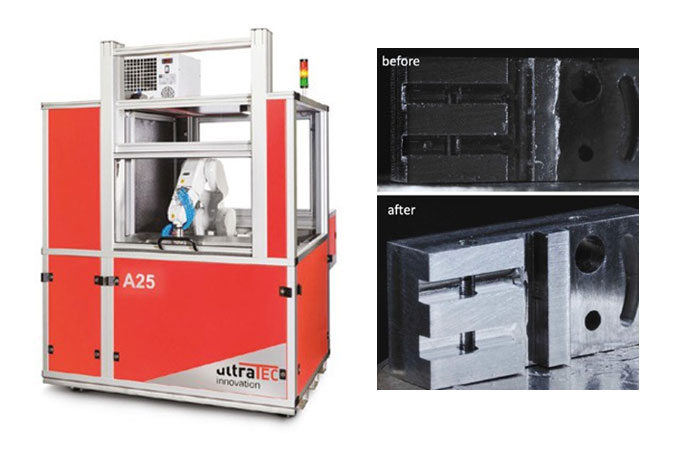
The aerospace industry works with some of the most advanced and challenging materials in manufacturing today. From Titanium and Inconel to Aluminum alloys and Hardened steels, aerospace components demand absolute precision and reliability. In this high-stakes environment, even the smallest burr can compromise safety, performance, and assembly accuracy. Ultrasonic deburring has emerged as a breakthrough solution, enabling manufacturers to achieve validated, burr-free components with unmatched consistency.
The aerospace sector is characterized by its use of diverse and complex materials, each selected to meet stringent requirements for strength, durability, heat resistance, and lightweight performance. Components such as turbine blades, fuel system parts, hydraulic components, and structural elements are often machined from materials like titanium, nickel-based superalloys, stainless steel, and high-strength aluminium.
Traditional deburring methods—manual deburring, brushing, grinding, or thermal processes—often struggle to meet the precision and repeatability required in aerospace manufacturing. Manual processes depend heavily on operator skill and can lead to inconsistent results, while aggressive mechanical methods risk damaging delicate edges or altering critical dimensions. This is where ultrasonic deburring technology is transforming the finishing process.
Ultrasonic deburring uses high-frequency vibrations transmitted through specially designed sonotrodes to remove burrs with extreme precision. Operating at ultrasonic frequencies, these sonotrodes create micro-vibrations that allow controlled material removal at the edge level without damaging the surrounding surfaces. Since the process is non-contact type, the result is a clean, smooth edge that meets stringent aerospace quality standards.
One of the biggest advantages of ultrasonic deburring is its ability to work effectively across a wide range of materials (process is almost material independent)—particularly the difficult-to-machine alloys commonly used in aerospace applications. Whether dealing with tough titanium alloys or hard nickel-based materials, ultrasonic technology ensures precise burr removal while maintaining the integrity of the component. Another key benefit is process validation and repeatability. Aerospace manufacturers must comply with strict quality and certification requirements, including traceability and consistent process outcomes. Ultrasonic deburring systems can be integrated into controlled production environments, ensuring that every component undergoes a validated and repeatable finishing process.
Furthermore, ultrasonic deburring significantly reduces the risk of secondary damage such as edge rounding, scratches, or dimensional distortion—issues that are critical when working with high-precision aerospace parts. The technology also improves productivity by reducing manual intervention and enabling faster processing cycles.
As aerospace designs become more complex and component tolerances tighter, finishing technologies must evolve accordingly. Ultrasonic deburring represents a future-ready solution that aligns perfectly with the industry’s push toward automation, precision manufacturing, and zero-defect production.
In a sector where reliability is paramount and quality cannot be compromised; ultrasonic deburring is proving to be not just an alternative—but the technology of the future for burr-free aerospace parts manufacturing.