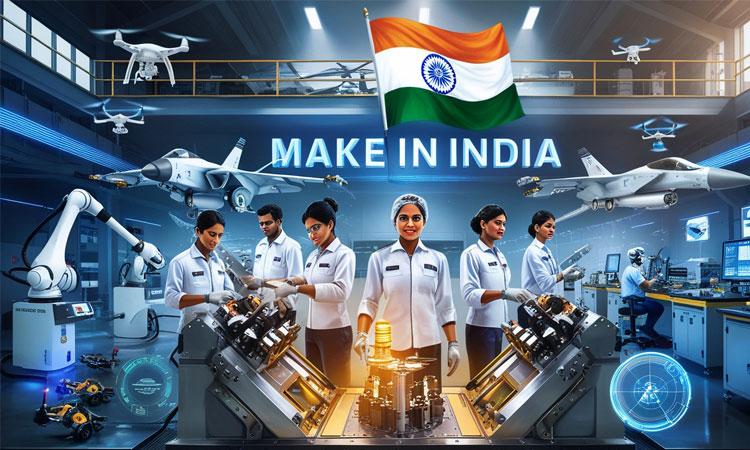
India’s aerospace and defense sectors are experiencing an unprecedented surge, propelled by a potent combination of innovation, indigenization, and strategic investments. Under the “Make in India” initiative, the aerospace manufacturing ecosystem is witnessing remarkable momentum, fueled by global interest, robust government support, and burgeoning local engineering prowess. The country is rapidly cementing its position as a critical node in the global aerospace value chain, with participation ranging from Tier-1 OEMs to over 16,000 MSMEs and advanced tooling suppliers. This article explores the evolving landscape, its key drivers, major players, and the promising trajectory for “Make in India for the Skies.”
The Strategic Imperative Driving Aerospace Manufacturing
The aerospace sector is a cornerstone of national capability, a fact deeply recognized by the Government of India. It has been designated a priority sector under “Make in India” and “Atmanirbhar Bharat” (Self-Reliant India). This strategic focus has led to significant policy reforms, including an increase in the FDI limit in defense manufacturing to 74% under the automatic route (and up to 100% via the government route), the introduction of Production-Linked Incentive (PLI) schemes, and the establishment of dedicated Defense Industrial Corridors (DICs) in Tamil Nadu and Uttar Pradesh.
India’s ambition extends beyond self-reliance; it aims to become a global supplier of aerospace components, subsystems, and even full platforms. With over 500 Indian companies actively involved in aerospace component manufacturing, and numerous foreign OEMs establishing joint ventures and partnerships, the foundation for this aspiration is incredibly solid. The Indian aerospace and defense market was valued at $27.1 billion in 2024 and is projected to reach $54.4 billion by 2033, demonstrating a Compound Annual Growth Rate (CAGR) of 6.99% during this period.
OEMs and Tier-1s: Anchoring the Ecosystem
Global aerospace giants such as Boeing, Airbus, Lockheed Martin, Safran, Rolls-Royce, and GE Aerospace have substantially ramped up their sourcing from India in recent years. Boeing, for instance, has sourced over $1 billion annually from India and collaborates with more than 300 suppliers across Tier-1, Tier-2, and Tier-3 levels.
Hindustan Aeronautics Limited (HAL) remains the bedrock of India’s aerospace manufacturing legacy, boasting an R&D intensity of 9.3%, one of the highest among global and Indian firms, with an R&D expenditure of $301 million in FY23. However, the landscape is diversifying with the emergence of private sector players like Tata Advanced Systems, Mahindra Aerospace, L&T Defence, and Adani Defence & Aerospace. These entities are pivotal in expanding manufacturing capacities and integrating global production standards within India.
Notable collaborations include Tata Boeing Aerospace Limited (TBAL) and Tata Lockheed Martin Aerostructures Ltd. (TLMAL), which are actively producing critical airframe components and fuselages for Apache and C-130 aircraft from Indian facilities. The Tata Aircraft Complex, inaugurated in October 2024 in Vadodara, will further boost indigenous defense by manufacturing 40 C-295 aircraft out of a total of 56.
MSMEs and Suppliers: The Operational Backbone
While OEMs capture headlines, the true operational backbone of the aerospace ecosystem lies with the approximately 16,000 small and mid-sized enterprises (MSMEs). These MSMEs, concentrated in clusters like Bengaluru, Hyderabad, Pune, and Coimbatore, supply a diverse range of products, including precision-machined components, complex sheet metal parts, fasteners, rubber components, castings, and electronics assemblies.
Driven by burgeoning export opportunities and technical collaborations, these MSMEs are rapidly evolving. They are investing heavily in advanced manufacturing capabilities, including 5-axis CNC machines, sophisticated tool management systems, and automation, to meet stringent global quality and traceability standards such as AS9100 and NADCAP. The private sector now contributes 21% to India’s total defense production.
Defence Industrial Corridors: New Engines of Growth
India’s two Defence Industrial Corridors (DICs) in Tamil Nadu and Uttar Pradesh are central to the “Make in India” aerospace vision. As of February 2025, these corridors have attracted investments exceeding ₹8,658 crores ($1.04 billion USD) across their six nodes in Uttar Pradesh (Agra, Aligarh, Chitrakoot, Jhansi, Kanpur, and Lucknow) and five nodes in Tamil Nadu (Chennai, Coimbatore, Hosur, Salem, and Tiruchirappalli). Furthermore, 253 MoUs have been signed, with a potential investment of ₹53,439 crore ($6.4 billion USD). State governments are providing significant incentives, including capital subsidies, concessional land rates, and single-window clearances, transforming these corridors into thriving hubs for advanced manufacturing, R&D, and exports.
Exports on the Rise: India as a Global Supplier
India’s defense exports have experienced an exponential rise, reaching a record high of ₹23,622 crore (approx. $2.76 billion USD) in FY 2024-25. This marks a staggering 34-fold increase in less than a decade, with exports now reaching over 100 countries. Aerospace components, including airframe parts, engine housings, actuators, landing gear assemblies, and avionics modules, constitute a significant portion of this growth. The private sector alone contributed ₹15,233 crore (64.5%) to defense exports in FY 2024-25.
This surge is primarily driven by:
- China+1 Strategy: Western firms are actively diversifying their supply chains away from China, with India emerging as a preferred destination due to its competitive costs and growing capabilities. A PwC and CII survey suggests India offers cost savings of 15-25% in manufacturing activities and an additional 10-20% through local sourcing of raw materials.
- Offset Obligations: Major defense deals with global OEMs increasingly include offset clauses, mandating local sourcing and technology transfer, further bolstering domestic manufacturing.
Skill Development & R&D: Fueling Long-Term Growth
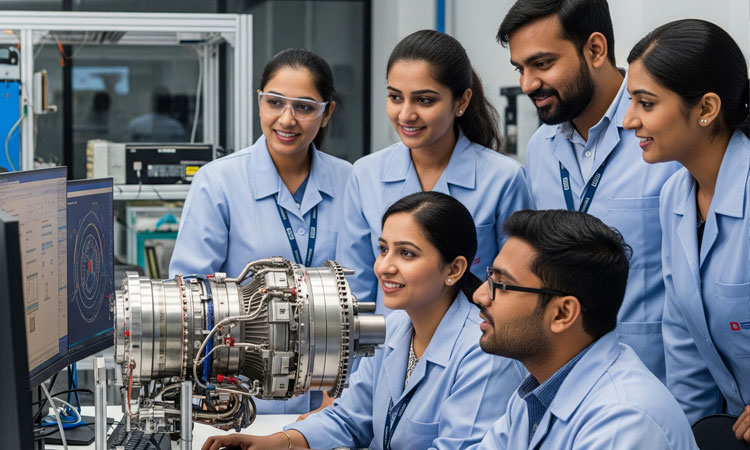
Sustainable aerospace growth hinges on continuous skill enhancement and robust R&D. Institutions like the Gas Turbine Research Establishment (GTRE), various DRDO labs, HAL’s R&D centers, and the Indian Institute of Science (IISc) are collaborating with private players to innovate in propulsion, avionics, composite structures, and 3D printing. The Defence Research and Development Organization (DRDO) received an allocation of ₹23,855 crore ($2.86 billion USD) in FY 2024-25, a slight increase from ₹23,264 crore in FY 2023-24. The Technology Development Fund (TDF) scheme has seen its project budget increase from ₹10 crore to ₹50 crore, aimed at fostering innovation among startups and MSMEs. As of February 2025, the Innovations for Defence Excellence (iDEX) scheme has involved 619 startups and MSMEs, with 430 iDEX contracts signed.
“Skill India” and other government initiatives are cultivating a pipeline of trained engineers and machinists specifically for the aerospace sector. Many aerospace companies are also establishing in-house training academies and simulation labs to impart crucial skills in CNC programming, Geometric Dimensioning & Tolerancing (GD&T), non-destructive testing, and quality assurance.
Addressing the Challenges
Despite this impressive progress, India’s aerospace manufacturing sector faces hurdles:
- Lengthy certification timelines, particularly for military products.
- Limited availability of aerospace-grade raw materials domestically.
- Dependence on imports for high-end machinery and testing systems.
- Need for deeper design and IP ownership across platforms.
Addressing these challenges demands sustained collaboration among government, industry, and academia. Fast-tracking certification processes, incentivizing deeper R&D, and establishing dedicated material parks are crucial steps to further strengthen the ecosystem.
The Road Ahead: From Assembling to Designing Aircraft
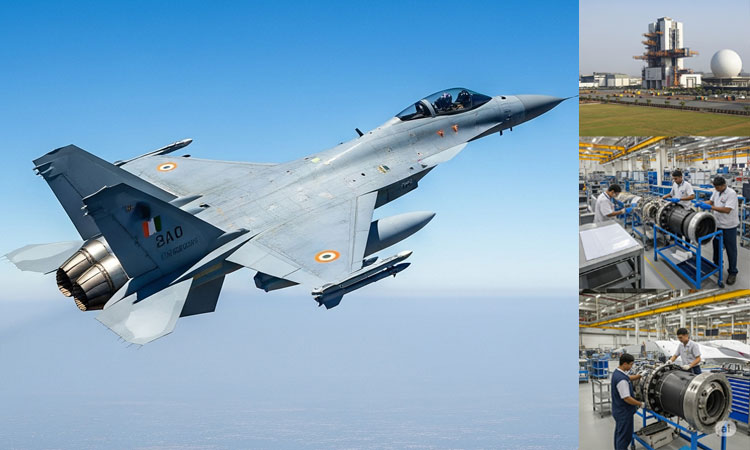
India has definitively proven its capability in assembling and supplying aerospace components. The next ambitious frontier is to evolve into a hub for design-to-delivery aircraft manufacturing. Programs like HAL’s Light Combat Aircraft (LCA) Tejas, the Advanced Medium Combat Aircraft (AMCA) fifth-generation fighter, and DRDO’s Unmanned Aerial Vehicles (UAVs) signal this strategic transition.
India aspires to be among the top 5 aerospace manufacturing nations by 2030, with the Ministry of Defence setting a target of achieving a turnover of $70 billion by 2030 for the aerospace manufacturing sector. The current trajectory, supported by government vision, burgeoning industrial capability, increasing global trust, and a spirit of local innovation, positions India to truly “Make for the Skies.”
From precision-machined engine parts to entire fuselage assemblies, India is rapidly becoming an indispensable player in the global aerospace manufacturing landscape. “Make in India for the Skies” is no longer just a slogan—it’s a dynamic reality, underpinned by progressive policy, expanding production, and an undeniable passion for aeronautical excellence. For the global aerospace and defense community, India is not merely an emerging partner; it is a force poised to lead the future of flight.