Why India’s Tooling Industry Is Entering Its Defining Decade
In the race to become a global manufacturing powerhouse, India’s biggest strength is no longer just its factories—it is the precision tools that build them. As the die & mould industry steps into the spotlight, a ₹3 lakh crore opportunity is beginning to reshape the nation’s industrial future.
In the high-stakes arena of global manufacturing, where speed, precision, and scalability define success, one sector quietly determines the performance of all others—the Die & Mold industry. Often referred to as the “Mother Industry,” tooling forms the foundation upon which automotive, aerospace, electronics, and consumer goods industries are built.
As we step into 2026, this once-overlooked sector in India is undergoing a profound transformation. No longer confined to the shadows of larger industries, it is now emerging as a central pillar of the country’s “Make in India 2.0” vision, backed by strong policy support, global demand shifts, and rapid technological evolution.
What lies ahead is not just growth—it is a defining decade. A decade that could see India’s tooling industry scale from a $20 billion market to a staggering ₹3 lakh crore ($37.7 billion) opportunity by 2034.
From Supporting Role to Strategic Driver
For decades, India’s tooling sector functioned as a backend enabler—critical, yet under-recognized. Toolrooms were often seen as job shops, operating in fragmented clusters with limited access to advanced technology.
That narrative is now changing—fast.
Today, tooling is no longer just about manufacturing molds; it is about enabling manufacturing ecosystems. Every new product launch, every production line expansion, every innovation in design begins with a tool. And as industries push for faster product cycles and higher precision, the importance of tooling has moved from operational necessity to strategic priority.
The numbers reflect this shift. The Indian tooling market, valued at over $20 billion, is currently growing at over 10% annually, signaling strong and sustained momentum.
A Market on the Brink of Transformation
The scale of the opportunity ahead is unprecedented. By 2034, the industry is expected to nearly double in size, driven by both domestic demand and global supply chain realignment.
Three structural shifts are powering this transformation:
- Rising Domestic Consumption: India’s expanding middle class and industrial base are fueling demand across automotive, electronics, and consumer goods sectors.
- Import Substitution: Nearly 34% of tooling demand is still met through imports, representing a massive opportunity for domestic manufacturers to capture value locally.
- Regional Specialization: Western India continues to dominate with strong automotive tooling capabilities, while Southern India is rapidly emerging as a hub for high-precision aerospace and electronics tooling.
This combination of scale, demand, and specialization is creating a robust and self-sustaining ecosystem.
The China Plus One Advantage
One of the most significant tailwinds for India’s tooling industry is the global shift toward supply chain diversification.
The “China Plus One” strategy—once a cautious boardroom discussion—has now become a full-scale industrial movement. Global OEMs are actively reducing their dependence on a single geography, and India has emerged as the most viable alternative.
This shift is creating multiple advantages:
- Increased Global Orders: International companies are sourcing tools from India to ensure supply chain resilience.
- Reduced Lead Times: Localization has already led to a 15% reduction in delivery timelines.
- Infrastructure Investments: Industrial corridors in Pune, Chennai, and Gujarat are witnessing significant investments from global logistics and manufacturing players.
India is no longer competing only on cost—it is competing on reliability, capability, and speed.
Export Potential: From Local to Global
A defining feature of this decade is India’s transition from a domestic-focused tooling market to a global export hub.
Indian toolmakers are increasingly delivering European-level precision at highly competitive costs, creating a compelling value proposition.
Key export drivers include:
- Micro-molds for medical devices
- High-cavity molds for electronics
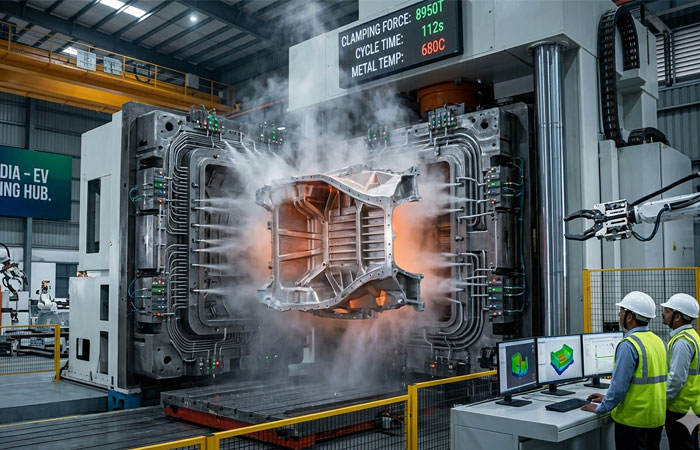
- Giga-casting dies for the EV industry
Additionally, global collaborations and technology partnerships are helping Indian toolrooms align with international standards, strengthening their credibility in export markets.
The MSME Backbone and the Rise of Mega Toolrooms
The Indian tooling ecosystem is unique—a blend of agility and scale.
On one side are thousands of MSME toolrooms, known for their flexibility, quick turnaround, and ability to handle complex, low-volume jobs. They form the backbone of the industry.
On the other side are large, integrated toolrooms within major industrial groups, driving investments in advanced technologies like:
- Giga-casting
- Semiconductor tooling
- Aerospace-grade precision manufacturing
Government initiatives, including dedicated toolroom training centers, are further strengthening this ecosystem by producing a steady pipeline of skilled talent.
However, challenges remain—particularly in access to capital for advanced machinery and software. Bridging this gap will be critical to sustaining growth.
Technology: The Real Differentiator
What truly defines India’s tooling decade is not just scale, but sophistication.
The industry is rapidly embracing Industry 4.0 technologies, transforming traditional toolrooms into smart manufacturing hubs.
Key innovations include:
- Digital Twins & Simulation: Reducing trial cycles and improving accuracy
- Smart Molds: Embedded sensors enabling predictive maintenance
- Additive Manufacturing: Conformal cooling through 3D-printed inserts
These advancements are not just improving efficiency—they are redefining what Indian toolmakers are capable of delivering on a global stage.
PLI: The Catalyst Behind the Surge
Government policy has played a pivotal role in accelerating this transformation.
The Production Linked Incentive (PLI) scheme, with an outlay of over ₹1.9 lakh crore, has triggered massive investments across sectors like electronics and automotive.
The impact on tooling has been direct and significant:
- A sharp decline in mobile imports, replaced by domestic production
- Increased demand for high-precision injection molds
- Rapid shift toward EV tooling, including battery and motor components
This policy-driven demand is creating long-term visibility and stability for toolmakers.
A Future Forged in Precision
India’s tooling industry is no longer an invisible enabler—it is a visible force shaping the future of manufacturing.
The ₹3 lakh crore opportunity is more than a projection; it is a reflection of a sector that has evolved in capability, confidence, and global relevance.
As the industry moves forward, the focus will shift from cost advantage to value creation, from volume to precision, and from local supply to global leadership.
Because in the end, every great product begins with a tool—and in this decade, India is learning not just to use them, but to lead the world in making them.