The real power of modern connectivity is in the parts that you can’t see in every router, smartphone, and base station. Precision machining turns ideas into reliable hardware. Because of the need for higher operating frequencies, extreme miniaturization, and huge volumes, machine shops have to quickly improve their capabilities. Suppliers around the world are putting more emphasis on automation and hybrid processes. In India, on the other hand, policy incentives are helping the country quickly grow its component ecosystem. This is an analysis of the trends that are affecting component machining. It focuses on global movements and India’s unique position, and it explains why these trends are so important for manufacturers.
In the last five years, both the required scale and precision have grown very quickly. Component makers now have to make smaller, more precise parts—important for RF modules, connectors, micro-mechanisms, and semiconductor packaging—while also delivering them in large quantities and at low prices. This complicated mix is driving different machining trends, such as a focus on ultra-precision micromachining, the use of hybrid manufacturing (which combines additive and subtractive methods), widespread automation in Industry 4.0, ongoing innovation in materials and tools, and tighter integration of metrology.
The Push for Sub-Micron Accuracy
Micromachining and ultra-precision processes are now very important to the industry. RF filters, MEMS, connector pins, and high-density interconnects now need tolerances in the single-digit micron range and surface finishes that traditional toolpaths can’t always get right. Now, advanced shops often use specialized micro-endmills, diamond tools, laser micro-machining, and focused ion beam/EDM refinements. This niche market is growing quickly, which is directly related to the trend of making electronics smaller.
Hybrid manufacturing is a useful way to deal with complicated shapes and material limits. It combines additive deposition to make near-net shapes with precision milling or grinding. For telecom hardware, where weight, signal integrity, and thermal paths are very important, hybrid techniques cut down on wasted material and machining cycles by a lot. Most importantly, they make it possible to make complicated shapes that were either impossible or too expensive to make before. Finishing steps that use lasers and micro-EDM help make sure that the surface quality and shape meet strict electrical standards.
Digital Integration and Automation
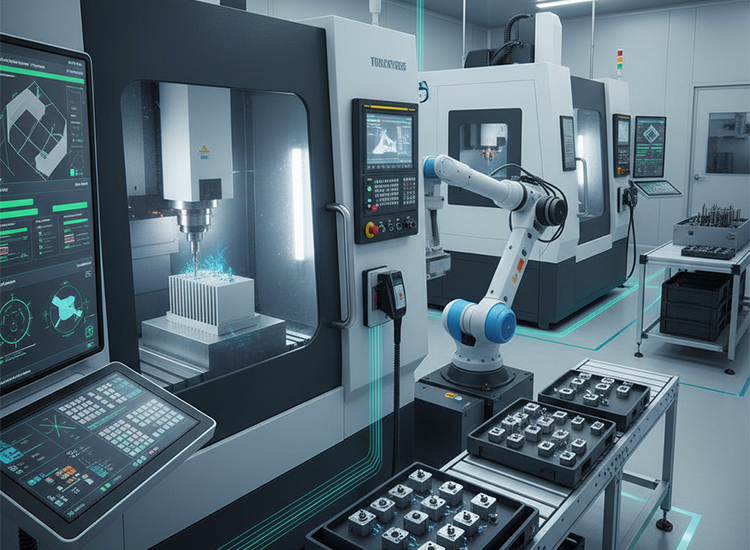
Automation and smart shops have gone from being ideas to things that people are putting money into. Automated tool-changing, pallet systems, machine-tending robots, and in-line metrology all help to speed up the process and reduce the chance of human error. This is very important for the telecom industry, which makes a lot of different types of parts in small quantities. Digital twins, inline sensors, and predictive maintenance are also very helpful in cutting down on unplanned downtime. This is especially important because many telecom parts now have shorter product cycles and more product variants. These investments in automation also make it easier for Indian manufacturers to quickly meet international quality standards, which gives them an edge over their competitors when it comes to export contracts.
Innovation in materials and tools is changing the rules of production in a big way. To make advanced high-frequency telecom PCBs, RF ceramics, special copper alloys for connectors, and different 5G substrates, you need new ways to cut and cool the materials so that they don’t get too hot, get burrs, or stick together. New coatings, cryogenic machining methods, and special coolants are making tools last longer and keeping micro-features stable, which lowers the cost per part even as precision needs grow.
Metrology’s most important change is that it has gone from being a final inspection to an integrated measurement system that works during the process. Optical profilers, scanning interferometers, and CT scanning for complex assemblies are all tools that give engineers immediate feedback. This closes the loop between design, machining, and testing. Rapid, in-process metrology prevents entire batches from being scrapped for telecom modules, where even small changes can hurt signal quality. This saves a lot of money.
The global manufacturing context and the dynamics of each country
The global electronics market is huge, worth about $4.3 trillion. The Asia Pacific region is the biggest player in the electronic components market, with over 50% of the global share. China, Japan, South Korea, and Taiwan are the biggest manufacturers, making up about 60% of the world’s electronics output. The global semiconductor market, which is the most important part of all electronics, is expected to reach an all-time high of about $697 billion in 2025 and is on track to reach $1 trillion by 2030. The speed of 5G, AI, and edge-compute rollouts is driving this growth, and all of these technologies need very precise parts.
India’s Strategic Momentum: India’s electronics production has seen a huge increase, going from about $37 billion in 2015–16 to $115 billion in 2023–24, with the goal of tripling this amount by 2025–26. The government’s Production Linked Incentive (PLI) programs are very important. For example, the Electronics Component Manufacturing Scheme (ECMS) got investment proposals of more than ₹1.15 lakh crore (about $13 billion), which is almost twice what they were hoping for. This shows that investors have a lot of faith in the plan and want to add more value to Indian products in areas like SMD passives and flexible PCBs. India is now the second-largest maker of mobile phones in the world.
That surge gives Indian precision shops a real chance. There is more demand for PCBs, RF modules, connectors, and small mechanical parts in India, and brands want shorter lead times and a more stable supply chain. Indian suppliers that put money into micromachining, automation, and metrology can get more valuable assembly work instead of just low-margin, labor-intensive jobs. The arrival of global OEMs (original equipment manufacturers), such as smartphone and telecom equipment assemblers, working with Indian component makers speeds up the transfer of technology and the adoption of standards.
Lingering Problems and the Way Ahead There are still problems. There isn’t much training available for micro-machining skills, and the equipment needed for automation and clean rooms is expensive. Smaller shops may also have trouble getting the certifications and traceability that telecom and defense customers need. Another axis is sustainability. To meet corporate and regulatory expectations, precision machining needs to use less water, produce less waste from exotic coolants, and use less energy.
Shops and OEMs should invest selectively in micromachining and metrology first (these improve quality right away), test hybrid processes on complex parts, work with tooling and coolant suppliers to cut down on trial time, and build modular automation cells that grow with order volume. Focused training programs and shared metrology and clean-room facilities can help MSMEs get started and make clusters more competitive.
To put it another way, “milling and drilling” is no longer enough to make electronic and telecom parts. It’s a mix of materials science, precision mechanics, smart automation, and deep metrology. India’s policy changes and rising demand at home have created a unique opportunity: stores that quickly adapt to micro-precision, hybrid methods, and digital workflows can move up the value chain and connect to global telecom and electronics supply networks, turning small, precise parts into big business opportunities.