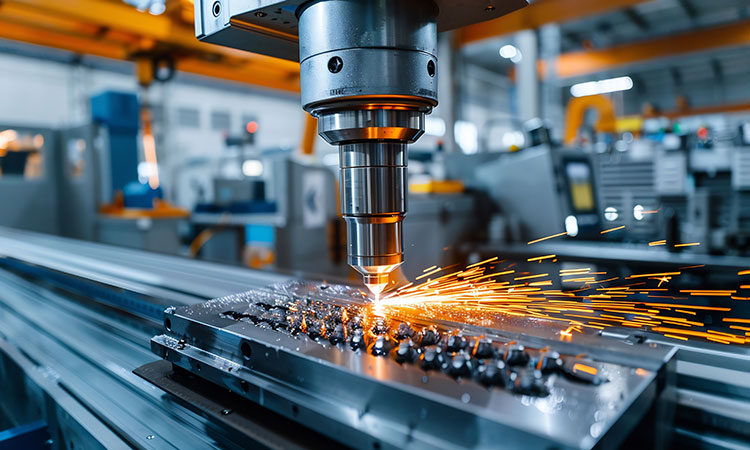
The year 2025 was a big turning point for the global machining and metal-cutting business. Machine shops and manufacturing companies around the world are no longer happy to only buy capital equipment; they are now actively adopting new technologies. This big change—caused by the coming together of targeted automation, the purposeful reshoring of important supply chains, and a strong focus on getting the most out of each worker—has permanently changed the way businesses compete.
This new definition has not been the same for everyone. Instead, it has made the geography of growth very uneven: big, mature markets are stabilizing, China is combining its huge size with selective technological sophistication, and new industrial powerhouses like India are adopting technology faster than ever. This paper breaks down the most important country-level changes and technology trends that will influence 2025. It gives a full picture of what these signals mean for machine-tool demand, investment strategies, and the future of global industrial rivalry.
The $100 Billion Capability Play in the Global Market
It is strongly believed that the global market for machine tools would be worth between $80 billion and $107 billion in 2025. This high valuation is due to a mix of high-value demand centered on advanced manufacturing needs. The market is aggressively pursuing high-precision metal-cutting systems, multi-axis mills, and advanced CNC retrofits that are expressly designed to allow for “lights-out” (unattended) manufacturing.
The scale of the market is due to two things: the ongoing need to replace old machines in established, mature manufacturing economies and the large number of new installations in quickly growing global manufacturing hubs. Suppliers are now less concerned with volume and more concerned with providing integrated capability, system reliability, and measurable productivity gains that make the extra cost worth it.
Growth by Country and Region
In 2025, the investment climates in important manufacturing countries are very different from each other because of the different industries and geopolitical agendas in those countries.
China: Size Meets Selective Sophistication
China retained its position as the undisputed single largest market for machine tools in 2025, accounting for approximately one-third of global consumption and production. Its long-lasting dominance is based on its huge and complicated domestic manufacturing base, which includes everything from traditional car parts to huge consumer electronics production to the rapidly growing EV drivetrain sector.
But the story of growth is changing from just adding up numbers. While consumption remains strong, a greater share of capital expenditure is targeting intelligent, high-end equipment—including high-speed spindles, integrated probing systems, and advanced automation cells—rather than solely low-cost capacity expansion. This complicated, mixed pattern makes global suppliers keep two product strategies for China: one that carefully balances competitive cost structures with cutting-edge automation capabilities that are made for this huge, complex market.
Japan: Accuracy and the Return of Capex Cycles
Japan showed clear signs of renewed strength in 2025, as orders for machine tools steadily rose from the lows seen in the previous years. Strong demand from Japan’s high-precision industries, such as aerospace, medical devices, and particularly specialized automobile parts, has been the main driver of the recovery. This demand stream sent Japanese machine builders higher-value orders and big export opportunities. The Japan Machine Tool Builders’ Association (JMTBA) said that data through the middle of 2025 showed that monthly order numbers were steadily rising. This meant that the country’s important capital investment cycles were effectively re-synchronizing with targeted, high-value global demand pockets.
Germany: Automation Prowess Amidst Domestic Softness
Germany’s machine-tool industry remains the global benchmark for high-value automation, engineering excellence, and complex factory-integration systems. Yet, 2025 presented another year of mixed overall performance. Domestic orders were notably sluggish, reflecting a broader caution and underlying weakness in European capital spending. On the other hand, there were strong pockets of demand in defense, automation-specific projects, and some export sectors. Because of this, German builders are quickly changing direction and focusing more on turnkey automation solutions, profitable software-enabled service contracts, and advanced digital after-sales services to make up for the weakness in the house market. In 2025, VDW’s report confirmed that overall production had gone down, but it also said that the international order intake was starting to improve.
United States: Modernization and the Reshoring Imperative
In the United States, the investment thesis for 2025 was fully concentrated on modernization and the strategic reshoring of higher-value manufacturing capacity. Policy-driven government incentives, paired with strong corporate measures targeted at securing vital supply chains (especially for semiconductors and strategic components), translated immediately into new machine investments. These investments heavily favored sophisticated systems—especially vertical machining centers used in high-specification aerospace and defense applications, alongside advanced EV components. American consumption in 2025 was less about obtaining sheer unit levels and more on deploying highly complex, adaptable high-mix/low-volume manufacturing cells and the rapid adoption of additive-hybrid manufacturing systems.
India: The Fastest-Growing Adopter
India’s machine-tool market emerged as arguably the fastest-growing adopter internationally in 2025. Analysts predict robust double-digit adoption rates to continue throughout the decade, spurred by the aggressive expansion of local OEMs and the national quest of self-reliance across crucial sectors including automotive, rail, defense, and medical equipment. Reports placed India’s 2024 market worth near USD 1.6–1.7 billion, with robust Compound Annual Growth Rate (CAGR) predicted well into the 2030s. The expansion is driven by rising automation uptake, a fast expanding domestic supplier base, and a favorable policy climate that actively stimulates private capital investment. India is now a must-win market for international suppliers, which means they need to put a lot of money into building localized service networks and flexible financing options.
Trending Analytics: The Automation-First Procurement Model
Analysis of buyer behavior in 2025 suggests a major shift in procurement criteria, moving sharply away from stand-alone devices toward integrated, productivity-centric solutions:
Automation-First Buys: End users are selecting fully integrated machining cells complete with robot tending, automated palletizing, and proactive tool-monitoring systems. This strategy immediately meets the major aims of reducing necessary headcount per shop floor and simultaneously maximizing throughput per operator.
NC and Multitasking Machines: Demand for advanced CNC (Computer Numerical Control) systems and sophisticated multitasking machines (particularly turn-mill and mill-turn centers) has soared. This reflects the industry-wide drive to condense operating phases and substantially reduce work-in-process (WIP) inventory.
Digital Twins and OEE Analytics: Digitalization is now a standard requirement. It is now expected that any new machine package would come with retrofit sensor packs, digital-twin simulation capabilities, and OEE (Overall Equipment Effectiveness) dashboards. Buyers are increasingly analyzing the whole-line productivity uplift, rather than simply focusing on abstract indicators like spindle speed.
Material-Driven Investment: The shift toward processing advanced and complex alloys—such as high-strength steels and Nickel-based superalloys in the aerospace and energy sectors—is necessitating new investments in robust toolholders, advanced coolant delivery systems, and highly wear-resistant tooling.
Sustainability as a Procurement Criteria: For large OEMs and Tier-1 suppliers, the environmental impact has become a real concern. Energy efficiency, water usage, and the recyclability of cutting fluids now formally affect significant purchase decisions, underlining a commitment to green manufacturing principles.
Risks and the Path to Opportunity
The worldwide machining sector faces macro concerns, including potentially tightening lending conditions in certain economies and growing geopolitical frictions that usually disrupt cross-border supply networks.
However, the opportunities for forward-looking participants greatly outweigh these dangers. Suppliers that successfully pivot to offer integrated solutions (combining machines with software, innovative financing, and strong local service) are getting a bigger “share of wallet.” For machine shops, the way to stay competitive in the long run in 2025 is to focus on capabilities, which means mastering automation, data-driven maintenance protocols, and the use of flexible, quickly reconfigurable manufacturing cells.
Capability Over Count
The machining scene of 2025 is fundamentally less concerned with the total count of machines sold and intensively focused on the capability, intelligence, and productivity delivered each machine. The differences in performance between countries are due to the makeup of their local industries. For example, China’s unmatched size, Japan’s focus on high-end precision, Germany’s expertise in automation, the US’s strategic reshoring momentum, and India’s fast, dynamic capacity building.
For equipment makers and buyers in all of these areas, the best strategy is the same: offer demonstrable, lifetime productivity increases, full lifecycle servicing, and software-enabled value that leads to quick, compelling Return on Investment (ROI). The machine tools bought and deployed in 2025 are considerably more than basic metal-cutting instruments; they are the complex, integrated engines that are actively powering the building of a smarter, more robust global industrial environment.