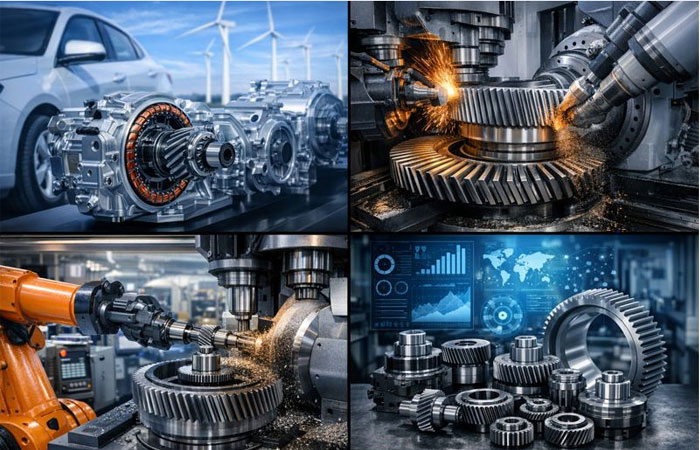
The global gearbox market is undergoing a structural transformation driven by electrification, renewable energy expansion, and rapid automation across industries. In 2024, the global gearbox and transmission market was valued at an estimated USD 30–32 billion, with projections indicating a 4–6% CAGR through 2030. This growth is not uniform: it is being reshaped by changing end-use requirements, new performance benchmarks, and—critically—by how manufacturers invest in machine tools and manufacturing technologies.
Global and Indian Market Snapshot
China dominates the global gearbox demand landscape, accounting for over 30–35% of global consumption, driven by its massive automotive output and leadership in wind energy installations. Europe, led by Germany, contributes roughly 20–22%, with a strong focus on high-precision, low-noise gearboxes for premium automotive and industrial automation. North America holds around 18–20%, supported by heavy engineering, off-highway vehicles, and wind power.
India is the fastest-growing gearbox market among major economies. The Indian gearbox market crossed USD 12 billion in 2024 and is expected to grow at 8–9% CAGR through the end of the decade. Key drivers include rising vehicle production, government-led renewable energy targets, and the “Make in India” push for localized manufacturing of power transmission components.
Demand Drivers Reshaping Gearbox Manufacturing
Automotive and EVs:
Automotive remains the largest gearbox consumer, but its character is changing rapidly. Conventional multi-speed transmissions for internal combustion vehicles are gradually giving way to single-speed and two-speed e-drive gearboxes for EVs. While EV gearboxes are mechanically simpler, they demand much tighter tolerances, superior surface finish, and extremely low noise levels due to the absence of engine masking noise. Global EV sales crossed 14 million units in 2023, and by 2030, EVs are expected to account for over 40% of new vehicle sales, dramatically altering gearbox design and manufacturing priorities.
Wind Energy:
Wind turbine gearboxes are among the most demanding mechanical systems, often operating under variable loads for 20–25 years. With annual global wind installations exceeding 110 GW, demand for large, high-torque gearboxes remains strong. India alone targets 140 GW of wind capacity by 2030, ensuring sustained demand for both new gearboxes and refurbishment machining.
Robotics and Automation:
Industrial robots, cobots, and automation systems rely on compact, high-precision gear units such as planetary and harmonic drives. Though smaller in market value, this segment commands premium margins and drives innovation in micro-machining and ultra-precision manufacturing.
Heavy Engineering:
Mining, construction, steel, and cement sectors continue to require robust, large-module gearboxes. Infrastructure spending globally—especially in India, Southeast Asia, and the Middle East—keeps this segment stable and investment-heavy.
Shift Toward High-Efficiency, Low-Noise, Compact Gearboxes
Across all segments, the industry is converging toward three design imperatives:
- Higher efficiency to reduce energy losses and meet sustainability norms
- Lower noise and vibration (NVH), especially critical for EVs and robotics
- Compact and lightweight designs that improve power density
This shift is driving widespread adoption of advanced gear profiles, hardened and ground gears, integrated housings, and optimized lubrication systems. Digital simulation and closed-loop quality control are now integral to gearbox development.
Impact on the Machine Tool Buying Market
This gearbox evolution is having a direct and measurable impact on machine tool investments worldwide.
- Rising Demand for Gear-Specific Machine Tools
Manufacturers are increasing investments in gear hobbing, shaping, skiving, and grinding machines capable of micron-level accuracy. Hard gear machining and finishing are seeing strong growth, pushing demand for high-stiffness CNC gear grinders and skiving centers. - Growth of 5-Axis and Multi-Tasking Machines
Compact gearbox designs and integrated housings require complex machining in fewer setups. As a result, 5-axis machining centers and mill-turn machines are becoming standard purchases rather than premium options. - Automation as a Default Requirement
High-volume EV and automotive gearbox production is accelerating adoption of robotic loading, pallet systems, and flexible manufacturing cells. Machine tool buyers increasingly evaluate automation readiness alongside cutting performance, driving higher average order values per installation. - Metrology-Driven Machine Selection
Low-noise gearbox requirements have elevated the role of in-process measurement, gear inspection systems, and closed-loop correction. Machine tools compatible with digital metrology integration are gaining preference. - Shift in Capital Spending Patterns
While EV gearboxes reduce component count, the precision requirement increases capital intensity per machine. Globally, machine tool builders report that gearbox-related projects now favor fewer but more advanced machines, often costing 20–30% more per unit than conventional setups. - India as a Strategic Buying Market
India is emerging as a key destination for machine tool investments linked to gearbox manufacturing. Local gearbox producers and Tier-1 suppliers are actively upgrading from conventional machines to CNC gear cutting, grinding, and automated lines, creating strong demand for both imported and domestically manufactured machine tools.
The gearbox market’s transition toward efficiency, silence, and compactness is fundamentally redefining manufacturing economics. For machine tool builders and suppliers, this represents a long-term demand cycle driven not by volume alone, but by precision, automation, and digital capability. As EVs, wind energy, and robotics scale further, gearbox machining will remain one of the most influential demand generators for advanced machine tools worldwide—particularly in fast-growing markets like India.