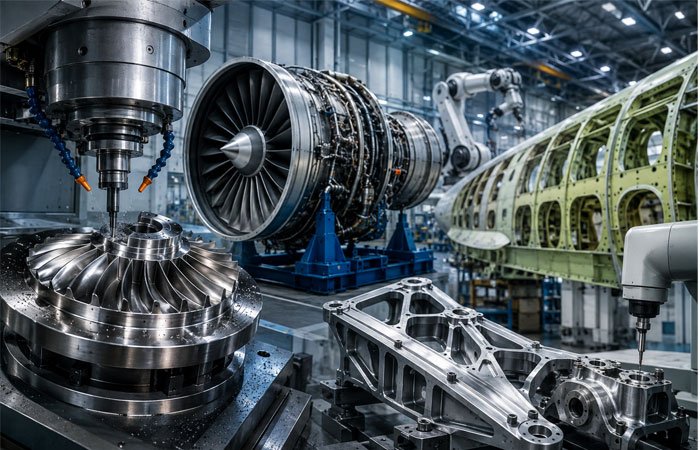
India’s aerospace manufacturing industry is entering a defining decade. For years, the country was recognized primarily as a supplier of sheet metal parts, brackets, machined fittings and assembly support for global aerospace programs. Today, that narrative is rapidly changing. India is steadily progressing towards manufacturing some of the world’s most sophisticated aerospace components—including turbine engine parts, monolithic structural airframes, landing gear components and complex titanium assemblies.
The transformation is being driven by unprecedented commercial aircraft demand, government-backed defence programmes, global supply chain diversification and the rapid maturity of India’s precision machining ecosystem.
With Indian airlines placing orders for more than 1,500 commercial aircraft and global OEMs expanding their manufacturing footprint in India, the opportunity extends far beyond aviation. It is creating tremendous business potential for machine tool manufacturers, cutting tool companies, tooling solution providers, metrology specialists, coolant suppliers, automation companies and digital manufacturing solution providers.
Demand is Creating a New Aerospace Manufacturing Economy
scale of future demand is extraordinary. India’s aircraft component market, valued at nearly US$17.3 billion in 2025, is projected to exceed US$31 billion by 2034. Simultaneously, the country’s precision machining market is expected to more than double from US$7.35 billion in 2026 to approximately US$16.6 billion by 2033, growing at over 12% CAGR.
Nearly 88% of this precision machining market is CNC-driven, highlighting how advanced machining technologies have become the backbone of India’s manufacturing competitiveness.
The recent fleet expansion plans announced by major Indian airlines have created long-term visibility for suppliers. Large engine procurement programmes, particularly for next-generation fuel-efficient engines, are encouraging global manufacturers to localize production and establish stronger partnerships with Indian machining companies.
For India’s manufacturing sector, this represents more than additional production—it marks the beginning of an ecosystem capable of producing globally certified aerospace hardware.
Aerospace Machining is Unlike Conventional Engineering
Unlike automotive production, aerospace manufacturing allows virtually no margin for error.
Aircraft engine components operate under temperatures exceeding 1,000°C while rotating at extremely high speeds. Structural airframe components must deliver maximum strength with minimum weight while enduring millions of fatigue cycles throughout an aircraft’s operational life.
These requirements demand machining accuracies measured in microns.
Materials such as Titanium Ti-6Al-4V, Inconel, Waspaloy, Rene alloys, and other nickel-based superalloys have become standard aerospace materials because of their exceptional strength-to-weight ratio and heat resistance. However, they are also among the most difficult materials to machine.
High cutting temperatures, work hardening, rapid tool wear, built-up edge formation and vibration make aerospace machining one of the most technically demanding manufacturing disciplines.
Success depends not only on sophisticated CNC machines but also on optimized tooling strategies, coolant technologies, process stability and continuous in-process inspection.
Multi-Axis Machining is Becoming the Industry Standard
One of the biggest technological shifts in Indian aerospace manufacturing is the widespread adoption of 5-axis machining centres and mill-turn platforms.
Complex components such as:
- Compressor blades
- Blisks
- Impellers
- Structural wing ribs
- Landing gear housings
- Bulkheads
- Floor beams
can now be machined in a single setup.
Reducing multiple setups dramatically improves positional accuracy while minimizing tolerance stack-up, improving productivity and reducing inspection time.
Machine tool builders are also integrating automatic pallet systems, robotic loading, tool monitoring and adaptive machining software, enabling lights-out manufacturing for repeat aerospace production.
For machine tool manufacturers, this creates significant opportunities to supply high-rigidity machining centres capable of handling titanium and superalloy machining with exceptional thermal stability.
Machining More by Removing Less
Modern aircraft design increasingly relies on monolithic structures rather than assembled components.
Instead of joining multiple fabricated parts, manufacturers machine complete structural members from a single forging.
Wing spars, fuselage frames and floor structures often require removing up to 90% of the original billet material while maintaining extremely tight dimensional tolerances.
This presents several machining challenges:
- Managing heat generation
- Avoiding part distortion
- Controlling residual stresses
- Maintaining vibration stability during long machining cycles
- Maximizing spindle utilization
Advanced CAM software, high-speed machining strategies and optimized cutting tool geometries are becoming indispensable for achieving these objectives.
Hybrid Manufacturing is Opening New Design Possibilities
The aerospace industry is also embracing hybrid manufacturing, combining additive manufacturing with precision CNC finishing.
Complex engine components are increasingly produced through metal additive manufacturing before undergoing finish machining to achieve aerospace-grade dimensional accuracy and surface integrity.
This approach enables:
- Internal cooling channels
- Lightweight lattice structures
- Reduced material waste
- Faster prototype development
- Lower buy-to-fly ratios
For Indian machine shops, hybrid manufacturing represents an opportunity to enter high-value aerospace programmes where conventional machining alone would be insufficient.
Digital Manufacturing Will Differentiate Future Suppliers
Perhaps the most significant transformation is not occurring inside the spindle—it is happening inside software.
Leading aerospace manufacturers are implementing Industry 4.0-enabled smart factories, where every machining process is digitally connected.
Digital twins allow engineers to simulate machining operations before production begins, predicting thermal deformation, tool deflection, chatter and machining dynamics.
Real-time machine monitoring continuously tracks:
- Spindle loads
- Tool wear
- Vibration
- Coolant performance
- Energy consumption
- Surface quality
Artificial Intelligence is increasingly being used to optimize cutting parameters automatically, extending tool life while improving consistency.
For aerospace production, where a single rejected component may represent thousands of dollars in material and machining costs, predictive manufacturing offers a major competitive advantage.
Building the Complete Aerospace Manufacturing Ecosystem
India’s aerospace ambitions extend well beyond machining alone.
Global OEMs are collaborating with Indian manufacturers to localize production of engine components, aerostructures, precision assemblies and maintenance infrastructure.
This ecosystem creates opportunities across the manufacturing value chain, including:
- Advanced CNC machine tools
- Cutting tools and tool holding systems
- High-pressure coolant technologies
- Coordinate Measuring Machines (CMM)
- Optical metrology
- Non-destructive testing (NDT)
- Industrial automation
- CAD/CAM software
- Digital manufacturing platforms
- Industrial lubricants and filtration systems
Every successful aerospace machining facility requires an integrated technology ecosystem rather than isolated manufacturing equipment.
Challenges That Must Be Addressed
Despite remarkable progress, several structural challenges remain.
India still imports a significant portion of aerospace-grade titanium, nickel-based superalloys and certified forgings. Developing domestic material production capabilities will be critical for supply chain resilience.
Equally important is strengthening the precision engineering workforce. Aerospace machining demands expertise in CNC programming, GD&T, cutting dynamics, metallurgy, quality systems and international certifications such as AS9100.
Investment in metrology infrastructure also remains essential. Aerospace quality is validated as much by measurement as by machining, making advanced inspection systems indispensable for global competitiveness.
The Road Ahead
India’s aerospace machining industry is no longer competing solely on labour cost—it is increasingly competing on engineering capability, process reliability and technological sophistication.
As global aerospace manufacturers diversify their supply chains, India has a unique opportunity to position itself as a trusted destination for high-value precision manufacturing.
For the machine tool industry, this evolution represents one of the largest growth opportunities of the coming decade. Demand for rigid multi-axis machining centres, intelligent automation, digital manufacturing software, advanced cutting tools and precision metrology will continue to accelerate as aerospace production expands.
The future of aerospace manufacturing will belong to companies that combine precision engineering with digital intelligence, advanced materials expertise and world-class quality systems.
India has already begun that journey. The next chapter is not about assembling aircraft components—it is about engineering the critical parts that keep the world’s aircraft safely in flight.