




From automotive transmissions and industrial automation to wind turbines, aerospace systems and electric mobility, gears and gearboxes remain fundamental to modern manufacturing. As global industries demand higher efficiency, greater reliability and improved power transmission, advanced machining technologies are transforming how the world designs and manufactures precision gears.
Gears may be among the oldest mechanical components, but their manufacturing is becoming increasingly sophisticated. Every tooth profile, surface finish, pitch accuracy and dimensional tolerance can influence noise, vibration, efficiency, load-bearing capacity and service life.
Today, the gear and gearbox industry stands at the intersection of precision engineering, automation, digital manufacturing and energy transition. Countries with established automotive industries, advanced machine-tool capabilities and strong industrial supply chains are competing to deliver more accurate, durable and efficient transmission systems.
For gear manufacturers, the challenge is no longer simply producing gears. It is manufacturing them faster, more consistently and at a competitive cost—while meeting increasingly demanding performance specifications.
A Multibillion-Dollar Global Trade Opportunity
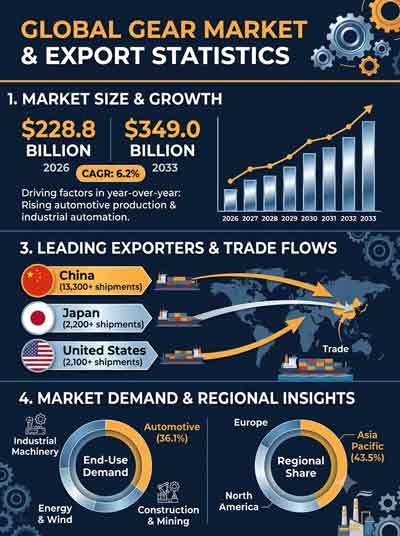
International trade figures underline the scale of the industry. According to World Bank World Integrated Trade Solution (WITS) data based on UN Comtrade, global suppliers are competing across both finished transmission components and the specialised machinery required to manufacture them.
In 2024, Germany exported approximately US$3.42 billion worth of products under HS code 848340, covering gears, gearing, ball screws, gearboxes and speed changers. China recorded approximately US$3.40 billion, followed by the United States at US$2.20 billion, Italy at US$2.14 billion and Japan at US$1.49 billion. These figures demonstrate the strength of established engineering economies and China’s growing manufacturing presence.
It is important to note that HS code 848340 covers a broader product category than gears and gearboxes alone. These trade values therefore indicate the scale of the relevant power-transmission market, rather than the standalone size of the global gear-machining industry.
The opportunity extends beyond components to the machine tools used to produce them. Germany exported approximately US$632 million in gear-cutting, gear-grinding and gear-finishing machinery in 2024, making it the leading national exporter in this category. Switzerland followed at approximately US$211 million, while Japan recorded US$121 million.
These figures reveal an important industry dynamic: the global race for transmission performance is also a race for advanced manufacturing technology.
Country-Wise Industry Outlook: Where The Opportunities Lie
 China: Scale, Speed and Manufacturing Competitiveness
China has established itself as a major force in global gear and gearbox manufacturing, supported by its extensive automotive, industrial machinery, electric vehicle and automation sectors.
In 2024, China exported approximately US$3.40 billion under HS code 848340. India was its largest destination among the countries listed in the trade data, accounting for approximately US$437 million in exports from China.
The country’s manufacturing ecosystem benefits from large production volumes, extensive supplier networks and growing demand for precision transmission systems. Its electric vehicle industry is also creating opportunities for specialised gears, reduction gearboxes and precision components.
Machining opportunity: High-productivity gear hobbing, automated production lines, precision grinding and integrated inspection systems are important technologies for manufacturers targeting high-volume production.
 Germany: Engineering Excellence and Premium Technology
Germany remains a global benchmark for precision engineering, industrial gearboxes and advanced gear-manufacturing machinery.
Its 2024 exports under HS code 848340 reached approximately US$3.42 billion. The country also exported approximately US$632 million in specialised gear-cutting, gear-grinding and gear-finishing machinery, reflecting its strength in manufacturing technology.
Demand is supported by industrial automation, automotive engineering, machine tools and sophisticated power-transmission applications.
Machining opportunity: Gear grinding, hard finishing, advanced cutting tools, thermal management and high-accuracy metrology are critical for achieving consistent quality and extending component life.
 Japan: Precision, Reliability and Advanced Manufacturing
Japan combines a strong automotive manufacturing base with established expertise in precision engineering and industrial machinery.
In 2024, Japan exported approximately US$1.49 billion in products covered by HS code 848340. Its exports of specialised gear-cutting, grinding and finishing machinery amounted to approximately US$121 million.
The country’s emphasis on manufacturing consistency, process control and equipment reliability makes precision gear production an important industrial capability.
Machining opportunity: High-accuracy gear finishing, process automation, cutting-tool optimisation and in-process measurement can help manufacturers improve productivity while maintaining stringent quality standards.
 India: A Growing Opportunity for Domestic Manufacturing
India presents a significant opportunity for gear and gearbox manufacturers, supported by automotive production, industrial machinery, infrastructure development, material handling and expanding manufacturing capacity.
According to the International Organization of Motor Vehicle Manufacturers, India produced approximately 6.01 million passenger cars and commercial vehicles combined in 2024, comprising 4.99 million cars and 1.02 million commercial vehicles.
The trade figures reveal both the opportunity and the competitive challenge. India exported approximately US$1.02 billion in products under HS code 848340 in 2024, while imports amounted to approximately US$641 million. China accounted for approximately US$363 million of India’s imports in this category.
Separately, a market assessment based on Frost & Sullivan analysis estimated India’s industrial gearbox market for units below 10 kNm of torque at ₹22.8 billion in FY2025, projecting growth to ₹34 billion by FY2030, equivalent to an estimated CAGR of 8.3%. This segment-specific estimate should not be confused with the entire Indian gearbox market.
Machining opportunity: Indian manufacturers can strengthen their competitiveness through CNC gear hobbing, shaping, skiving, precision grinding, advanced cutting tools, automated inspection and improved process integration.
Reducing dependence on imported components and manufacturing equipment will require sustained investment in technology, skills and quality systems.
The Technology Shift: From Conventional Cutting To Intelligent Machining
Across markets, gear manufacturing is evolving through several interconnected technologies.
- CNC gear hobbing and shaping: Improve production flexibility and dimensional consistency.
- Gear skiving: Enables efficient machining of internal and external gears in suitable applications.
- Gear grinding and hard finishing: Deliver improved accuracy, surface quality and performance.
- Advanced cutting tools and coatings: Help manage tool wear, productivity and machining costs.
- Automation and digital monitoring: Improve repeatability, traceability and machine utilisation.
- Advanced metrology: Supports inspection of tooth profiles, pitch accuracy, runout and other critical parameters.
Electric mobility, robotics, wind energy and automated material handling are also influencing gearbox design. While some electric drivetrains eliminate conventional multi-speed transmissions, they continue to require precision reduction gears and other specialised power-transmission components.
The Road Ahead
The future of gear and gearbox machining will be shaped by a combination of precision, productivity, automation and manufacturing economics.
China demonstrates the advantage of scale, Germany the strength of advanced engineering, Japan the value of process discipline, and India the potential of a growing manufacturing ecosystem.
For Indian gear manufacturers, the opportunity is to move beyond volume-led production towards higher-value components, tighter tolerances, export-ready quality and technologically advanced manufacturing processes.
The next competitive advantage will not come from cutting more teeth alone. It will come from machining every tooth with greater accuracy, consistency and efficiency.
Editorial note: Country-wise trade values cited above relate to 2024 and the specified HS product classifications. They are trade statistics, not standalone estimates of national gear-machining market size.
Gears Of Progress: How Advanced Machining Is Redefining The Global Gear & Gearbox Industry
Country-wise industry insights, manufacturing trends and emerging opportunities for precision engineering
From automotive transmissions and industrial automation to wind turbines, aerospace systems and electric mobility, gears and gearboxes remain fundamental to modern manufacturing. As global industries demand higher efficiency, greater reliability and improved power transmission, advanced machining technologies are transforming how the world designs and manufactures precision gears.
Gears may be among the oldest mechanical components, but their manufacturing is becoming increasingly sophisticated. Every tooth profile, surface finish, pitch accuracy and dimensional tolerance can influence noise, vibration, efficiency, load-bearing capacity and service life.
Today, the gear and gearbox industry stands at the intersection of precision engineering, automation, digital manufacturing and energy transition. Countries with established automotive industries, advanced machine-tool capabilities and strong industrial supply chains are competing to deliver more accurate, durable and efficient transmission systems.
For gear manufacturers, the challenge is no longer simply producing gears. It is manufacturing them faster, more consistently and at a competitive cost—while meeting increasingly demanding performance specifications.
A Multibillion-Dollar Global Trade Opportunity
International trade figures underline the scale of the industry. According to World Bank World Integrated Trade Solution (WITS) data based on UN Comtrade, global suppliers are competing across both finished transmission components and the specialised machinery required to manufacture them.
In 2024, Germany exported approximately US$3.42 billion worth of products under HS code 848340, covering gears, gearing, ball screws, gearboxes and speed changers. China recorded approximately US$3.40 billion, followed by the United States at US$2.20 billion, Italy at US$2.14 billion and Japan at US$1.49 billion. These figures demonstrate the strength of established engineering economies and China’s growing manufacturing presence. World Integrated Trade Solution
It is important to note that HS code 848340 covers a broader product category than gears and gearboxes alone. These trade values therefore indicate the scale of the relevant power-transmission market, rather than the standalone size of the global gear-machining industry.
The opportunity extends beyond components to the machine tools used to produce them. Germany exported approximately US$632 million in gear-cutting, gear-grinding and gear-finishing machinery in 2024, making it the leading national exporter in this category. Switzerland followed at approximately US$211 million, while Japan recorded US$121 million. World Integrated Trade Solution
These figures reveal an important industry dynamic: the global race for transmission performance is also a race for advanced manufacturing technology.
Country-Wise Industry Outlook: Where The Opportunities Lie
China: Scale, Speed and Manufacturing Competitiveness
China has established itself as a major force in global gear and gearbox manufacturing, supported by its extensive automotive, industrial machinery, electric vehicle and automation sectors.
In 2024, China exported approximately US$3.40 billion under HS code 848340. India was its largest destination among the countries listed in the trade data, accounting for approximately US$437 million in exports from China. World Integrated Trade Solution
The country’s manufacturing ecosystem benefits from large production volumes, extensive supplier networks and growing demand for precision transmission systems. Its electric vehicle industry is also creating opportunities for specialised gears, reduction gearboxes and precision components.
Machining opportunity: High-productivity gear hobbing, automated production lines, precision grinding and integrated inspection systems are important technologies for manufacturers targeting high-volume production.
Germany: Engineering Excellence and Premium Technology
Germany remains a global benchmark for precision engineering, industrial gearboxes and advanced gear-manufacturing machinery.
Its 2024 exports under HS code 848340 reached approximately US$3.42 billion. The country also exported approximately US$632 million in specialised gear-cutting, gear-grinding and gear-finishing machinery, reflecting its strength in manufacturing technology. World Integrated Trade Solution
Demand is supported by industrial automation, automotive engineering, machine tools and sophisticated power-transmission applications.
Machining opportunity: Gear grinding, hard finishing, advanced cutting tools, thermal management and high-accuracy metrology are critical for achieving consistent quality and extending component life.
Japan: Precision, Reliability and Advanced Manufacturing
Japan combines a strong automotive manufacturing base with established expertise in precision engineering and industrial machinery.
In 2024, Japan exported approximately US$1.49 billion in products covered by HS code 848340. Its exports of specialised gear-cutting, grinding and finishing machinery amounted to approximately US$121 million. World Integrated Trade Solution
The country’s emphasis on manufacturing consistency, process control and equipment reliability makes precision gear production an important industrial capability.
Machining opportunity: High-accuracy gear finishing, process automation, cutting-tool optimisation and in-process measurement can help manufacturers improve productivity while maintaining stringent quality standards.
India: A Growing Opportunity for Domestic Manufacturing
India presents a significant opportunity for gear and gearbox manufacturers, supported by automotive production, industrial machinery, infrastructure development, material handling and expanding manufacturing capacity.
According to the International Organization of Motor Vehicle Manufacturers, India produced approximately 6.01 million passenger cars and commercial vehicles combined in 2024, comprising 4.99 million cars and 1.02 million commercial vehicles. OICA
The trade figures reveal both the opportunity and the competitive challenge. India exported approximately US$1.02 billion in products under HS code 848340 in 2024, while imports amounted to approximately US$641 million. China accounted for approximately US$363 million of India’s imports in this category. World Integrated Trade Solution
Separately, a market assessment based on Frost & Sullivan analysis estimated India’s industrial gearbox market for units below 10 kNm of torque at ₹22.8 billion in FY2025, projecting growth to ₹34 billion by FY2030, equivalent to an estimated CAGR of 8.3%. This segment-specific estimate should not be confused with the entire Indian gearbox market. Securities and Exchange Board of India
Machining opportunity: Indian manufacturers can strengthen their competitiveness through CNC gear hobbing, shaping, skiving, precision grinding, advanced cutting tools, automated inspection and improved process integration.
Reducing dependence on imported components and manufacturing equipment will require sustained investment in technology, skills and quality systems.
The Technology Shift: From Conventional Cutting To Intelligent Machining
Across markets, gear manufacturing is evolving through several interconnected technologies.
- CNC gear hobbing and shaping: Improve production flexibility and dimensional consistency.
- Gear skiving: Enables efficient machining of internal and external gears in suitable applications.
- Gear grinding and hard finishing: Deliver improved accuracy, surface quality and performance.
- Advanced cutting tools and coatings: Help manage tool wear, productivity and machining costs.
- Automation and digital monitoring: Improve repeatability, traceability and machine utilisation.
- Advanced metrology: Supports inspection of tooth profiles, pitch accuracy, runout and other critical parameters.
Electric mobility, robotics, wind energy and automated material handling are also influencing gearbox design. While some electric drivetrains eliminate conventional multi-speed transmissions, they continue to require precision reduction gears and other specialised power-transmission components.
The Road Ahead
The future of gear and gearbox machining will be shaped by a combination of precision, productivity, automation and manufacturing economics.
China demonstrates the advantage of scale, Germany the strength of advanced engineering, Japan the value of process discipline, and India the potential of a growing manufacturing ecosystem.
For Indian gear manufacturers, the opportunity is to move beyond volume-led production towards higher-value components, tighter tolerances, export-ready quality and technologically advanced manufacturing processes.
The next competitive advantage will not come from cutting more teeth alone. It will come from machining every tooth with greater accuracy, consistency and efficiency.