




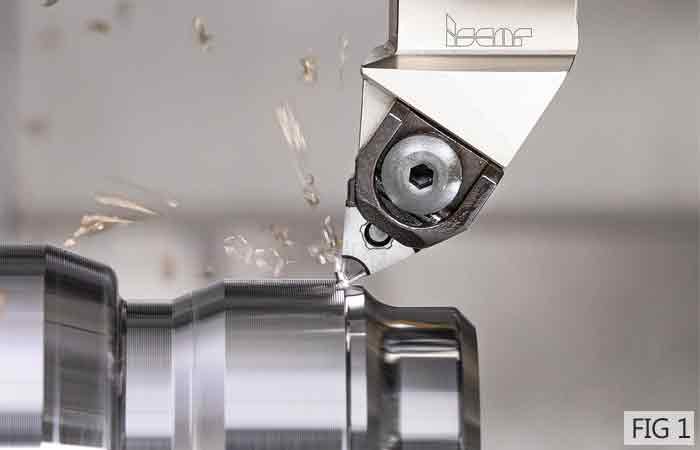
 Standards ensure quality, interchangeability and consistency in manufacturing. In cutting-tool technology, ISO 1832 established a common system for identifying indexable inserts based on their shape, dimensions, accuracy and other characteristics. However, standardisation has not restricted innovation; it has created a foundation for continuous improvement. Introduced in the late 1970s, ISO 1832 simplified insert identification and interchangeability, enabling manufacturers to use compatible inserts from different suppliers and reduce tooling inventory. Nevertheless, the standard does not specify critical performance factors such as chip-breaker geometry, cutting-material grades or digital representations. These areas continue to offer opportunities for innovation.
Innovation Within Standardised Tooling
ISCAR demonstrates how advanced engineering can improve performance while retaining compatibility with conventional tooling. Its LOGIQ-6-TURN inserts feature six usable cutting edges and a 55-degree corner, enabling semi-finishing and finishing
operations in standard TNMG insert pockets. This design improves carbide utilisation while delivering high surface quality.
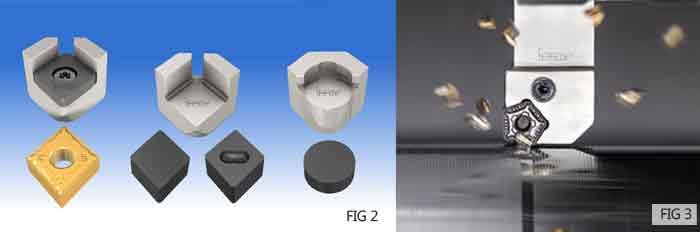
The CER-M-TURN family incorporates exchangeable cartridges that accommodate different insert shapes, including round, square and rhombic inserts. If an insert breaks, replacing the cartridge can reduce repair costs and tool damage.
ISCAR has also introduced specialised cutting materials for demanding applications. The IC1024 carbide grade is designed for hard steel and cast iron machining at hardness levels up to HRC 62, while IC706 targets titanium machining, offering wear resistance and protection against plastic deformation through its submicron substrate and TiB₂ coating.
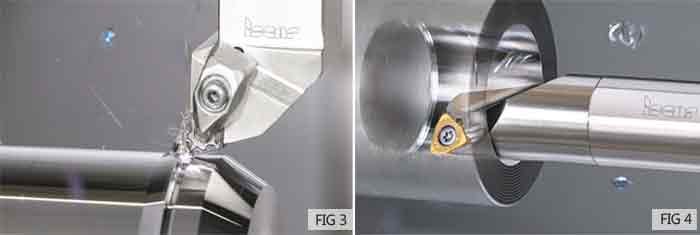
Beyond Iso: Near-To-Iso Designs
Where conventional standards limit design possibilities, proprietary near-to-ISO geometries offer alternatives. ISCAR’s DOVE-IQ-TURN features double-sided pentagonal inserts with ten cutting edges and secure dovetail clamping. The NEOTURN family includes a 70-degree XNMG insert that combines profiling flexibility with corner strength. Meanwhile, MINI-P-TURN offers double-sided, six-edged inserts for hard steel and cast iron turning.
Digitalisation And The Smart Factory
Modern manufacturing increasingly relies on digital twins and computer interpretable tool data. ISO 13399 supports standardised digital representation of cutting tools, complementing the physical interchangeability established by ISO 1832. ISCAR’s digital tool packages provide virtual tool models, CAM integration, collision checking, recommended cutting data and engineering calculations, supporting smarter machining decisions.
Ultimately, standardisation and innovation are complementary. While ISO standards provide consistency and compatibility, advanced geometries, cutting materials and digital technologies enable manufacturers to achieve higher productivity and prepare for the smart factory.