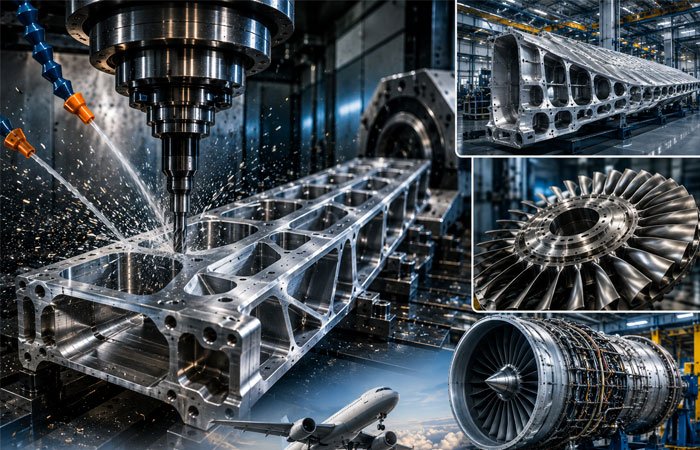
Enabling the Next Generation of Lightweight, High-Performance Aerospace Structures
As the aerospace industry strives to build lighter, stronger, and more fuel-efficient aircraft, manufacturing technologies are evolving at an unprecedented pace. Among them, High-Speed Milling (HSM) has become one of the most transformative processes in modern aircraft production. Today, HSM is no longer simply a productivity enhancement—it is a strategic manufacturing capability that enables the production of complex monolithic aerospace structures with exceptional precision, superior surface quality, and reduced manufacturing costs.
The rapid expansion of India’s aerospace sector further reinforces the importance of this technology. The country’s aircraft component market, valued at approximately US$17.3 billion in 2025, is projected to reach US$31.3 billion by 2034, while the precision machining market is expected to grow from US$7.35 billion in 2026 to US$16.6 billion by 2033, registering a robust 12.4% CAGR. As aircraft production and exports continue to rise, demand for advanced high-speed machining solutions is expected to accelerate significantly.
The Shift Towards Monolithic Aircraft Structures
Traditional aircraft manufacturing relied heavily on assembling hundreds of individual sheet metal parts using rivets, bolts, and fasteners. Modern aircraft, however, increasingly utilize monolithic structural components machined from a single solid billet.
Critical aerospace components such as:
- Wing spars
- Bulkheads
- Fuselage frames
- Floor beams
- Wing ribs
are now produced as single-piece structures, improving strength while reducing weight and assembly complexity.
Producing these large components requires removing enormous volumes of material—often up to 90% of the original billet—while maintaining micron-level dimensional accuracy throughout the machining process.
How High-Speed Milling Works
High-Speed Milling operates with spindle speeds typically ranging from 20,000 to over 40,000 RPM, combined with optimized feed rates and shallow radial depths of cut.
Unlike conventional machining, HSM fundamentally changes cutting dynamics.
At high cutting speeds, most of the generated heat is carried away by the chip instead of being transferred into the cutting tool or workpiece. This minimizes thermal distortion and helps maintain dimensional stability throughout long machining cycles.
Lower chip loads also reduce cutting forces, allowing manufacturers to machine extremely thin aerospace structures—sometimes less than 1 mm wall thickness—without vibration, chatter, or deformation.
Another major advantage is surface quality. HSM routinely achieves surface finishes better than Ra 0.8 µm, significantly reducing secondary polishing and finishing operations.
Material-Specific Machining Strategies
Aircraft components are manufactured from advanced lightweight materials specifically selected for strength, corrosion resistance, and fatigue performance. Each material demands a unique machining strategy.
Aluminium-Lithium alloys, widely used for fuselage structures and wing components, allow extremely high material removal rates exceeding 8–10 litres per minute, making them ideal for high-productivity rough machining.
Titanium alloys (Ti-6Al-4V), commonly used in landing gear structures, engine mounts, and critical load-bearing components, require lower spindle speeds, higher torque, and efficient heat management. High-pressure coolant systems and cryogenic machining using liquid nitrogen are increasingly adopted to improve tool life and maintain dimensional accuracy.
For nickel-based superalloys such as Inconel 718, used extensively in aircraft engines, manufacturers employ dynamic trochoidal toolpaths, ceramic cutting tools, and rigid 5-axis machining centres to manage extreme cutting temperatures while maintaining consistent tool performance.
Technology Driving Productivity
The success of High-Speed Milling depends on far more than spindle speed alone.
Modern aerospace machining centres integrate:
- High-speed 5-axis CNC systems
- Linear motor drives
- Thermal compensation systems
- Adaptive feed control
- High-performance CAM software
- Tool condition monitoring
- Automatic tool changers
- Digital twin simulations
Artificial Intelligence and real-time sensor feedback continuously optimize cutting parameters based on spindle load, vibration, and tool wear, enabling highly stable unmanned machining operations.
Benefits Beyond Productivity
High-Speed Milling delivers substantial manufacturing and operational advantages.
Cycle times can be reduced by 40–70% compared with conventional milling methods, improving machine utilization and reducing production costs.
Monolithic components eliminate thousands of mechanical fasteners and joints, resulting in lighter airframes with improved structural integrity and lower maintenance requirements.
Reduced assembly operations also enhance manufacturing consistency while minimizing cumulative tolerance errors.
India’s Opportunity in Aerospace Manufacturing
As global aerospace OEMs expand manufacturing partnerships with Indian suppliers, High-Speed Milling is becoming a critical capability for producing world-class aircraft structures.
This trend is creating significant opportunities for machine tool manufacturers, cutting tool companies, CAM software developers, workholding specialists, coolant suppliers, metrology providers, and automation companies serving the aerospace sector.
The Road Ahead
The future of aerospace manufacturing will be defined by lightweight structures, digital manufacturing, and intelligent machining systems. High-Speed Milling sits at the centre of this transformation, enabling manufacturers to convert massive aerospace-grade billets into complex, lightweight structural components with exceptional precision and efficiency.
For India’s rapidly expanding aerospace industry, investing in advanced High-Speed Milling technology is more than a productivity decision—it is a strategic step toward becoming a globally competitive hub for next-generation aircraft manufacturing.