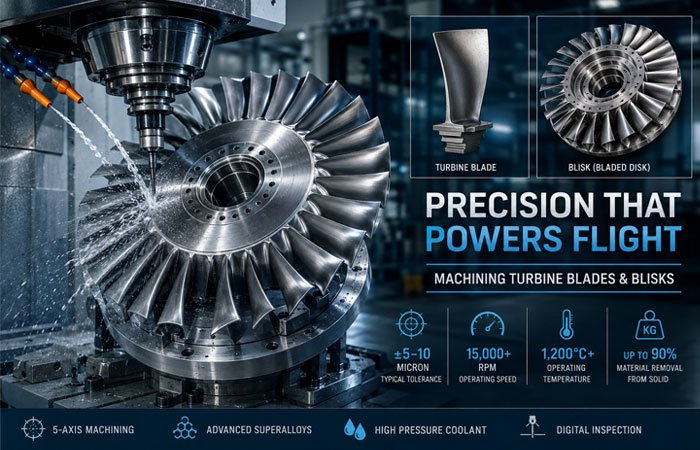
Modern aircraft engines represent the pinnacle of precision engineering, and at the core of every high-performance turbine engine are two of its most sophisticated components—turbine blades and blisks (Bladed Disks). These critical rotating parts directly determine engine efficiency, fuel consumption, emissions, and operational reliability. As global aircraft production accelerates and India strengthens its aerospace manufacturing capabilities, precision machining of turbine blades and blisks is emerging as one of the country’s highest-value manufacturing opportunities.
The commercial aerospace sector is witnessing unprecedented growth. According to industry estimates, the global aircraft engine market is expected to exceed US$120 billion by 2030, while India’s aircraft component market is projected to grow from US$17.3 billion in 2025 to over US$31 billion by 2034. India’s precision machining industry is also forecast to expand at a 12.4% CAGR, reaching US$16.6 billion by 2033, with CNC machining accounting for nearly 88% of the sector’s revenue. These trends are creating enormous demand for advanced machining technologies capable of producing aerospace-grade engine components.
Why Turbine Blades Demand Exceptional Precision
Turbine blades operate in one of the harshest engineering environments imaginable. Positioned directly behind the combustion chamber, they are continuously exposed to temperatures exceeding 1,200°C, centrifugal forces of several thousand g’s, and rotational speeds that may surpass 15,000 RPM.
To survive these extreme conditions, turbine blades are manufactured from advanced nickel-based superalloys such as Inconel, Rene alloys, and single-crystal superalloys. These materials provide exceptional heat resistance but are extremely difficult to machine due to their high strength, poor thermal conductivity, and tendency to rapidly wear cutting tools.
Even a microscopic dimensional deviation or surface defect can significantly reduce engine efficiency or lead to premature fatigue failure. Consequently, aerospace machining typically demands dimensional tolerances within ±5 to ±10 microns and exceptionally fine surface finishes.
Blisks: Redefining Engine Performance
Unlike conventional turbine assemblies where blades are mechanically attached to a separate disk, blisks integrate both components into a single monolithic structure.
This innovative design offers multiple advantages:
- Lower engine weight
- Improved aerodynamic efficiency
- Reduced vibration
- Higher fuel efficiency
- Fewer assembled parts
- Enhanced reliability
However, manufacturing a blisk is significantly more challenging. A single titanium or nickel-alloy forging must be machined into dozens of ultra-thin, twisted aerofoil blades without introducing distortion or residual stress.
Because the entire component is machined from one solid billet, machining often removes up to 90% of the original material, demanding exceptional process stability and precision.
Advanced Machining Technologies
Manufacturing turbine blades and blisks requires far more than conventional CNC machining.
Today’s aerospace facilities increasingly rely on:
- 5-axis simultaneous machining centres for producing complex free-form blade geometries.
- Mill-turn machining platforms that combine multiple operations into one setup, reducing cumulative tolerance errors.
- High-pressure coolant (HPC) systems operating at pressures exceeding 70 bar to improve chip evacuation and extend tool life.
- Cryogenic machining, using liquid nitrogen or carbon dioxide, to reduce cutting temperatures when machining titanium and nickel superalloys.
- Adaptive toolpath strategies that automatically optimize cutting loads to maintain dimensional accuracy throughout long machining cycles.
Together, these technologies improve productivity, enhance surface integrity, and significantly reduce tooling costs.
Digital Manufacturing is Changing Aerospace Production
Modern aerospace machining is increasingly driven by digital technologies.
Digital twins simulate machining operations before production begins, allowing engineers to predict vibration, thermal expansion, cutter deflection, and machining forces. Artificial intelligence continuously monitors spindle load, tool wear, coolant flow, and vibration, automatically adjusting machining parameters to maintain process stability.
In-process probing and automated Coordinate Measuring Machines (CMMs) further ensure that every blade profile meets stringent aerospace certification requirements without excessive manual inspection.
Opportunities for India’s Machine Tool Industry
India’s expanding partnerships with global aerospace manufacturers are creating new opportunities across the manufacturing ecosystem. Demand is rising not only for advanced machining centres but also for cutting tools, tool holders, CAM software, metrology equipment, industrial automation, coolant technologies, and digital manufacturing solutions.
As programmes involving next-generation commercial aircraft, defence aviation, and indigenous aero-engine development gather momentum, domestic machine shops capable of machining turbine blades and blisks to international standards will become integral contributors to global aerospace supply chains.
Precision machining of turbine blades and blisks is therefore more than a manufacturing capability—it is a strategic technological milestone. Companies investing today in multi-axis machining, advanced materials expertise, and digital manufacturing will be well positioned to shape the future of India’s aerospace industry while supporting the next generation of safer, lighter, and more fuel-efficient aircraft.