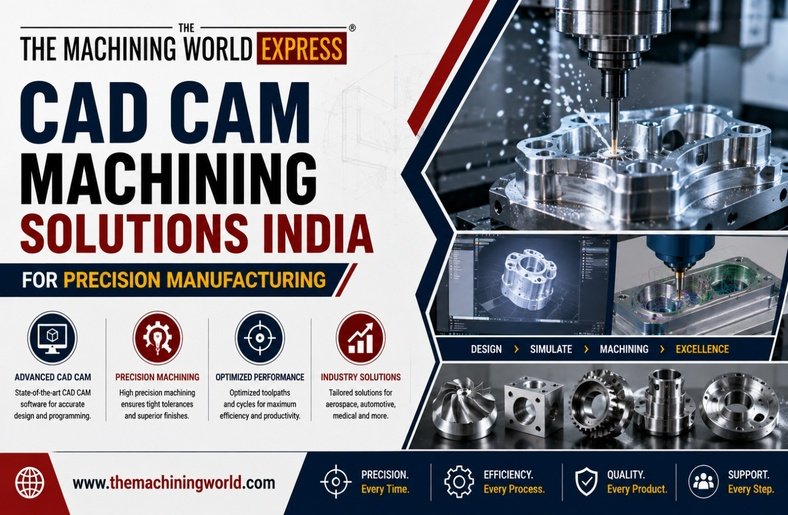
Over the years, the manufacturing industry has changed the way they were using digital technology. CAD/CAM is now an important part of that change. It lets engineers create a digital design, plan CNC programs, test toolpaths through simulation, and send the final instructions to a machine without relying on manual programming at every stage.
This makes it easier to work on detailed parts and maintain the same quality across production runs. For Indian manufacturers, these capabilities are becoming increasingly useful as CNC machining becomes more advanced.
In this article, The Machining World Express will help you understand how CAD/CAM works, where it is used, its main benefits, and what manufacturers should consider before adopting it.
What Are CAD CAM Machining Solutions?
CAD CAM machining solutions connect part design with CNC machining. CAD software is used first to create a “2D” drawing or “3D” model with the required dimensions and features. The design is then taken into CAM software, where the programmer plans cutting operations and creates toolpaths for the CNC machine.
Before machining, those paths can be simulated to catch possible mistakes. Post-processing then converts the toolpath into code suited to the machine and its controller. The same setup can also be used for high-speed, multi-axis and 5-axis machining.
Why CAD CAM Is Important for Indian Manufacturers?
Indian manufacturers are handling more complex parts today. Automotive and EV components, aerospace parts, moulds, medical components, and heavy engineering products often require tight tolerances and shapes that are difficult to program manually.
CAD/CAM software makes these jobs easier by creating toolpaths directly from the digital model. Simulation also helps identify errors before machining begins.
For repeat production, the same design and machining program can be reused and updated when needed. This saves setup time and helps keep production consistent.
CAD/CAM is now widely used with 3-axis, 4-axis, and 5-axis CNC machines, which makes it a regular part of modern machining practice.
What Are the Key CAD CAM Machining Solutions?
2D and 3D CAD Design
CAD software is used to create detailed engineering drawings and 3D models before machining begins. It lets designers visualize every feature, check dimensions, apply tolerances, and modify designs quickly without creating physical prototypes for every revision.
CNC Programming and Toolpath Generation
CAM software works out how the cutting tool should move around the component. Roughing, drilling, finishing and other operations can be programmed according to the part and machine. Good toolpaths can reduce unnecessary movements and help keep machining under control.
3-Axis, 4-Axis and 5-Axis Machining
CAD CAM solutions support multiple CNC machining configurations. While 3-axis machining handles standard components, 4-axis and 5-axis machining make it possible to manufacture complex parts from multiple angles in fewer setups.
Machining Simulation and Verification
Running an untested CNC program on an expensive machine can be a costly way to discover a mistake. Simulation provides a virtual check of the machining process and can help identify collisions, incorrect movements and other problems before the actual job begins.
CNC Post-Processing
Different CNC machines and controllers do not necessarily use the same output format. A post-processor converts the CAM toolpath into machine-ready code for the intended control. This step is important because the program has to match the machine on which it will run.
Industries Using CAD CAM Machining Solutions in India
The use of CAD CAM Machining Solutions India has expanded across many industries, like:
- Automotive manufacturers use CAD CAM for engine blocks, transmission systems, EV components, suspension parts, and brake components that require tight tolerances.
- Aerospace and defence industries rely on CAD CAM to machine lightweight structural components, turbine parts, brackets, housings, and complex aircraft components.
- Die and mould manufacturers use CAD CAM to create mould cavities, injection moulds, dies, punches, and intricate 3D surfaces used in mass production.
- Medical equipment manufacturers produce implants, surgical tools, orthopedic components, and precision medical parts using advanced CNC machining supported by CAD CAM software.
- Electronics companies use these solutions to manufacture heat sinks, housings, connectors, enclosures, and miniature precision components for electronic devices.
- Heavy engineering industries use CAD CAM machining for industrial machinery components, shafts, gears, fixtures, tooling, and other large precision parts.
The Machining World Express covers machining developments across automobile, aerospace and defence, electronics, medical equipment, heavy engineering, railways, and die and mould sectors, making these areas particularly relevant to its readers.
Benefits of CAD CAM Machining Solutions
CAD CAM technology can help manufacturers throughout the manufacturing process:
- Improve dimensional accuracy
- Reduce programming and setup work
- Produce complex shapes more easily
- Cut down avoidable machining errors
- Improve repeatability between batches
- Use cutting tools and material more efficiently
- Move from design to production faster
Note: CAD CAM indeed helps, but good machining practices still matter.
Conclusion
In short, CAD CAM helps take machining projects from an engineering drawing to a finished component more efficiently. It gives programmers a better way to plan the work before the machine starts cutting, particularly when parts become more detailed or production volumes increase.
As Indian manufacturers adopt more advanced CNC and multi-axis machines, CAD CAM solutions will continue to play an important role.
To stay updated, The Machining World Express is a useful resource for keeping up with new machining technologies, industry developments and practical manufacturing insights.
Frequently Asked Questions (FAQs)
Q1. What is CAD CAM machining?
- CAD/CAM machining is a digital manufacturing process that uses CAD software to design a component and CAM software to turn that design into CNC toolpaths and machine code.
Q2. What industries use CAD CAM solutions in India?
- Industries commonly use CAD CAM for precision components are: Automotive, aerospace, defence, medical, electronics, die and mould, railways, and heavy engineering.
Q3. Can CAD CAM software support 5-axis machining?
- Yes, many modern CAM systems work with 5-axis machines. They can handle complex parts and reach areas that are hard to machine with a standard 3-axis setup.
Q4. How does CAM software improve CNC machining?
- CAM software helps create efficient toolpaths, simulate machining operations, and identify potential problems before the CNC machine starts cutting the material.
Q5. How do I choose a CAD CAM solution for my machining business?
- You should look at your CNC machines, part complexity, required axes, controller compatibility, simulation, post-processing, technical support, and overall machining needs.