




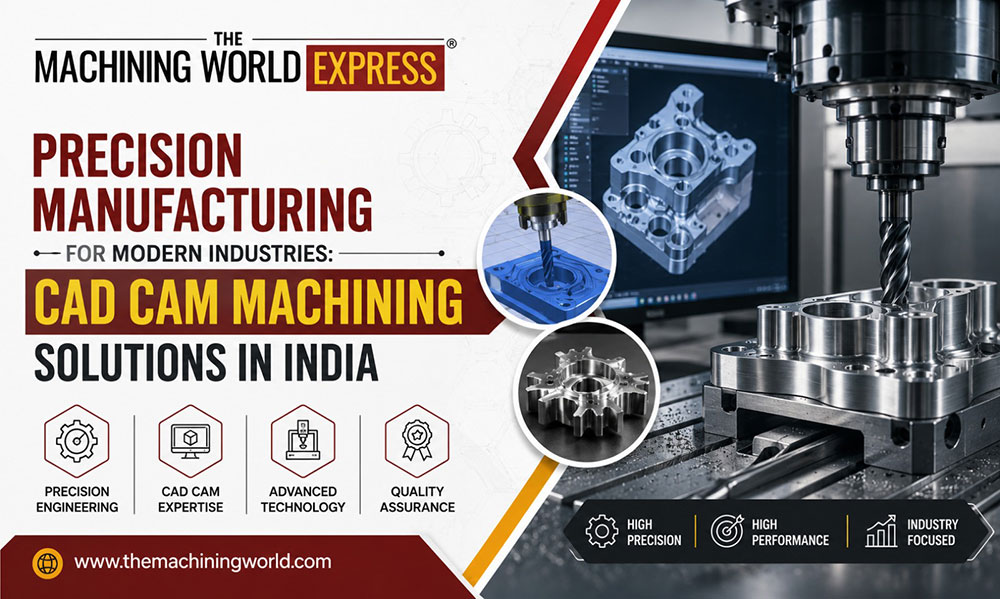
Now manufacturing looks a lot different than it did ten years ago. Companies aren’t leaning on conventional machining alone anymore to turn out accurate, complex parts. Digital tools have taken over a lot of the heavy lifting, and that shift is what’s driving so much interest in CAD CAM Machining Solutions in India — a way of pairing smart design software with automated machining so results stay consistent, batch after batch.
You’ll see it everywhere now — automotive shops and industrial equipment manufacturers. They’re all leaning into CAD CAM because it lets them hold tight tolerances without the guesswork that comes with manual methods.
So what exactly is CAD CAM machining?
CAD is the software engineers use to build digital models of a part before anything gets cut. CAM takes that model and turns it into the actual instructions a CNC machine needs to run.
Put the two together and you’ve got a workflow that goes straight from design to production. With far less back-and-forth than the old way of doing things. That’s really the appeal behind CAD CAM Machining Solutions in India. Intricate parts and a process that doesn’t fall apart when specs get complicated.
How it actually works on the shop floor
It starts with an engineer building the part in CAD. Every hole and dimension mapped out digitally before a single tool touches material. Once that design is locked in. CAM software reads the model and works out the toolpaths the CNC machine will follow.
The machine does the cutting or milling along following those programmed paths. Until the finished piece matches the design. Less manual adjustment and a production line that moves faster because of it.
Why manufacturers keep choosing it
It’s precise. When a design gets translated digitally into machine instructions. There’s not much room for the small deviations that can throw off a part’s performance.
It’s quicker. Automated setups cut down the prep time between jobs, so manufacturers can turn projects around without cutting corners on quality.
It’s consistent. Since every part runs off the same digital program, you’re not dealing with the piece-to-piece variation that comes with manual work.
It wastes less material. Toolpaths get optimized before machining even starts, which means less scrap and lower material costs over time.
It’s easier to change. Need to tweak a design? Engineers can update the CAD file directly instead of scrapping the whole production setup and starting over.
Where this technology gets used
CAD CAM Machining Solutions in India show up across a surprising range of industries these days.
Automotive — engine parts, transmission components, brake systems, molds, and prototypes that need to be dead-on accurate.
Aerospace — where tolerances are unforgiving and every part has to be both lightweight and durable.
Medical devices — surgical instruments and equipment where precision isn’t optional, it’s the whole point.
Industrial machinery — custom fixtures and tooling built to exact factory specs.
Electronics — enclosures and other small but critical components.
The bigger picture: why businesses are making the switch
Manufacturers are under constant pressure to move faster without letting quality slip. CAD CAM machining helps with both sides of that equation — it streamlines the process and takes a lot of the human error out of the equation.
Compared to traditional machining, it lets businesses:
- Handle complex geometries without extra difficulty
- Cut down production time
- Improve dimensional accuracy
- Bring manufacturing costs down
- Scale up output when demand rises
- Keep quality steady across large runs
That combination is exactly why CAD CAM Machining Solutions in India have become such a smart investment for companies trying to modernize.
What to look for in a machining partner
Not every shop is equipped the same way. So a few things are worth checking before you commit to a partner:
- Equipment — newer CNC machines generally mean better accuracy and finish quality.
- Team experience — engineers who can spot design issues early and suggest smarter machining approaches save you time down the line.
- Quality control — every part should get inspected before it ships, not just spot-checked.
- Material range — aluminum, stainless steel, brass, copper, titanium, engineering plastics, specialty alloys — the more versatile the shop, the fewer headaches for you.
- Delivery reliability — schedules matter, especially when your own production depends on theirs.
Where this is headed
India’s manufacturing sector isn’t slowing down on automation. As more companies adopt Industry 4.0 practices, CAD CAM systems are starting to integrate with AI, cloud-based monitoring, and smarter CNC automation — which only adds to what these systems can already do.
That means CAD CAM Machining Solutions in India will keep playing a central role across automotive, aerospace, defense, electronics, healthcare, and industrial manufacturing as demand for precision engineering grows.
Companies putting money into this technology now are simply better positioned for what’s coming next.
Final thoughts
Precision, speed, consistency — that’s the combination modern manufacturing runs on, and it’s exactly what CAD CAM technology delivers. Whether you’re working on prototypes, one-off custom parts, or full production runs, going with the right CAD CAM Machining Solutions in India partner makes a real difference in both efficiency and quality.
If you’re after machining expertise you can actually rely on, backed by solid technology and people who know what they’re doing, The Machining World Express offers precision manufacturing built around what today’s industries actually need.
FAQs
- What are CAD CAM machining solutions?
It’s the combination of computer-aided design and computer-aided manufacturing — using both together to produce accurate, high-quality parts through CNC machining. - Which industries rely on CAD CAM machining most?
Automotive along with aerospace and industrial manufacturing all use it heavily for precision components. - What materials work with CAD CAM machining?
Aluminum along with copper, plastics, and various engineering alloys are all common. - Why does CAD CAM machining beat traditional methods on accuracy?
Because the design and toolpaths are digital from the start, there’s much less room for the manual errors that creep into conventional machining. - How do you pick the right CAD CAM machining company?
Look at their engineering team’s experience. The age and quality of their CNC equipment. How seriously they take quality control? What materials they can handle? Whether they’ve got a track record of hitting deadlines.

1 Comment
Pingback: CAD CAM Machining Solutions India | TMW Express