The Fourth Test For A Coolant
Most machine shops judge a coolant on three things: tool life, surface finish and sump life. Parts for semiconductor equipment add a fourth: what the fluid leaves on the part after cleaning. Components that sit inside ultra-high vacuum (UHV) systems must not release hydrocarbon traces. Molecular contamination can make such a system malfunction, so equipment makers set a ceiling on outgassing for every incoming part. The cutting fluid is therefore qualified before the first chip is cut, alongside the material and the cleaning line.
India: From Chip Packaging To The Supply Chain Around It
India now has five chip assembly and packaging plants in commercial production, and the policy focus has moved to the suppliers around them. The second phase of the India Semiconductor Mission names machines and materials as one of its six pillars. Electronics is following the same path, from assembling phones to making what goes inside and around them.
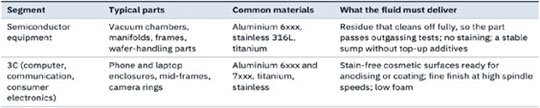
These moves pull precision machining into India from two sides. Equipment makers will need vacuum-grade machined parts from local shops, and phone and laptop brands will need enclosures machined here. Both raise the cleanliness bar for the coolant.
What The Fluid Has To Do
Semicon and 3C parts look different, but they ask the same thing of a coolant: cut well, then disappear completely in cleaning. The table below reflects general machining practice in the two segments.
What Omneo Grade 2 Actually Tests
An OMNEO Grade 2 fluid release shows that parts machined with a fluid can be cleaned to a vacuum-grade outgassing limit. Omneo Systems B.V., a Dutch contamination-control specialist, runs the method (OMNEO GSO 24 0622 Grade 2) and compares results with ASML’s outgassing specification GSA 07 9510, Grade 2 Molecular.
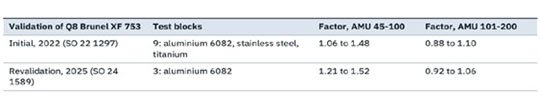
Test blocks are machined with the fluid, cleaned, and measured by residual gas analysis (RGA). Each block gets a cleanliness factor against a reference, for volatile hydrocarbons (AMU 45-100) and non-volatile hydrocarbons (AMU 101-200). Omneo treats a factor of 1.8 or more as a reject, and 1.5 to 1.8 as a warning that the process may not be consistent.
Every block passed. One 2025 reading, 1.52 after vapour cleaning with Dualene HPS, sits just inside the warning band; the alkaline and Opteon SF80 routes left more margin. Omneo prolonged the validation, and certificate 0107 2025 runs to 1 July 2027.
The release covers three materials and three cleaning routes:
- Materials: aluminium 6082, stainless steel 316L, titanium Grade 5
- Alkaline precision cleaning with Deconex HT 1511 at 2%, followed by bake-out
- Vapour precision cleaning (Dowclene 1601; its successor Dualene HPS was used in 2025)
- Precision cleaning with Opteon SF80, followed by bake-out
Two conditions matter on the shop floor. The certificate applies to the fluid mixed with tap water only; adding biocides, pH boosters, inhibitors or water softeners takes it out of scope. And it releases the fluid, not the part: each shop still validates its own cleaning line with its customer.
Where Q8 Brunel Xf 753 Fits
Q8 Brunel XF 753 belongs with the shops that want to qualify for vacuum-grade and cosmetic-grade work, where the buying question is proven cleanliness and price per litre comes second. It is a water-miscible cutting fluid from Q8Oils (Kuwait Petroleum N.V., Antwerp), within a metalworking range that runs from general metal removal to precision applications.
Three facts from the certificate carry the positioning:
- One fluid, three metals. It is released for aluminium, stainless steel and titanium, so a shop can run mixed semicon work from one sump.
- Three cleaning routes. Alkaline, vapour and solvent cleaning are all validated, so the fluid can fit the cleaning line a shop already owns.
- Tested twice. It was validated in 2022 and re-tested in 2025, which gives buyers a dated, traceable record to show their own customers.
For 3C enclosure lines there is no OMNEO requirement. Our reading is that the same property still counts: a fluid that cleans to vacuum grade leaves little behind to stain a surface before anodising. That claim should be proven on the customer’s own alloy and finish before it is promised.
A sensible first step for an Indian shop is a single-machine trial: mix with tap water at the recommended
concentration, keep additives out of the sump, and send cleaned sample parts for RGA or the customer’s own cleanliness check.