How India’s energy-equipment build-out is rewriting the metalworking fluid specification
A Q8Oils perspective on machining economics, alloy difficulty and the operator environment in open HBM and VTL shops
THE MACRO PICTURE: ORDER BOOKS WITH VISIBILITY AGAIN
India’s heavy engineering and energy-equipment sector has moved from a decade of thin order books to genuine multi-year visibility. BHEL reported FY2025-26 turnover of around Rs 32,350 crore, up 18%, with order inflows of about Rs 75,000 crore and a closing order book near Rs 2.4 lakh crore. It commissioned 8.9 GW of power capacity during the year.
THE NUCLEAR PIPELINE IS THE STRUCTURAL STORY UNDERNEATH
India operates 24 reactors totalling 8.78 GW, with nine units of roughly 7.5 GW under construction, ten indigenous 700 MWe PHWRs approved in fleet mode, and a Nuclear Energy Mission targeting 100 GWe by 2047 under the SHANTI Act, 2025. TERI estimates investment of Rs 23-25 lakh crore. The Prototype Fast Breeder Reactor at Kalpakkam achieved first criticality in April 2026.
THE APPLICATION: OPEN MACHINES, LONG CYCLES, EXPENSIVE PARTS
For machine shops, this means more pressure vessels, condensers, heat exchangers, tube sheets, end shields, steam-generator shells, turbine casings and large forgings, often in demanding materials and under tighter customer audits.
Work runs on horizontal boring machines, large VTLs, floor borers and gantry mills, with cycles lasting days or weeks. Large 5,000- 50,000 litre sumps age in place, while way-lube and hydraulic-oil ingress is common. Parts can sit between operations for weeks in humid coastal air. Scrap is catastrophic when forgings carry monthslong lead times.
THE METALLURGY IS WHERE FLUIDS GET DIFFICULT
Stainless steels are chloride-sensitive, while nickel alloys and titanium are sulphur-sensitive. Condenser and heat-exchanger work demands chlorine-free, non-active chemistry to prevent staining.
WHY THE MULTINATIONALS ARE RE-SPECIFYING
Global engineering groups increasingly audit operator exposure and coolant chemistry. TRGS 611, tighter boron limits and evolving biocide restrictions are increasingly relevant in tenders.
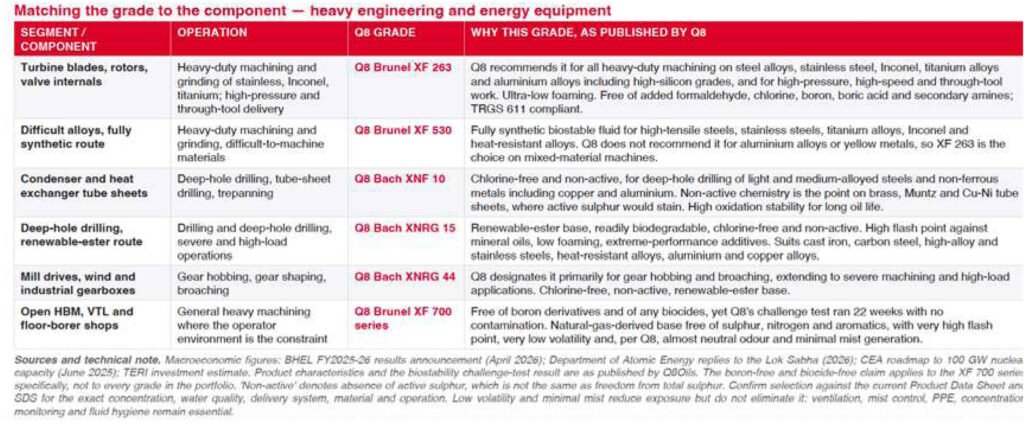
MATCHING THE GRADE TO THE COMPONENT
Q8Oils addresses this through application-specific grades: Brunel XF 263 and XF 530 for difficult alloys; Bach XNF 10 and XNRG 15 for deep-hole tube-sheet work; and the Brunel XF 700 series for open machines, offering boron- and biocide-free chemistry with low volatility and minimal mist generation.
The procurement question is no longer simply which coolant is strongest, but which chemistry suits the component, machine, operation and people standing next to it.