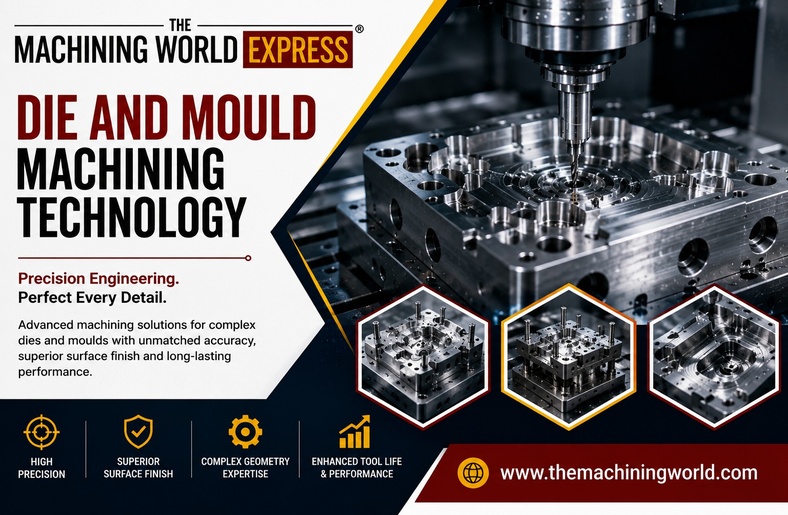
Die and Mould Machining Technology is the backbone of modern manufacturing. Nowadays, almost every industry, from — automotive and electronics to packaging and medical devices depends on accurately made dies and moulds to produce parts in large numbers.
A small mistake in the tool can affect thousands of finished products, that is why precision matters so much. Today, manufacturers use advanced methods, which we’re going to discuss, to produce reliable tooling with consistent results.
In this guide, you’ll learn what die and mould machining technology is, the materials used to make these tools, why 5-axis machining is becoming popular, and some most asked questions.
What Is Die and Mould Machining Technology?
In simple terms, “Die and Mould Machining Technology” is the process of making precision tools that shape metal, plastic, or other materials into finished products.
A die is mainly used to shape sheet metal stamping, while a mould is commonly used to make plastics or cast parts. These tools are used repeatedly in mass production. So, they must be strong, highly accurate and durable.
Technologies such as CNC machining, EDM, and 5-axis machining, are primarily used because they help manufacturers produce dies and moulds with consistent quality.
What Materials Are Used for Dies and Moulds?
The material depends specifically on the type of die or mould and the work it needs to perform.
“Tool steel” is currently the most preferred because it stays strong even after repeated use.
Many manufacturers also use:
- die steel,
- high-speed steel,
- carbide, and,
- ceramics (in some cases).
These materials are quite hard, which makes machining more difficult. But, they also help the tool keep its shape and last much longer.
CNC Machining Has Changed Die and Mould Production
In the past, it wasn’t easy to produce a die or mould. Their production depended heavily on manual machining and the experience of skilled machinists. Although those skills are important even today, CNC technology has truly changed the manufacturing process.
“Computer Numerical Control” or (CNC) machines follow digital instructions to remove material with remarkable precision. Every movement of the cutting tool is controlled by software, allowing complex shapes to be produced consistently.
CNC machining offers quite a few advantages, such as:
- Better dimensional accuracy
- Consistent quality across multiple parts
- Faster production
- Lower chance of human error
- Easier machining of complex designs
The machinings we have currently, can perform milling, drilling, boring, and finishing works on a single machine. This saves production time and improves overall efficiency.
Why 5-Axis Machining Is Becoming More Popular
Traditional “3-Axis Machines” are still suitable for many machining job applications. However, complex dies and moulds usually require more flexibility.
That’s why the “5-Axis machining center” was introduced. It lets the cutting tool and workpiece move in multiple directions at the same time. This makes it easier to machine deep cavities, curved surfaces, and detailed features without repeatedly changing the setup.
The benefits of using 5-Axis Machines include:
- Improved machining accuracy
- Better surface finish
- Shorter cutting tools for greater stability
- Reduced setup time
- Faster production of complex components
Fewer setups also mean there will be fewer positioning errors, which helps maintain tight tolerances throughout the manufacturing process.
How EDM Makes Complex Shapes Possible
Some die and mould features cannot be produced easily with conventional cutting tools. In such cases, Electrical Discharge Machining, commonly known as EDM, becomes valuable.
Rather than cutting the material directly, EDM removes metal using controlled electrical sparks between the electrode and the workpiece.
This process is especially useful for machining:
– Deep cavities
– Sharp internal corners
– Narrow slots
– Fine details
– Hardened materials
Wire EDM is another popular method used to create accurate profiles and punch-and-die components. Since there is no direct cutting force, manufacturers can produce delicate features without causing deformation.
In many cases, manufacturers use EDM alongside CNC machining to achieve the final shape.
Is Grinding and Surface Finishing Matter?
CNC machining and EDM are indeed important steps. However, they don’t complete the job. They usually need grinding and surface finishing to remove small defects and help the die or mould reach the required size and smooth finish.
A good surface finish also improves the quality of the final product and reduces wear on the tool during production. In some applications, polishing is also done to create a mirror-like finish, especially for plastic moulds and optical components.
CAD and CAM Make Manufacturing Smarter
Modern die and mould manufacturing depends heavily on CAD and CAM software.
- CAD or (“Computer-Aided Design”) is used to create a detailed 3D design of the die or mould before production begins.
- CAM or (“Computer-Aided Manufacturing”) then converts that design into machining instructions for CNC machines.
This reduces manual work, improves accuracy, and helps manufacturers find possible errors before actual machining starts, saving both time and material.
Conclusion
In the past years, Die and Mould Machining Technology has become one of the most important parts of manufacturing. From “CNC machining” and “5-axis technology” to EDM, grinding, CAD/CAM integration, and automation, everything contributes to producing reliable tooling.
Since, the demand for faster production and higher precision keeps growing, the technologies we’ve discussed here will play an even bigger role in the future of die and mould manufacturing.
Frequently Asked Questions (FAQs)
Q1. What is die and mould machining technology?
- Die and mould machining technology is the process where it uses CNC, EDM, and precision machining to produce accurate tooling for large-scale production.
Q2. Which materials are commonly used for dies and moulds?
- The materials that are used mainly for dies and moulds are tool steel, die steel, carbide, high-speed steel, ceramics, and a few others.
Q3. Why is 5-axis machining preferred for mould manufacturing?
- It allows manufacturers to machine complex moulds shapes with fewer setups. This gives better accuracy, improved surface finish, and reduced production time.
Q4. What is the purpose of EDM in die and mould machining?
- “Electrical Discharge Machining” is mainly used for parts that are difficult to machine with regular cutting tools. It creates deep cavities, sharp corners, and complex features precisely.
Q5. Why CAD and CAM important in die and mould manufacturing?
- CAD is used to design the die or mould, while CAM prepares the machining program.