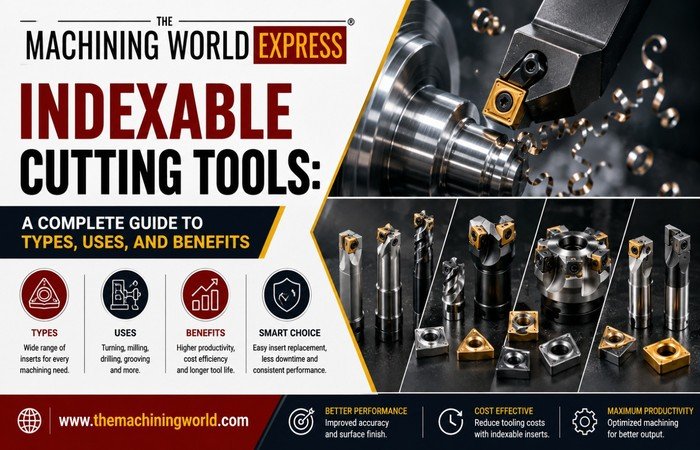
A cutting tool has a simple job: “remove material and produce the required shape”. But when the same tool is used for hundreds or thousands of parts, tool wear can quickly become a concern.
This is one reason indexable cutting tools are so widely used in machining in 2026.
They use replaceable inserts instead of relying on one permanent cutting edge. When an edge becomes worn, the insert can often be turned or flipped to use another edge.
The complete holder does not have to be thrown away.
For anyone learning about CNC machining or metal cutting, understanding this tooling system can make tool selection much easier.
In this The Machining World Express guide, we will cover the main types of indexable cutting tools, how they work, benefits, common uses, and how they compare with solid carbide tools.
What Are Indexable Cutting Tools?
Indexable cutting tools are machining tools fitted with removable cutting inserts. This is a typical tool that has a tool body or holder, a seat for the insert, the insert itself, and a screw or clamp to keep it securely in place.
The insert sits in a carefully made pocket so that it stays in the correct position during cutting. When one of the working edges wears out, the machinist can loosen the clamp or screw, and index the insert to another usable edge.
Some inserts can be flipped as well. Once all available edges have been used, the insert itself is replaced while the tool body can continue to be used.
How Do Indexable Cutting Tools Work?
The insert is the part that actually meets the workpiece during machining. As the cutter or workpiece moves, it removes material from the surface and produces chips.
Gradually, heat, friction, and cutting forces wear down the cutting edge. Rather than replacing the whole tool, the machinist can stop the machine, loosen the screw or clamp, and move the insert to fresh edge. Once secured in place, machining can continue.
Note: This may sound simple to you, but the small details matter. The insert must sit flat against its seat, the pocket should be clean, and the clamping system must hold it firmly. A poorly seated insert can affect the cut, surface finish, and tool life.
Types of Indexable Cutting Tools
Indexable Turning Tools
Used on lathes and turning centers for operations such as facing, external turning, profiling, and finishing. Different insert shapes suit different materials and conditions.
Indexable Milling Tools
These include face mills, shoulder mills, and other cutters fitted with replaceable inserts. They are widely used when higher material removal rates and larger cutter sizes are needed.
Indexable Drills
Indexable drills use replaceable inserts to produce holes in metal components. They are useful for larger hole sizes and production work where quick cutting-edge replacement is valuable.
Indexable Boring Tools
Boring tools use inserts to enlarge or finish existing holes. They are useful when a machined hole needs greater accuracy, a specific diameter, or improved surface quality.
Indexable Grooving, Threading, and Parting Tools
These specialized tools use small inserts designed for narrow grooves, threads, and parting operations. The insert geometry is matched closely to the required groove, thread, or cut.
Benefits of Indexable Cutting Tools
Multiple Cutting Edges
Many indexable inserts provide several usable edges. Rotating or flipping the insert allows the operator to use another edge before installing a new insert.
Reduced Tool Replacement Time
Only the insert needs to be changed when it wears. This can make tool changes quicker and reduce interruptions, especially during repeated production work.
Cost Efficiency
Only the worn insert needs to be replaced in many cases. The tool body can remain in service, which can help control tooling expenses over time.
Consistent Machining Performance
Manufactured inserts are designed with controlled dimensions and geometry. Using fresh edges can help maintain stable cutting results from one part to the next.
Flexibility
Different insert grades, shapes, chipbreakers, and edge geometries can be used with suitable tool bodies. This gives machinists options for different materials and operations.
Common Applications of Indexable Cutting Tools
Indexable tooling is found in many areas of metalworking. CNC turning and milling are two of the most common, but the range goes much further.
These tools are also used for:
- General engineering,
- Heavy Engineering,
- Automotive components,
- Aerospace parts,
- Die and mould work,
- Production machining, and
- Large-volume manufacturing.
Drilling is another major application, with indexable drill systems designed for productive hole-making. Manufacturers offer different tool bodies, insert grades, and geometries for different workpiece materials and cutting conditions.
The important point is that the insert should match the job. Material, depth of cut, feed rate, cutting speed, machine stability, and the required finish all have a role in tool selection.
As machining practices continue to change, staying updated on cutting tools and manufacturing technology becomes equally important. The Machining World Express helps readers explore these topics and better understand the tools and technologies used in modern machining.
Conclusion
Indexable cutting tools offer a practical way to manage cutting edges without replacing the complete tool each time one becomes worn.
Since the inserts can be replaced and come in a range of designs, these tools can be used for many machining jobs. They are commonly used in both job shops and large-scale production.
These tools are widely used in 2026 because they can provide a good balance of productivity and flexibility. Plus, indexable tools drastically lower machining costs and reduce machine downtime, which can be good for businesses looking to improve efficiency.
Frequently Asked Questions (FAQs)
Q1. What are indexable cutting tools?
- Indexable cutting tools are tools that use replaceable inserts as their cutting edges. When an edge becomes worn, the insert can often be rotated or flipped to use another edge. Once the available edges are used, the insert is replaced instead of replacing the entire tool body.
Q2. What are indexable inserts used for?
- Indexable inserts are used for turning, milling, drilling, boring, grooving, and threading.
Q3. Are indexable cutting tools better than solid carbide tools?
- Not in every situation. Indexable tools suit many production jobs, on the other hand, solid carbide can work better for smaller and detailed operations.
Q4. How do you select an indexable insert?
- To select, consider the material, machining operation, cutting conditions, required finish, insert geometry, grade, and recommended tool settings.