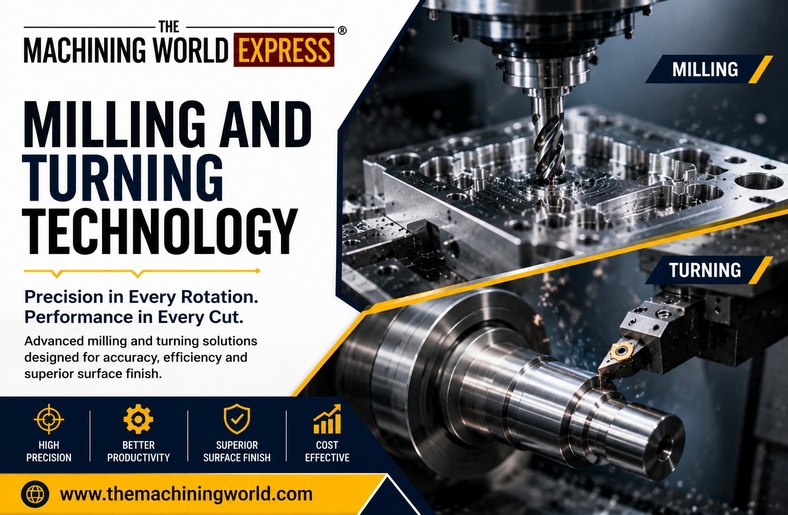
In modern manufacturing, we look for precision, speed, and consistency. To meet the need easily, “milling and turning technology” are among the most important methods used today.
These two machining techniques have become the go-to methods in modern production. The reason is simple: they allow manufacturers to create components with extremely tight tolerances and excellent surface finishes.
In this article, we’ll discuss and help you understand how both milling and turning work, how they improve productivity, and achieve better results in manufacturing.
What Is Milling and Turning Technology?
Milling and turning technology refers to the use of a particular machine and cutting tools that helps remove material from a workpiece until the desired shape is achieved.
Today, these operations are largely performed with computer numerical control (CNC) systems that provide exceptional precision and repeatability. Both methods fall under the category of subtractive manufacturing because they remove material instead of adding it.
Turning Technology in Detail
Turning is a machining process in which the workpiece rotates and the cutting tool remains stationary. This process is usually performed on a “lathe”.
When the material rotates, the cutting tool removes small amounts of metal and create the required shape. Turning is commonly used to manufacture round or cylindrical components.
Common turning operations include:
- Facing
- Threading
- Boring
- Grooving
- Taper turning
- Knurling
Turning technology is widely used to manufacture:
- Shafts
- Bushings
- Couplings
- Pins
- Sleeves
- Pulleys
Modern CNC turning centers can perform multiple operations during a single setup. Many machines are equipped with live tooling systems that allow drilling and milling operations without moving the workpiece to another machine.
This reduces production time while improving accuracy.
Milling Technology in Detail
Milling works a bit differently from turning technology. In this process, the cutting tool rotates, and the workpiece stays fixed or moves in a controlled path.
As the tool cuts away material, the part gradually takes its required shape. This process is suitable for making both simple components and complex parts with detailed features.
Common milling operations include:
- Face milling
- End milling
- Slot milling
- Profile milling
- Pocket milling
- Drilling
Milling machines are generally divided into three categories:
1. Vertical Milling Machines
Vertical milling machines have a vertically positioned spindle. They are commonly used for general manufacturing work because they are versatile and easy to operate.
2. Horizontal Milling Machines
Horizontal machines use a horizontally positioned spindle. These machines are often preferred for heavy cutting operations because they provide excellent stability and efficient chip removal.
3. Multi-Axis Milling Machines
Multi-Axis (three-axis/four-axis/five-axis) machines can produce extremely complex parts with exceptional precision. These machines are mainly used in industries where accuracy is key.
Key Differences Between Milling and Turning Technology
Although both processes remove material from a workpiece, there are several important differences that separate them. Let’s learn the difference between Milling and Turning:
| Feature | Turning | Milling |
| Primary movement | Workpiece rotates | Cutting tool rotates |
| Machine type | Lathe | Milling machine |
| Main purpose | Producing round parts | Producing flat and complex surfaces |
| Tool design | Single-point cutting tool | Multi-point cutting tool |
| Material removal | Continuous cutting action | Intermittent cutting action |
| Typical products | Shafts, pins, bushings | Brackets, molds, housings |
These differences help manufacturers choose the most efficient method for a particular work.
Advantages of Turning Technology
Turning, especially when producing cylindrical components, gives you several benefits like:
- High production speed: The continuous movement of the workpiece allows large amounts of material to be removed quickly.
- Excellent surface finish: Turning tech produces smooth surfaces and highly accurate dimensions, which makes it suitable for precision applications.
- Better consistency: Computer-controlled machines maintain the same level of accuracy throughout long production runs.
Advantages of Milling Technology
Milling technology too has become important because of several reasons:
- Greater design freedom: Milling machines can create slots, pockets, grooves, and complex contours that would be difficult to produce using other methods.
- Improved accuracy: Advanced software systems allow machines to maintain extremely tight tolerances.
- Multi-axis capability: Modern machines can approach a component from different angles, reducing the need for additional setups.
Industries That Depend on Milling and Turning Technology
These machining methods support a wide range of industries around the world, such as:
- Aerospace industry: Aircraft components require exceptional strength and accuracy. In this, multi-axis machining systems help manufacturers create complex parts.
- Automotive industry: Manufacturers use “turning and milling technology” to produce gears, shafts, engine parts, and transmission parts.
- Medical industry: Medical equipment manufacturers rely on these processes to create surgical tools, implants, and precision instruments.
- Electronics industry: In the electronic sector, there is a need for small components to ensure proper performance. Milling and turning technology methods helps in this regard.
- Energy sector: Power generation equipment, turbines, valves, and other critical components always require advanced machining techniques.
Conclusion
Milling and turning technology continues to improve and helps the manufacturing process become easier. Both processes offer unique advantages. They play essential roles in the production of high-quality components used in countless industries.
“Turning” remains the preferred option for cylindrical parts. On the other hand, “milling” offers the flexibility required for complex shapes. And, when combined, both these technologies deliver the speed, accuracy, and reliability required in modern times.
At The Machining World Express, we closely follow the latest developments in machining technology and provide you updated insights about everything.
Frequently Asked Questions (FAQs)
Q1. What is the main difference between milling and turning technology?
- In “turning”, the workpiece rotates. In “milling”, the cutting tool rotates to shape the material.
Q2. Why is CNC technology used in milling and turning machines?
- CNC tech improves accuracy, reduces human error, and increases production speed.
Q3. Which industries rely most on milling and turning technology?
- Industries like “aerospace”, “automotive”, “medical”, “electronics”, and “energy” are highly dependent on these technologies to produce precise products.
Q4. Which process is more suitable for manufacturing cylindrical parts?
- Turning is preferred over milling because it produces round parts, such as shafts, pins, etc.
Q5. What advantages do hybrid milling and turning machines offer?
- Hybrid machines perform multiple operations in one setup. They reduce production time, and improve overall accuracy and efficiency.