Challenges, Technology Trends and the Role of Q8 Metalworking Fluids
The global medical implant industry is experiencing strong growth, driven by ageing populations, rising orthopaedic procedures, growing demand for dental restorations, sports injuries, and advances in personalised healthcare. Titanium alloys, cobalt-chromium alloys, stainless steels and high-performance polymers such as PEEK dominate implant manufacturing. These materials present significant machining challenges due to their exceptional strength, toughness, low thermal conductivity and stringent surface integrity requirements.
Current Technology Trends in Implant Machining
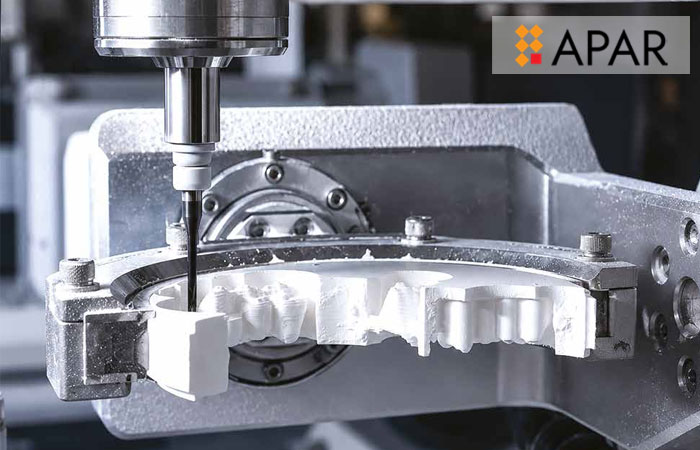
Manufacturers are increasingly investing in advanced machining infrastructure and tooling to meet the demands of next-generation implant designs.
- Advanced Machine Platforms5-axis machining centers, Swiss-type turning centers and hybrid additive manufacturing are becoming standard in implant production environments.
- High-Pressure Coolant SystemsThrough-tool high-pressure coolant delivery, automation and adaptive machining are enabling tighter tolerances and greater repeatability.
- Next-Generation Cutting ToolsNano-coated carbide tools, advanced PVD coatings, high-feed milling technologies and specialised geometries for titanium and cobalt-chromium machining are now widely adopted.
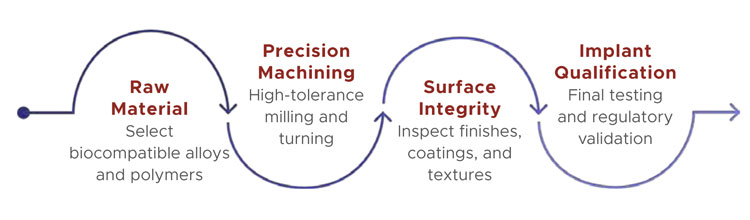
The implant manufacturing workflow demands uncompromising precision at every stage — from material selection through to final qualification — making process control and fluid performance critical success factors.
Key Machining Challenges
Heat Concentration Titanium alloys retain heat in the cutting zone, accelerating tool wear and affecting dimensional accuracy.
Surface Integrity Medical implants require exceptional surface finish with no thermal damage, burrs or micro-cracks.
Chip Control Difficulties Stringent contamination control remains a persistent challenge across all implant materials.
Rapid Tool Wear The combination of high strength and low thermal conductivity in cobalt-chromium and titanium alloys shortens tool life significantly.
Why Metalworking Fluids Matter — and How Q8 Delivers
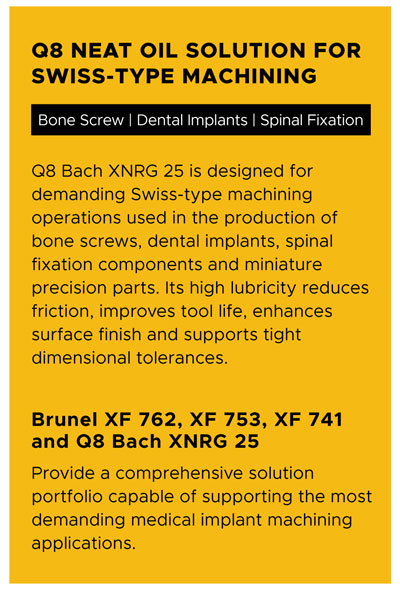
Metalworking fluids have become critical process enablers. They influence tool life, productivity, surface finish, dimensional consistency and overall manufacturing cost. Implant manufacturers increasingly seek fluids that deliver excellent lubricity, cooling performance, cleanliness and long sump life
The Path Forward
As medical implant manufacturers continue to adopt advanced machining technologies, the role of cutting fluids becomes increasingly important. The combination of modern machine tools, advanced cutting tools and Q8 metalworking fluids can help manufacturers achieve:
- Extended Tool Life Reduced wear through superior lubricity and thermal management.
- Superior Surface Quality Consistent finish integrity meeting the strictest implant standards.
- Greater Process Reliability Stable sump life and cleanliness supporting high-volume production.
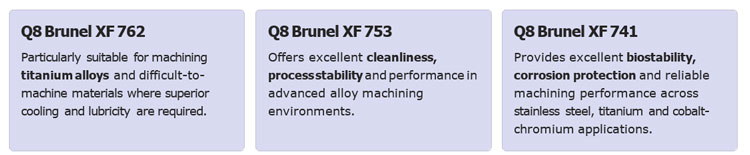
Q8 Water-Soluble Solutions