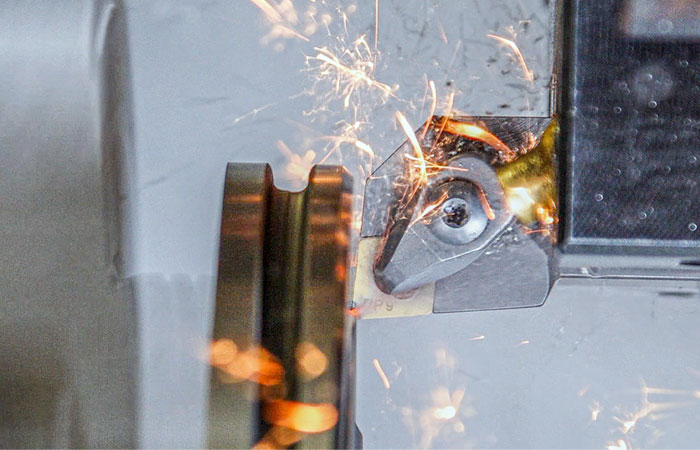
As manufacturers worldwide continue to navigate supply chain uncertainties, rising material costs, and increasing productivity demands, cutting tool strategies are undergoing significant transformation. One of the most notable trends emerging across automotive, heavy engineering, pump and valve, and industrial casting sectors is the strategic adoption of ceramic cutting tools for cast iron machining.
For decades, tungsten carbide has been the preferred choice for a wide range of machining applications due to its versatility and toughness. However, growing concerns surrounding the availability and strategic dependence on tungsten are prompting manufacturers to evaluate alternative tool materials that can deliver superior performance in specific machining environments. This shift is driving renewed interest in advanced ceramic cutting technologies.
Why Ceramics Are Gaining Momentum
Cast iron machining generates extremely high cutting temperatures, particularly during dry machining and high-speed turning operations. Under such conditions, conventional carbide tools often approach their thermal performance limits.
Ceramic cutting tools, particularly those based on alumina and silicon nitride, offer a distinct advantage. These materials maintain hardness, wear resistance, and dimensional stability even under extreme heat conditions. As a result, manufacturers can significantly increase cutting speeds while maintaining consistent performance and predictable wear characteristics.
This capability has positioned ceramics as a valuable solution for operations where thermal stress is the primary challenge rather than mechanical shock or interrupted cutting.

Moving Beyond One-Tool-Fits-All Strategies
A key trend in modern machining is the move toward strategic tool material allocation. Rather than viewing ceramic tooling as a replacement for carbide, manufacturers are increasingly selecting tool materials based on the dominant stresses within each operation.
Carbide remains highly effective in applications involving interrupted cuts, unstable setups, and heavy mechanical loads where edge toughness is essential. However, in stable cast iron machining environments dominated by heat generation, ceramic grades often deliver significantly better productivity.
This engineering-driven approach enables manufacturers to optimize machining performance while reducing dependence on any single tool material.
Productivity Through High-Speed Machining
The greatest advantage of ceramic tooling lies in its ability to operate at substantially higher cutting speeds. Increased speeds translate directly into shorter cycle times, improved spindle utilization, and higher throughput in production environments.
Manufacturers machining wheel hubs, structural castings, pump housings, and automotive components are increasingly reporting productivity gains through the selective replacement of carbide inserts with ceramic grades. These improvements are particularly valuable in high-volume production where even small reductions in machining time can create substantial cost savings.
Sustainability Benefits Drive Adoption
Another factor contributing to the growing popularity of ceramic tooling is its compatibility with dry machining processes.
Many cast iron applications can be machined without coolant when using advanced ceramic grades. Eliminating coolant not only reduces operating costs but also lowers energy consumption, minimizes fluid handling requirements, and decreases environmental impact.
As manufacturers place greater emphasis on sustainable production practices, dry machining capabilities are becoming an increasingly important consideration in tooling selection.
NTK’s Specialized Ceramic Solutions
Recognizing these industry trends, NTK Cutting Tools has developed a portfolio of ceramic grades specifically engineered for cast iron applications.
The company’s SP9 coated silicon nitride grade supports roughing and finishing operations in gray and ductile cast iron. SX6, a high-toughness silicon nitride ceramic, is designed for demanding roughing applications including scaled cast surfaces. For high-speed finishing, HC1 and HW2 alumina-based ceramic grades deliver excellent performance and surface quality.
The Future of Cast Iron Machining
As manufacturers seek higher productivity, improved resource efficiency, and greater supply chain resilience, ceramic tooling is expected to play an increasingly important role in machining strategies.
The trend is clear: success in modern manufacturing is no longer about selecting a single tool material for every operation. Instead, it involves aligning material properties with process requirements to maximize performance. In cast iron machining, advanced ceramic tooling is proving to be a powerful enabler of productivity, stability, and sustainable manufacturing.
Visit: https://ntkcuttingtools.com/