The medical device industry relies heavily on materials that offer exceptional strength, corrosion resistance, and biocompatibility. Among the most widely used are Cobalt-Chrome (Co-Cr) alloys and medical-grade stainless steels, particularly 316L and 420 grades. These materials are commonly found in orthopedic implants, cardiovascular devices, bone fixation systems, dental implants, and surgical instruments where long-term reliability and patient safety are critical.
While these alloys provide outstanding performance inside the human body, they also rank among the most difficult materials to machine. Their high strength, rapid work-hardening behavior, and poor thermal conductivity create significant challenges for manufacturers striving to achieve the tight tolerances and superior surface finishes demanded by medical applications.
Why These Materials Are Challenging
Cobalt-Chrome alloys are valued for their exceptional wear resistance and mechanical strength. Widely used in hip and knee implants, these alloys typically exhibit hardness levels between 300 and 450 HB and tensile strengths exceeding 900 MPa. However, their low thermal conductivity prevents heat from dissipating efficiently during machining, causing extreme temperatures to build up at the cutting edge.
Medical-grade stainless steels present a different but equally challenging scenario. Grade 316L is highly corrosion resistant and commonly used in implants and fixation devices, while grade 420 is hardened for surgical instruments requiring excellent wear resistance. Both grades tend to work-harden rapidly during cutting operations, increasing tool wear and machining difficulty.
In addition, stainless steels are prone to built-up edge formation, where material adheres to the cutting edge under high pressure, negatively affecting tool life, dimensional accuracy, and surface finish quality.
Optimizing Cutting Conditions
Successful machining of Co-Cr and stainless steel depends heavily on controlling heat generation and minimizing work-hardening effects.
For Cobalt-Chrome alloys, cutting speeds are generally maintained between 25 and 50 m/min when using solid carbide tooling. Medical-grade 316L stainless steel can be machined at higher speeds ranging from 80 to 160 m/min, while hardened 420 stainless steel typically operates between 60 and 100 m/min.
Feed rates also play a critical role. Rather than using light cuts that rub against hardened surfaces, manufacturers employ consistent and relatively aggressive feed rates to ensure the tool cuts beneath the work-hardened layer generated during previous passes.
Importance of High-Pressure Coolant
High-pressure coolant systems have become indispensable in medical machining. Operating at pressures between 70 and 150 bar, these systems effectively penetrate the cutting zone, remove heat, and evacuate chips before they can be recut.
The benefits include lower cutting temperatures, improved tool life, enhanced surface quality, and greater process reliability. In many cases, high-pressure coolant can reduce tool-tip temperatures by up to 200°C, significantly extending cutting tool performance.
Advanced Tooling Solutions
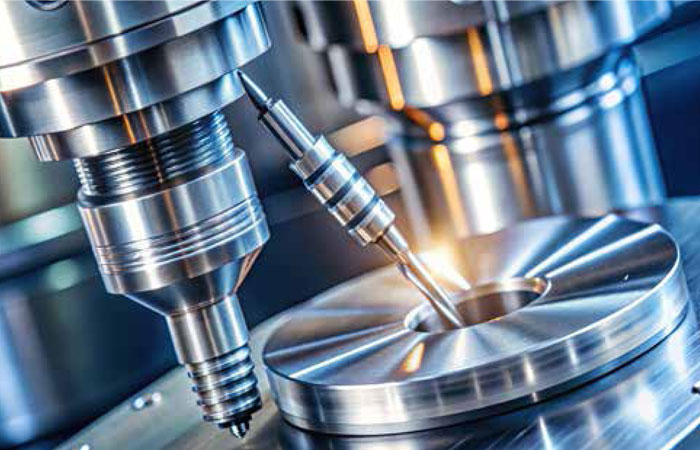
Medical alloys require cutting tools specifically designed for difficult-to-machine materials. Modern tooling typically utilizes sub-micron carbide substrates combined with highly positive rake geometries and ultra-sharp cutting edges.
Advanced coatings such as TiAlN and AlTiN-SiN provide superior heat resistance and wear protection, enabling tools to withstand the extreme temperatures generated during machining.
For milling operations, variable helix and unequal-index end mills are frequently employed to minimize vibration and chatter while producing the superior surface finishes required for medical implants and surgical instruments.
Precision for Patient Safety
In medical manufacturing, machining performance directly influences product quality and patient outcomes. By combining optimized cutting parameters, high-pressure coolant technology, advanced carbide tooling, and modern coating systems, manufacturers can successfully machine Cobalt-Chrome and stainless steel components with the precision, consistency, and reliability demanded by today’s healthcare industry.
As the global demand for orthopedic implants, dental devices, and minimally invasive surgical instruments continues to grow, mastering the machining of these challenging materials will remain a key competitive advantage for medical component manufacturers.