The global medical implants market is expanding rapidly, projected to grow from $115.39 billion to $187.47 billion over the next decade. Driven by an aging global population and a sharp rise in orthopedic and dental procedures, this booming demand places unprecedented pressure on medical device manufacturers. Under strict regulatory scrutiny from bodies like the FDA, manufacturing an implant is no longer just about shaping material; it is about achieving micrometer-level accuracy and flawless surface integrity.
To meet these demanding standards, advanced grinding technology has emerged as the definitive manufacturing backbone for the medical sector.
The Shift to Next-Gen Materials
Historically, orthopedic implants like hip and knee joints were milled from standard titanium. However, the modern pursuit of longer-lasting, wear-resistant implants has shifted the industry toward challenging materials like cobalt-chromium alloys, stainless steel, and bio-ceramics (such as zirconia).
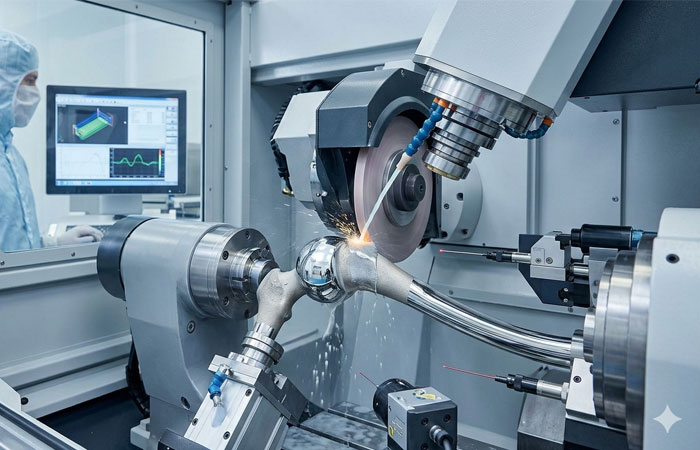
Metallic biomaterials accounted for roughly 50% of the implant market share, prized for their strength in load-bearing applications. Yet, these high-strength materials are notoriously difficult to machine. Conventional milling frequently leaves behind micro-burrs and surface stresses. Advanced precision grinding, using metal-bonded diamond or ceramic wheels, provides the high-shear, low-force abrasive action necessary to sculpt these hard alloys without fracturing the material or inducing thermal damage.
The Imperative of Surface Integrity
Surface integrity is directly tied to patient safety and implant longevity. In joint replacements, improper surface finishes lead to friction, premature wear, and dangerous debris. Furthermore, implant surfaces must actively discourage bacterial adhesion to prevent post-surgical infections.
Advanced grinding technologies allow manufacturers to achieve a phenomenal surface roughness profile—often reaching an Ra value of less than 0.005 μm for artificial hip ball joints. This mirror-like finish reduces friction and maximizes biocompatibility, drastically extending the lifespan of the implant and mitigating the risk of costly revision surgeries.
Industry Trends: Closed-Loop Automation and Digitalization
To maintain tight tolerances while keeping pace with high throughput demands, the grinding industry is undergoing rapid technological evolution. Two major trends are redefining the manufacturing floor:
- Closed-Loop Manufacturing: Leading grinding platforms now digitally link machining centers directly with optical measuring systems. Measurement reports are generated in real-time and fed back to the grinder automatically, executing autonomous corrections without manual intervention. This dramatically eliminates human error and reduces setup bottlenecks.
- Integrated On-Machine Dressing: Technologies like integrated wire-dress systems allow metal-bonded grinding wheels to be sharpened directly on the machine at full operating speed. This eliminates the need to dismount the wheel, preventing re-assembly errors and securing repeatable precision.
As the medical device landscape embraces personalized, 3D-printed orthopedic solutions and smart sensor-enabled devices, grinding technology remains the critical final gatekeeper of quality. By merging automated process control with high-precision abrasives, modern grinding ensures that the implants of tomorrow deliver the exact geometric accuracy and surface perfection required for lifetime performance.