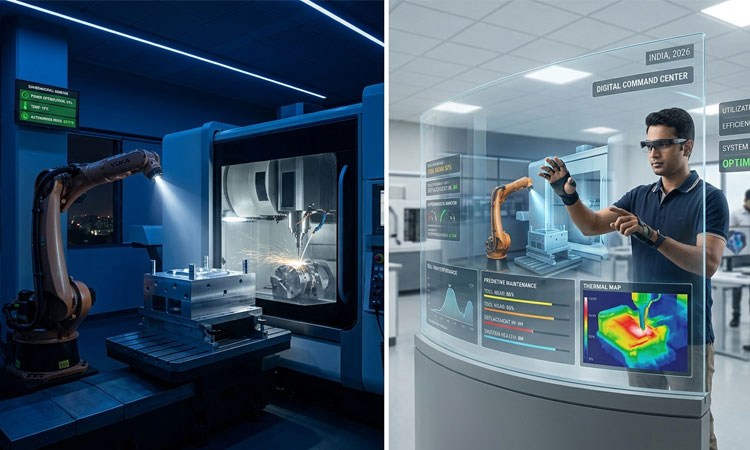
As the hum of machines replaces the presence of manpower, a new era of toolmaking is emerging in India—one where productivity never sleeps. But is “lights-out” manufacturing truly the future of Indian toolrooms, or is it still an aspirational myth? The answer lies somewhere in between—and it is redefining the very DNA of the industry.
India’s Automation Readiness: From Catch-Up to Competitive
India’s journey toward automation has accelerated significantly in recent years. The industrial automation market is currently growing at an impressive pace, projected to reach nearly $26 billion by 2033, reflecting a strong appetite for smart manufacturing solutions.
Within the tooling sector, the transformation is already visible.
Approximately 15–20% of Tier-1 Indian toolrooms have achieved what can be described as partial lights-out capability. These facilities operate unattended during night shifts, particularly for repetitive processes such as CNC milling and EDM operations.
At the same time, a new generation of greenfield “dark factories” is emerging across Maharashtra and Tamil Nadu. These facilities are being designed from the ground up with:
- IoT-enabled machines
- Integrated digital twins
- Real-time data synchronization
The adoption of industrial 5G and edge computing has further accelerated this shift. What was once limited by latency and connectivity issues is now evolving into seamless communication between machines, systems, and design environments.
India is no longer experimenting with automation—it is beginning to industrialize it.
The Business Case: Rethinking ROI in the Age of Automation
Traditionally, automation decisions were driven by a single factor: labor cost savings. In 2026, that narrative has expanded significantly.
The return on investment (ROI) for lights-out toolrooms is now evaluated across multiple dimensions:
- Utilization Rates
Manual toolrooms typically operate at 60–70% efficiency, constrained by shift timings, operator fatigue, and downtime. Automated cells, on the other hand, can push utilization beyond 95%, ensuring continuous production.
- Tool Life Optimization
AI-driven systems can now predict tool wear with remarkable accuracy. Instead of replacing tools based on fixed schedules, they are changed only when necessary—resulting in up to 15% savings in tooling costs.
- Energy Efficiency
Running a “dark” facility significantly reduces energy consumption. Without the need for extensive lighting or human-centric climate control, companies are achieving 20–25% energy savings.
- Faster Break-Even Cycles
Perhaps the most compelling shift is in payback timelines. Leading Indian toolrooms that have adopted automation report a break-even period of 3.5 to 5 years, compared to nearly 7 years a decade ago.
This evolution in ROI thinking is making automation not just viable—but strategically essential.
The Reality Check: Why Most Toolrooms Still Keep the Lights On
Despite the clear advantages, a majority of Indian toolrooms—especially MSMEs—have yet to fully embrace lights-out manufacturing.
The reasons are complex and deeply structural.
The Capital Barrier
For small and mid-sized toolrooms, the cost of automation remains a significant hurdle. An industrial robot integrated with advanced systems can cost anywhere between ₹40 lakh to ₹1.2 crore, making it a high-risk investment.
For many MSMEs, this is not just a capital expense—it is a strategic gamble.
The Skill Gap
Automation does not eliminate jobs—it transforms them.
The industry is witnessing a growing demand for multi-skilled professionals who understand both machining and digital systems. However, there is a shortage of such talent.
Recent estimates suggest that over 50% of India’s manufacturing workforce requires reskilling to effectively operate and manage automated environments.
This skill gap is becoming one of the biggest bottlenecks in scaling lights-out operations.
The Complexity of Tooling
Unlike mass production industries, tooling is inherently high-mix, low-volume (HMLV).
Each mold or die is unique. Each project has its own specifications. Programming robots to handle such variability is significantly more complex than automating repetitive assembly lines.
This makes full lights-out automation in tooling far more challenging than in other manufacturing sectors.
The Human Evolution: From Operator to Orchestrator
One of the biggest misconceptions about lights-out manufacturing is that it replaces human workers. In reality, it elevates their role.
In modern toolrooms, the traditional machinist is evolving into an “Operations Orchestrator.”
Their responsibilities now include:
- Validating simulation models and digital twins
- Monitoring system performance and data analytics
- Handling exceptions that automation cannot resolve
- Driving continuous process improvements
Rather than being displaced, skilled professionals are becoming more valuable—shifting from execution to decision-making roles.
The Emerging Middle Ground: “Dim-Light” Manufacturing
While fully autonomous toolrooms may still be limited, a hybrid model is rapidly gaining traction.
Welcome to the era of “Dim-Light Manufacturing.”
In this model:
- Machines run unattended for 8–12 hours, typically overnight
- Minimal human supervision is required
- Critical operations remain automated, while complex tasks are handled during the day
This approach offers the best of both worlds—higher productivity without the full complexity of complete automation.
For many Indian toolrooms, this is not just a stepping stone—it is becoming the new industry standard.
The Road Ahead: Compete While You Sleep
As global manufacturing becomes more competitive, the ability to deliver faster, cheaper, and with higher precision will define success.
Lights-out manufacturing is not just about efficiency—it is about strategic advantage.
Toolrooms that can operate beyond human limitations—literally working while the world sleeps—will be better positioned to:
- Meet tight global deadlines
- Reduce costs without compromising quality
- Scale operations without proportional increases in manpower
Myth, Reality, or Inevitable Future?
So, is the lights-out toolroom a myth or a reality?
In 2026, it is both.
For large, technology-driven toolrooms, it is already a reality. For MSMEs, it remains an aspirational goal—but one that is steadily becoming achievable.
What is undeniable, however, is the direction of the industry.
The lights are not going out because humans are leaving the shop floor. They are going out because machines have become intelligent enough to carry forward the work—guided by human insight, data, and design.
And in this evolving landscape, one truth stands clear:
The future of tooling will belong to those who can produce—even in the dark.